Methods of consolidating financial statements are three ways of including the data of group companies in the consolidated financial statements: full consolidation, proportionate consolidation and the equity method. The choice depends on whether the parent controls the company, controls it jointly with others, or has significant influence over it.
Key takeaways
- Full consolidation applies to subsidiaries, i.e. entities controlled by the parent, most often with a shareholding above 50%. The subsidiary’s financial statement items are added in full.
- Proportionate consolidation applies to jointly controlled entities. Items are added in proportion to the shareholding, and no minority interests arise.
- The equity method applies to associates. In practice, the value of the shares is updated every year for changes in the company’s net assets.
- Full and proportionate consolidation require consolidation adjustments, including the elimination of intercompany balances, transactions and unrealised margins.
- Proportionate consolidation is provided for in the Polish Accounting Act. Under IFRS, jointly controlled entities are accounted for using the equity method.
Consolidation methods used to prepare consolidated financial statements
The purpose of consolidation is to prepare joint financial statements of the group, covering all entities[i] that belong to it. The consolidated financial statements should present the income statement, the balance sheet and the cash flow statement as if the consolidated companies formed a single economic entity.
In this article we present the three consolidation methods used in practice to prepare consolidated financial statements under the Polish Accounting Act and International Financial Reporting Standards (IFRS):
- full consolidation,
- proportionate consolidation,
- the equity method.
[i] The Polish Accounting Act provides for exemptions from the obligation to consolidate companies: Articles 57 and 58 of the Act.
Consolidation methods – comparison
The consolidation method applied translates directly into the values presented in the group’s consolidated financial statements. In the vast majority of cases, the choice of method depends directly on the size of the parent’s shareholding in the company being consolidated.
The table below presents the key information on applying each consolidation method.
| Consolidation method | How it works | When it applies |
|---|---|---|
| Full consolidation | The financial statement items of the consolidated entity are added in full (100%), regardless of the actual percentage of shares held and control exercised. Transactions between the consolidated entity and the parent and all other fully consolidated entities are eliminated. | Control over the company (a subsidiary); most often a shareholding of more than 50% in the company’s equity. |
| Proportionate consolidation | The financial statement items of the consolidated entity are added in proportion to the actual percentage of shares held and control exercised. Transactions between the consolidated entity and the parent and all other proportionately consolidated entities are eliminated. | Joint control over entities in which the parent holds 50% of the equity. Joint control results from an agreement between the shareholders, the articles of association or the statutes. |
| Equity method | The net equity attributable to the parent is recognised in the assets of the group’s balance sheet, including goodwill or negative goodwill. | Associates: entities in which the parent has an equity interest but neither controls nor jointly controls them, and over which it has significant influence (usually from 20% of the votes). |
In the following sections we discuss each of these consolidation methods in detail. For each method you will find information on how it works and a detailed explanation of the conditions in which it should be applied.
Full consolidation
When to use full consolidation?
Full consolidation applies when an entity belonging to the group is a subsidiary of another group entity. Under the Polish Accounting Act, a subsidiary is an entity controlled by the parent.
Control over another entity means, under the Act, the ability to direct the financial and operating policies of that entity in order to obtain economic benefits from its activities. The most common case of full consolidation is when the parent holds a majority interest (more than 50%) in the net assets of the related entity.
In this scenario, control is exercised through the owner’s ability to appoint the company’s governing bodies and directly influence how they operate. With full consolidation, it should be noted that the percentage of control should take into account both direct interests (held by the parent) and indirect interests (held by other related entities controlled by the parent).
There may also be cases where full consolidation is applied even though the parent does not hold the majority of the equity of the consolidated company, for example because of personal links – family or functional.
How does full consolidation work?
When a fully consolidated subsidiary is acquired or established, the first consolidation requires the following steps:
- measuring the net assets of the acquired company at fair value,
- determining the acquisition price of the company’s net assets,
- determining whether goodwill or negative goodwill arose on the transaction,
- adding in full the individual financial statement items of all group companies subject to consolidation,
- determining the equity attributable to the minority shareholder,
- eliminating the value of the shares in the subsidiary in the parent’s balance sheet against the subsidiary’s net assets at the acquisition date.
In subsequent periods, when preparing the consolidated financial statements under full consolidation, the subsidiary’s assets, liabilities, income and expenses are added to the individual items presented by the parent, and the relevant consolidation adjustments are then made.
The purpose of consolidation adjustments is to turn the “arithmetic sum” of the companies’ financial statements into a picture of the group operating as a single legal entity, so that transactions between group companies do not overstate the group’s revenues, costs, profits, losses, assets and liabilities.
The examples of consolidation adjustments used in full consolidation listed below are described in detail in a separate article on our blog:
- elimination of intercompany balances,
- elimination of intercompany transactions,
- elimination of unrealised margins on assets, e.g. fixed assets or inventories,
- adjustment of depreciation of fixed assets sold within the group,
- update of the profits attributable to minority shareholders,
- adjustments related to dividend payments,
- amortisation of goodwill.
Proportionate consolidation
When to use proportionate consolidation?
Proportionate consolidation is used for jointly controlled entities, i.e. those over which the consolidated entities have joint control.
What does this mean in practice? A jointly controlled entity is most often a company in which the parent holds (directly or indirectly) up to 50% of the net assets, while the other shareholder is an external party. With this ownership structure, neither shareholder has full control over the company’s operations.
Proportionate consolidation is provided for in the Polish Accounting Act. Under IFRS, jointly controlled entities are accounted for using the equity method, as we describe in the article on consolidated financial statements under IFRS.
How does proportionate consolidation work?
On first-time consolidation of an entity consolidated proportionately, the consolidating company:
- measures the net assets of the acquired company at fair value,
- determines the acquisition price of the company’s net assets,
- determines whether goodwill or negative goodwill arose on the transaction,
- adds the individual financial statement items of all jointly controlled companies subject to consolidation, in proportion to the parent’s shareholding, to the parent’s financial statement items in full,
- eliminates the value of the shares in the jointly controlled company in the parent’s balance sheet against the net assets of the jointly controlled company at the acquisition date, in proportion to the shareholding acquired.
In subsequent reporting periods, the parent adds the individual financial statement items in proportion to its shareholding. Then, as in full consolidation, the relevant consolidation adjustments have to be made:
- elimination of intercompany balances,
- elimination of intercompany transactions,
- elimination of unrealised margins on assets, e.g. fixed assets or inventories,
- adjustment of depreciation of fixed assets sold within the group,
- adjustments related to dividend payments,
- amortisation of goodwill.
Compared with full consolidation, proportionate consolidation involves no minority interests. Likewise, eliminations of intercompany balances, transactions and margins must take into account the percentage of joint control.
The equity method
When to use the equity method?
The equity method is used for associates. It can also be applied (as equity-method measurement) to jointly controlled entities (see proportionate consolidation), provided the group’s accounting policy selects this method for jointly controlled companies.
In addition, this method can be used for subsidiaries and jointly controlled entities if there are restrictions on exercising control or joint control over them and these entities were consolidated in previous years, or the parent has assumed the rights of a significant investor or a shareholder of a jointly controlled entity.
The equity method is essentially a way of measuring the interest in the net assets of a subordinated entity, taking into account goodwill or negative goodwill determined at the date of obtaining control, joint control or significant influence.
The initial value of the interest is updated at the balance sheet date for which the financial statements are prepared, for changes in the net assets of the subordinated entity that occurred in the reporting period. In view of the above, the equity method comes down to updating the value of the shares held every year.
This measurement is presented in the balance sheet under “shares in subordinated entities measured using the equity method” and in the income statement under “profit (loss) on shares in entities measured using the equity method”.
Goodwill identified on the acquisition of an entity subsequently measured using the equity method is recognised together with the value of the acquired shares under “shares in subordinated entities measured using the equity method”. Negative goodwill under the equity method is presented under “deferred income”.
Methods of consolidating financial statements – summary
Depending on the shareholding in subsidiaries, jointly controlled entities or associates, there are several consolidation methods: full consolidation, proportionate consolidation and the equity method.
The key differences concern the presentation of goodwill, the calculation of minority interests and the scope of consolidated data. It is important to understand these nuances well when preparing consolidated financial statements.
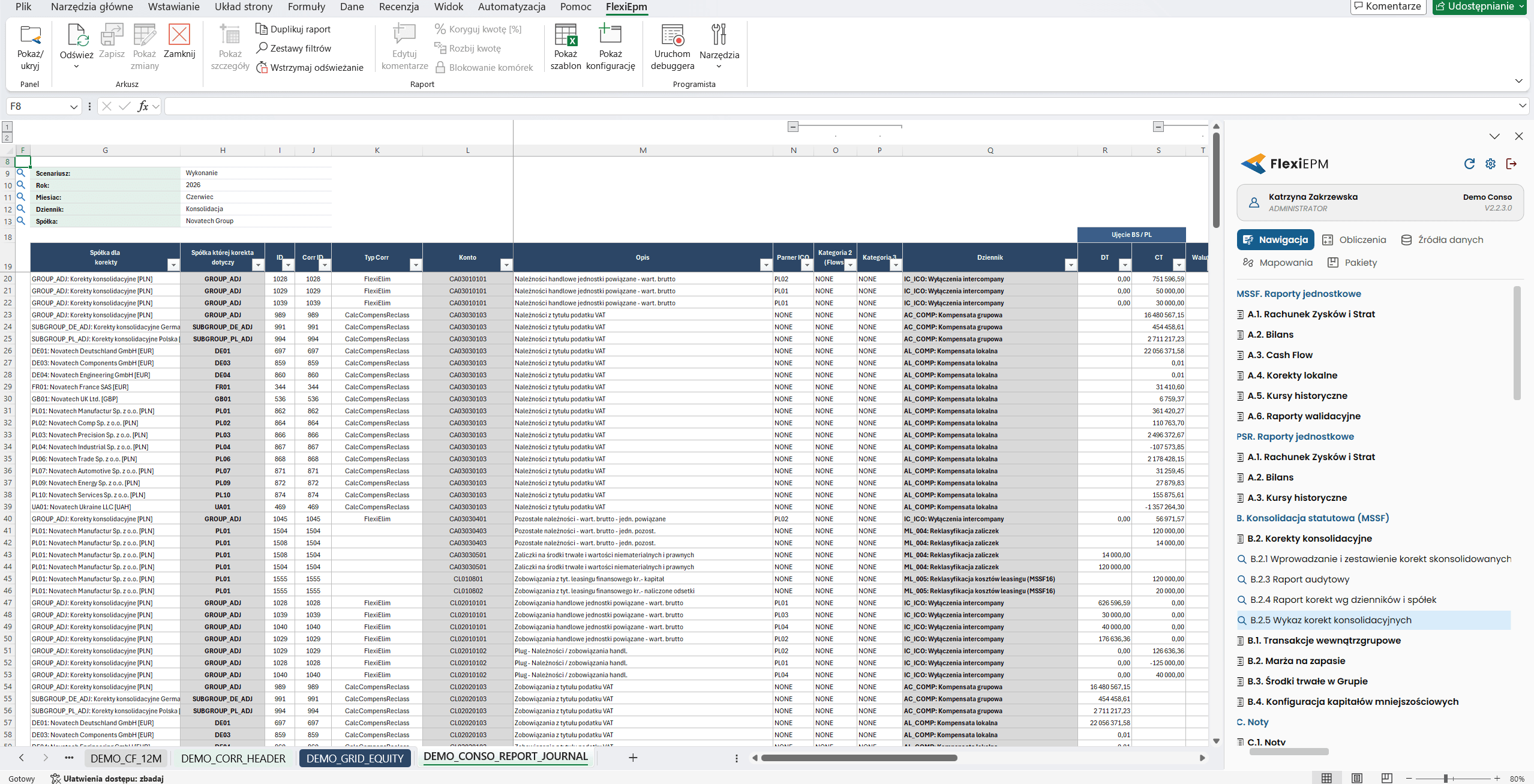
We show how consolidation methods are set up in FlexiEPM on the financial consolidation system page.