IFRS 16 lease accounting
When does IFRS 16 apply? How should a lessee present leases in its financial statements to comply with IFRS 16? How do you measure the right-of-use asset and the lease liability?
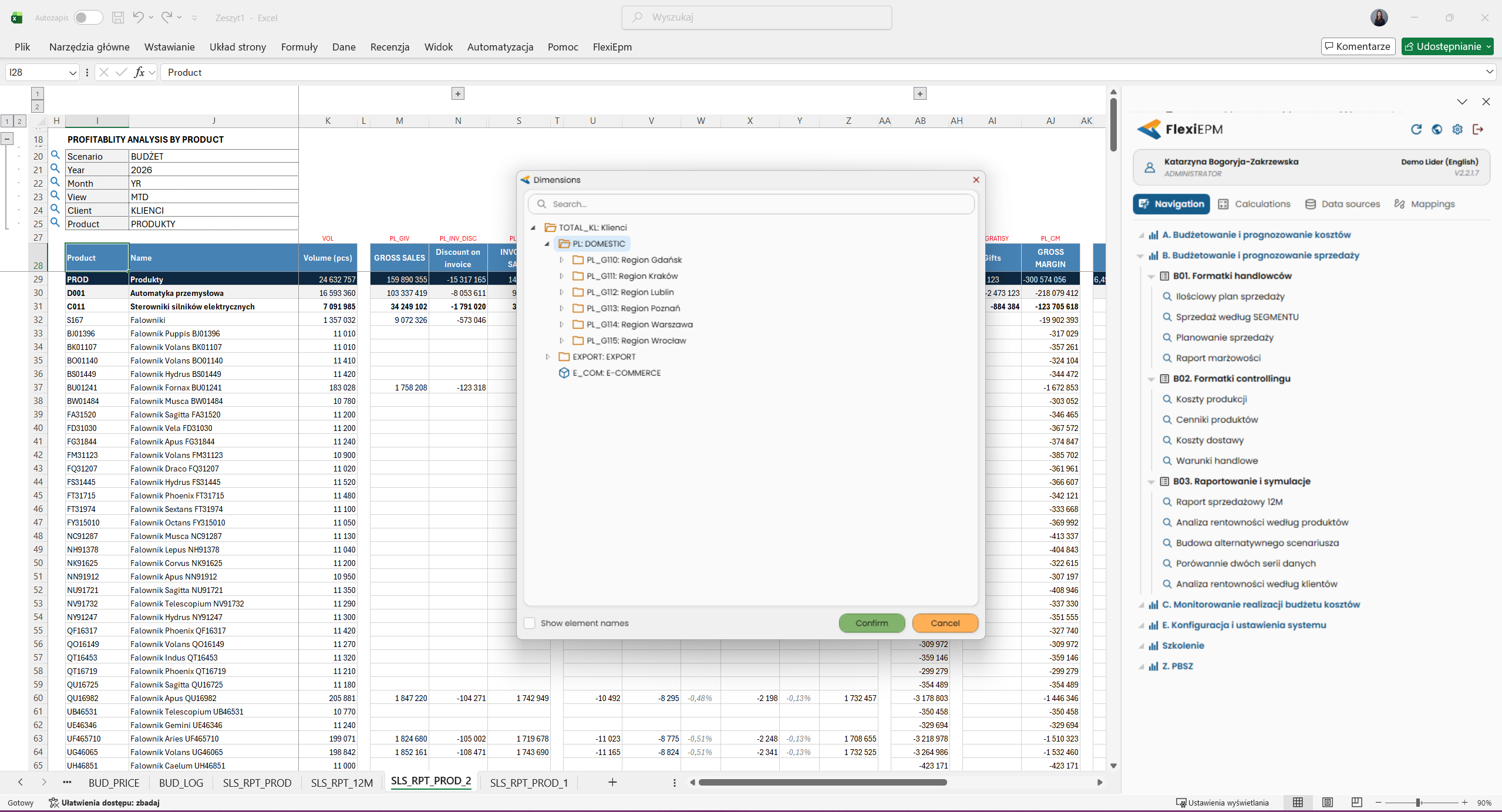
Cost allocation is the key to understanding product and customer profitability. FlexiEPM is an EPM-class system in which controlling allocates indirect costs to cost centres, profit centres, projects, customers and products according to its own rules, without spreadsheets or macros.
You choose the allocation keys yourself, and the results go straight to management reports. The same rules apply to actuals, budget and forecast.
Optimize data processing in the allocation model by eliminating Excel sheets and formulas. Automatically calculate allocation keys based on financial and operational data.
Control reports show how each charge was calculated, so every month you can check that costs have been fully allocated. At INTER Polska, the allocation model covers more than a hundred rules and over a dozen data sources.
We design and adjust allocation rules according to your company’s business model. With the tool, you can allocate costs to profit centres, projects, customers, or products, with exactly the level of precision you need.
Forget about manually preparing input data for allocations. With automation, FlexiEPM retrieves and processes direct costs directly from the accounting system. Importing transaction details allows you to drill down to the invoice level.
Allocation keys are collected across the organization in the system: templates gather the data from other departments. Keys such as the number of FTEs are entered in natural units, and the system converts them into percentages.
FlexiEPM lets you replicate your company’s business model. Freely define allocation stages and rules to build a process that settles costs in line with your chosen methodology, and manage the model configuration independently, without writing VBA macros or involving IT specialists. Allocation rules are kept in one table, where you specify the cost line, the source cost centres, the key and the units the cost goes to, including exclusions.
With FlexiEPM, you can allocate indirect costs to profit centres, business segments, projects, customers, or products. Build a management income statement and a controlling model that enables multidimensional profitability analysis.
You can also allocate payroll costs and assign employees to projects. A detailed labour cost allocation model distributes salaries in line with your employees’ timesheets, while sensitive HR data is processed securely.
The model also works for allocating costs in budgets and forecasts, so all scenarios stay comparable. Allocation can have several stages, for example first to activities and then to operating units. At a large food manufacturer, the system sets the order of steps for more than 60 cost centres itself, and recalculating the monthly allocation takes less than a minute.
The system provides reports that show how costs were allocated, so you can quickly verify that the allocation is correct. They are especially useful when answering ad hoc questions about how specific charges were calculated.
At the same time, you can prepare a complete set of management reports and monitor unit performance before and after cost allocation.
A multidimensional margin statement lets you analyse profit centre profitability both by direct costs and with allocated indirect and corporate overhead costs included. For each amount you can see which cost centre it comes from, which key was used to allocate it and what percentage it represents. Manual adjustments go to a separate layer, so it is always clear what comes from accounting, what from allocation and what from adjustments.
#KNOWLEDGE BASE

When does IFRS 16 apply? How should a lessee present leases in its financial statements to comply with IFRS 16? How do you measure the right-of-use asset and the lease liability?

How do you prepare a consolidated balance sheet for a group of companies? This practical guide walks you through the process step by step: preparing separate balance sheets, local adjustments, capital adjustments and goodwill, and eliminations of intercompany balances.

Since IFRS 16 came into force, lease liabilities have become more complex to manage. One of the key elements is discounting future payments. In this article we show how to calculate the present value of the liability, compare different approaches to the discount factor and explain what to watch out for in monthly calculations.