


How to prepare a consolidated balance sheet? A practical guide to consolidating assets and liabilities in a group
The balance sheet and the income statement are the two primary statements that make up the financial statements. Groups of companies are required to prepare consolidated financial statements, which means consolidating both the balance sheet and the income statement.
In this article we present a compendium of knowledge on preparing a consolidated balance sheet.
Consolidated balance sheet: key information
The consolidated balance sheet is a key part of the consolidated financial statements and summarises the financial position of the group. Put simply, the consolidated balance sheet is the sum of the separate balance sheets of the consolidated companies, adjusted for eliminations of transactions between group companies.
The structure of a consolidated balance sheet does not differ significantly from the balance sheet of an entity that does not consolidate. In both cases there are assets, equity and liabilities, broken down further into more detailed levels. The difference is that a consolidated balance sheet may include items that arise only in the financial consolidation process, for example goodwill, non-controlling interests and exchange differences on translating foreign subsidiaries.
Because the consolidated balance sheet is a complex document, preparing it requires attention to many aspects and details. It is often a task for accounting and finance specialists using advanced IT tools to analyse and consolidate financial data.
The choice of reporting standards is the main factor affecting the structure of the consolidated balance sheet. It can be prepared under the Polish Accounting Act or under International Financial Reporting Standards (IFRS).
The group prepares the consolidated balance sheet and the entire consolidated financial statements in line with the group accounting policy.
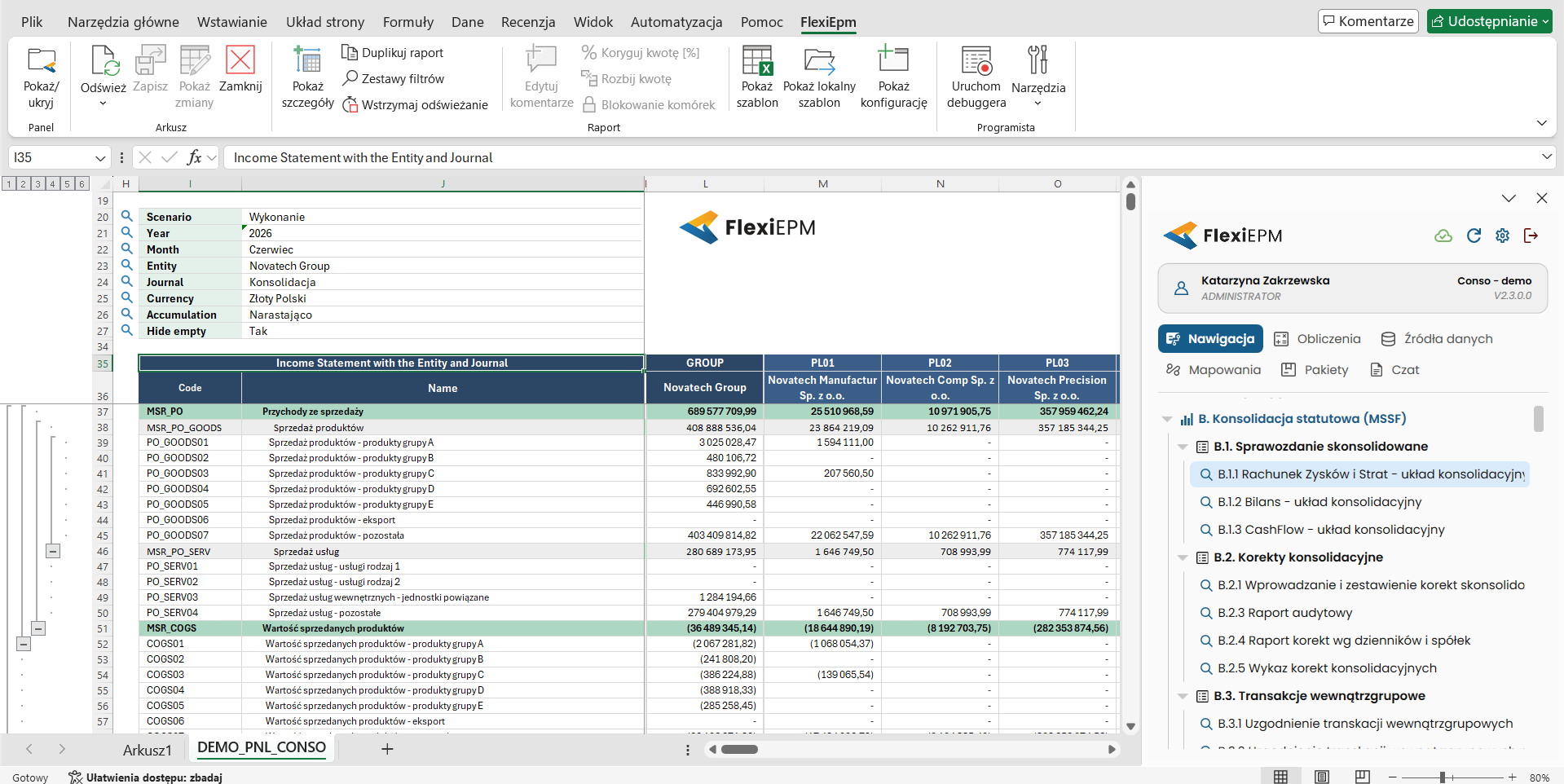
Consolidated balance sheet: preparing separate balance sheets for consolidation
The process of preparing the consolidated balance sheet starts at local level, with the accounting teams of the subsidiaries. They know best how to prepare the balance sheets of their companies so that they give a true picture of their financial position.
Preparing a separate balance sheet from accounting data
The separate balance sheet is prepared mainly from data in the finance and accounting system, often using the general ledger trial balance. Accounting staff assign balances from different accounts to the appropriate asset and liability items.
For settlement accounts, you need to check on which side the balance appears. Debit balances are treated as assets and credit balances as liabilities. In some cases, balances may need to be offset.
For example, deferred tax assets and liabilities are recorded in separate accounts, but in the separate and consolidated balance sheet they should be shown as a net amount on one side only.
Local adjustments in preparing the consolidated balance sheet
To prepare the consolidated balance sheet, data from the separate balance sheets may need appropriate adjustments. Such adjustments of company data to the needs of consolidation are called local adjustments.
Local adjustments may be needed because of:
- Differences between the accounting policies of the company and the group. For example, a subsidiary may keep its books under the Polish Accounting Act, while the consolidated financial statements are presented under International Financial Reporting Standards (IFRS).
- A different reporting date of the subsidiary than that of the parent. If the reporting dates of the separate and consolidated financial statements differ, the subsidiary’s financial statements can be included in the consolidation provided that they are prepared no more than 3 months before the date of the consolidated balance sheet.
In addition, significant events affecting the balance sheet and the income statement that occurred between the subsidiary’s and the consolidated reporting dates must be disclosed in the consolidated financial statements.
If the separate financial statements were prepared more than 3 months before the date of the consolidated financial statements, the subsidiary must prepare new separate financial statements as at the date of the consolidated financial statements.
Practical aspects of preparing company data for balance sheet consolidation
When you design the process for the consolidated financial statements, it is worth reducing the workload at each stage. Below are tips that will simplify preparing the consolidated balance sheet of a group based on data from individual subsidiaries:
- Introduce a uniform group chart of accounts used for consolidation. A group chart of accounts does not require companies to change their local charts of accounts: when preparing the consolidated balance sheet, companies can map their accounts to the chart of accounts set by the group.
- Standardise reporting packages. Subsidiary data should be delivered to the consolidation team in an agreed format. This makes it easier to include company data in the consolidation worksheet.
- Standardise forms for reconciling intercompany balances. A uniform, repeatable approach speeds up the period-end close.
- Check data completeness on an ongoing basis, for example with validation reports that compare balance sheet items with the notes. Such checks catch discrepancies before they reach the final financial statements.
Consolidated balance sheet: consolidation adjustments
Well-prepared company data is added to the sum of the consolidated balance sheet. Under full consolidation, the companies’ amounts are included in full. For companies consolidated using the proportionate method, individual items are included in proportion to the interest that group entities hold in the subsidiary.
Remember that the consolidated financial statements should present information as if the group operated as a single economic entity. If there are transactions between group companies in the period, they need to be removed from the sum of the balance sheet with appropriate adjustments.
Capital (historical) adjustments
They eliminate the effect of acquiring a subsidiary. On the one hand, we remove the value of the shares that the group recognised in its assets on acquiring the subsidiary. On the other hand, we remove the equity of the subsidiary as at the acquisition date.
The aim of historical adjustments is that the share capital shown in the consolidated balance sheet equals the share capital of the parent company. These adjustments are made in every subsequent reporting period until the company leaves the group.
Posting: [Debit] Equity / [Credit] Shares
Recognising goodwill and negative goodwill
If the consideration paid to acquire a subsidiary exceeds its net assets, positive goodwill should be recognised in the consolidated balance sheet and amortised in subsequent reporting periods. This is the rule under the Polish Accounting Act. Under IFRS, goodwill is not amortised; it is tested for impairment at least once a year.
Conversely, when the consideration paid is lower than the company’s net assets, show negative goodwill in the consolidated balance sheet and release it to other operating income in subsequent reporting periods.
If investors from outside the group also hold shares in the subsidiary, an additional item appears in the consolidated balance sheet: non-controlling interests. Its value is based on the share of these other investors in the subsidiary’s net assets.
| Item | Debit | Credit |
|---|---|---|
Goodwill (excess of the value of shares over the corresponding share of net assets) |
Goodwill (assets) | |
Non-controlling interests | ||
Shares in subsidiaries | ||
Equity of subsidiaries | ||
Negative goodwill (excess of the corresponding share of net assets over the value of shares) | ||
Negative goodwill (equity and liabilities) | ||
Non-controlling interests | ||
Shares in subsidiaries | ||
Equity of subsidiaries | ||
Elimination of intercompany receivables and payables
These adjustments reduce the receivables and payables presented in the consolidated balance sheet by the amounts arising from trade transactions within the group during the reporting period, for example accounting or IT services.
Elimination adjustments in the consolidated balance sheet aim to show only receivables and payables to entities outside the group. They are updated in every subsequent reporting period. Before balances are eliminated, the companies need to reconcile them. We describe how this works in the system on the page Intercompany transaction reconciliation.
Note that for a company consolidated using the proportionate method, the adjustment amount is proportional to the parent’s interest in the subsidiary. Under the equity method, there are no adjustments eliminating intercompany balances, because this method measures the investee’s net assets in the consolidated balance sheet.
Posting: [Debit] Trade payables / [Credit] Trade receivables
Elimination of intra-group loans
These adjustments ensure that the data presented in the consolidated balance sheet relates only to transactions with entities outside the group. Therefore, if group companies grant loans to each other, the resulting balances must be eliminated from the consolidated balance sheet.
As with the elimination of intercompany receivables and payables, adjustments eliminating intra-group loans are updated in subsequent reporting periods.
Posting: [Debit] Loans and borrowings (liabilities) / [Credit] Loans granted (assets)
Impact of the consolidation method on the consolidated balance sheet
The consolidation method chosen for a company has a significant impact on how separate balance sheets are combined and how consolidation adjustments are prepared.
The table summarises how the different consolidation methods are applied in preparing the consolidated balance sheet of a group.
| Full consolidation | Proportionate consolidation | Equity method | |
|---|---|---|---|
Group’s level of control over the entity |
over 50% |
20–50% |
up to 50% |
At acquisition |
– Measurement of the acquired company’s assets at fair value
– Determination of goodwill or negative goodwill at the acquisition date |
Measurement of the interest in the investee’s net assets, including goodwill or negative goodwill determined at the date of obtaining control, joint control or significant influence | |
In subsequent reporting periods |
– Elimination of intercompany receivables and payables
– Elimination of unrealised margins on fixed assets and inventories
– Adjustment of depreciation of fixed assets sold within the group
– Update of equity attributable to non-controlling interests
– Adjustments related to dividend payments
– Goodwill amortisation |
Update at the balance sheet date | |
Checklist for preparing a consolidated balance sheet
To sum up, to prepare a consolidated balance sheet correctly, follow these steps:
- Choose how to present the subsidiary’s net assets: full consolidation, proportionate consolidation or the equity method.
- Align accounting policies across all group companies, including the measurement of balance sheet items.
- Prepare reporting packages for subsidiaries in a format agreed by the group.
- Add up the relevant balance sheet items of all consolidated companies, taking into account the rules of their consolidation.
- Make capital adjustments: eliminate the effects of the acquisition, recognise goodwill or negative goodwill and determine non-controlling interests.
- Eliminate the effects of intercompany transactions, such as receivables, payables and loans, from the consolidated balance sheet.
We show how the whole process works in the system on the page Consolidation of financial statements step by step. For the module and implementations, see the financial consolidation system page.

