




#REPORTING MODULE

Management and Financial Reporting
system

With FlexiEPM, the management board and managers see the company’s financial and operational results in one place. Data from accounting and ERP systems and from files goes into one model, and you refresh reports in Excel after each data load. You save time on manual reporting, avoid errors and respond faster to what is happening in the company.

Scroll down to learn more

100%

integration with Microsoft Excel

#FOR WHOM

What business problems does a reporting system solve?

FlexiEPM is an EPM system for management and financial reporting. It takes data from accounting and ERP systems and from files, processes it in one model and delivers reports in Excel. It is used by large companies, corporate groups and fast-growing mid-sized companies.

#1

The need for a comprehensive performance management solution

FlexiEPM supports management reporting and automates monthly financial result preparation, margin analysis, and KPI monitoring.

It’s much more than traditional Business Intelligence. It’s a complete performance management platform that supports all processes of controlling and financial reporting.

As part of the company’s digital transformation of controlling, FlexiEPM provides one consistent environment for processing ACTUAL, BUDGET, and FORECAST data.
The result? Total transparency of financial processes and better, data-driven decision-making.

#2

Challenges with multiple systems and data sources

FlexiEPM efficiently solves the problem of integrating data from multiple systems.
It simplifies the creation and automation of management income statements, allowing for a full decomposition of P&L by profit centers.

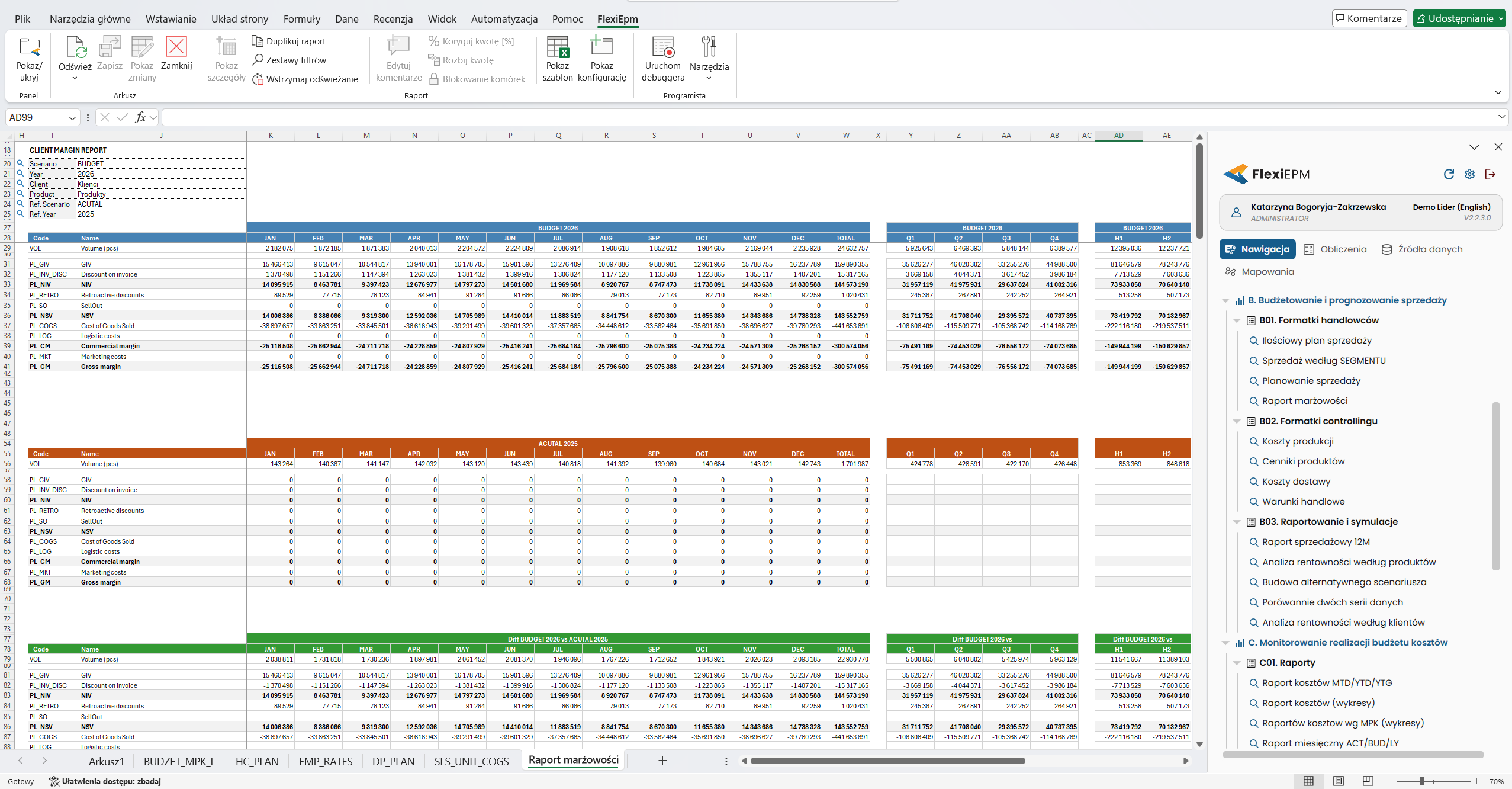
The system connects data from accounting, sales, warehouse, and CRM systems to create consistent reports showing revenues, margins, and profits across products, distribution channels, customers, and projects.
It allocates costs and matches revenues, providing managers with precise insight into sales profitability.

We design transparent reporting models that allow for adjustments, exceptions, and internal transformations, ensuring that management reports are fully aligned with accounting data.

FlexiEPM also excels in capital groups, integrating data from multiple entities, even when they operate on different accounting systems, charts of accounts, or currencies.
The result is a clear, consolidated view of financial results across business segments, markets, and customers.

#3

Overreliance on spreadsheets

FlexiEPM significantly reduces the number of Excel files circulating in your organization.
Instead of scattered spreadsheets, complex formulas, and cross-file dependencies, it introduces a centralized data model built on Microsoft SQL Server. Many companies we work with have reached the limit of Excel’s automation capabilities for management reporting.
In our implementations, we replace complex, error-prone VBA models with a scalable, transparent, and easy-to-maintain system that eliminates bottlenecks and enables rapid adaptation to organizational change. But Excel doesn’t disappear: it evolves.
FlexiEPM still lets you use Excel, but in a completely new way.
Reports generated by the system are compact, clean, and easy to analyze, containing only essential data, without complicated links or formulas.
This makes them faster, more reliable, and user-friendly for managers and analysts alike.

#FLEXIEPM features

A flexible system
for reporting automation

We adapt the solution to the company’s needs, so reports genuinely support decisions. Each stage of reporting reflects the organization’s goals and specifics. Instead of combining data manually, the team focuses on analyzing results.

Reporting directly in Excel

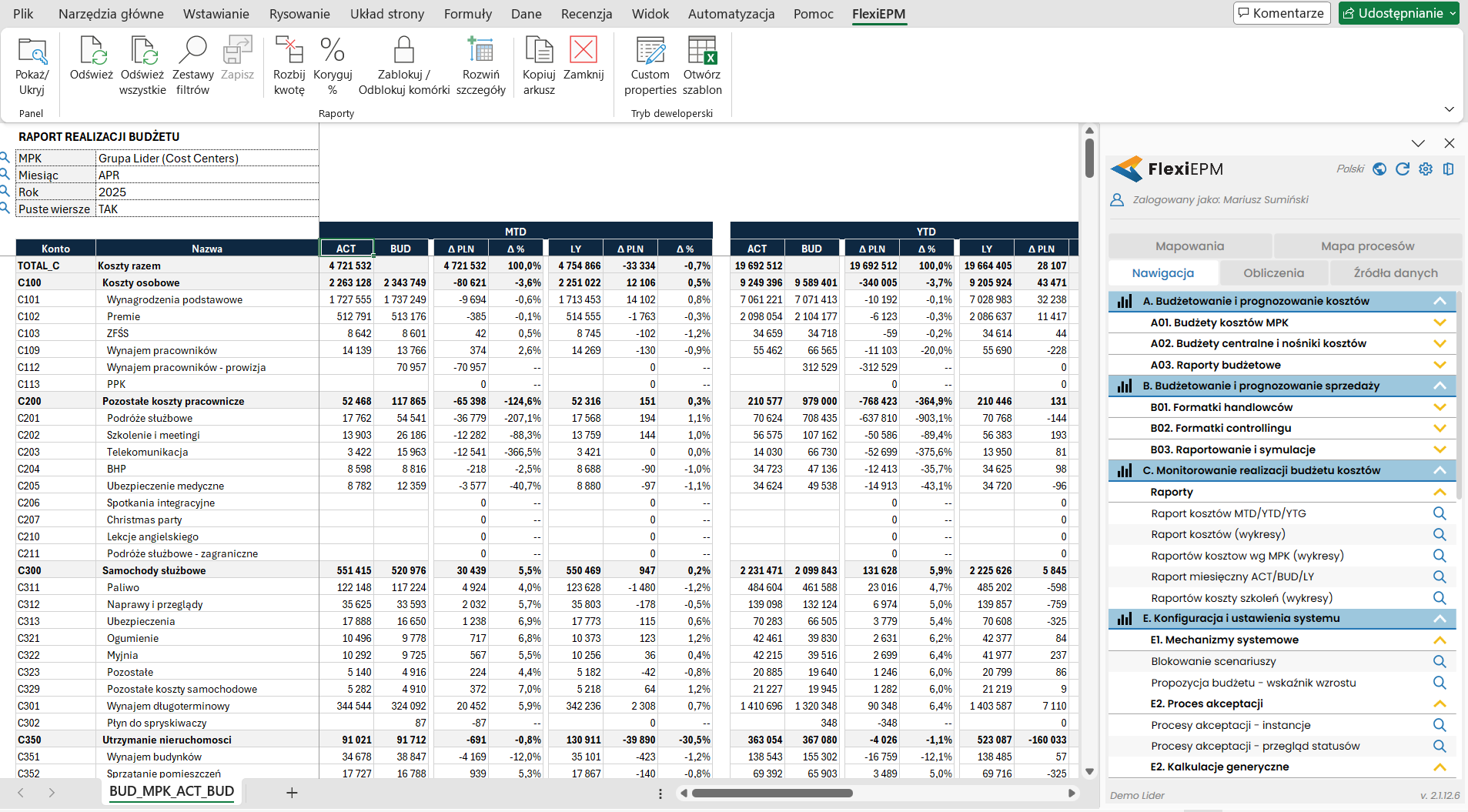
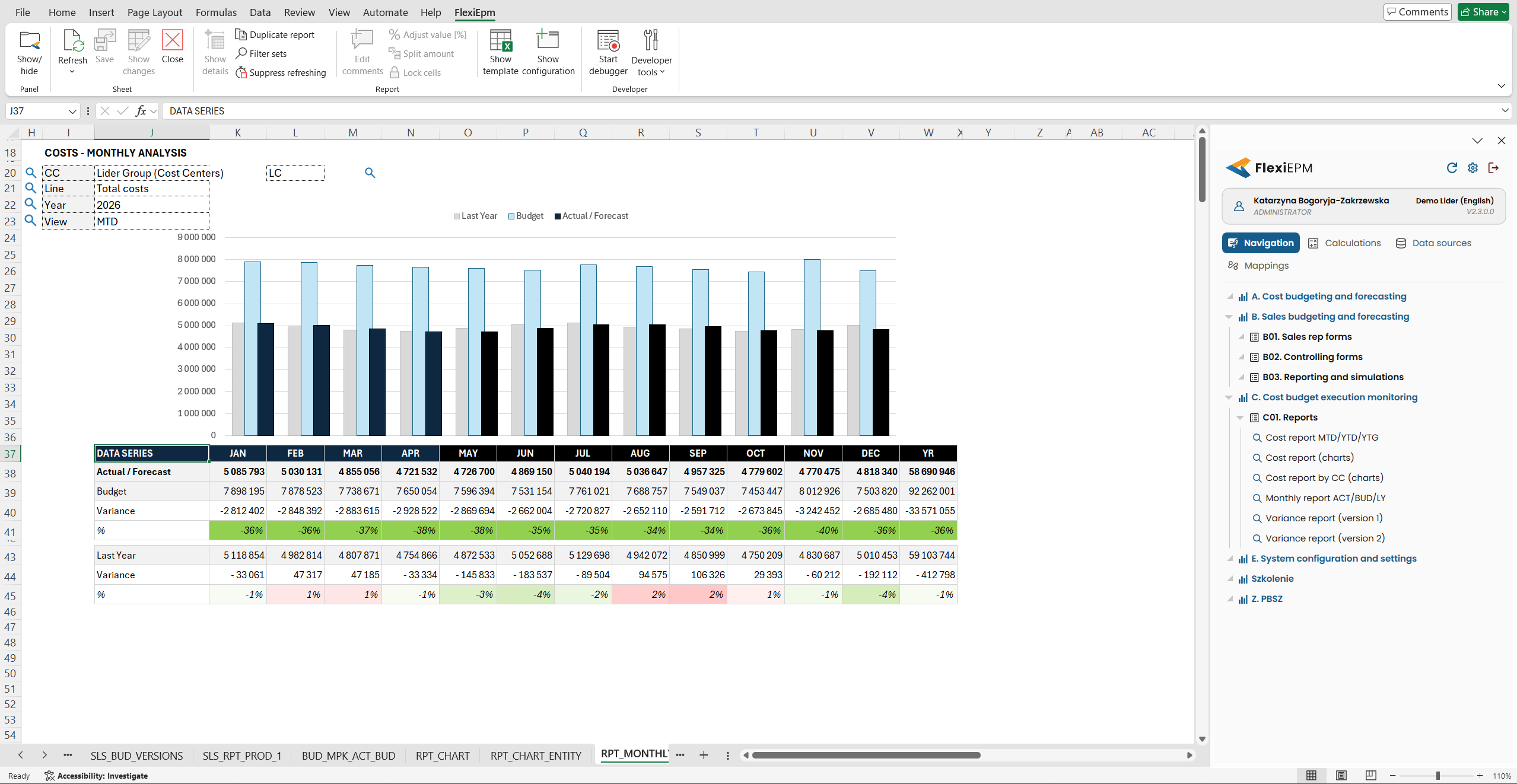
FlexiEPM enables reporting directly within Microsoft Excel, allowing users to work in a familiar environment. Reports are lightweight, clear, and refreshable on demand, presenting data in an easily readable numerical format.

Users can freely edit, format, and customize their reports, building dashboards and summaries that combine data with visualizations in any configuration.

Self-service report and analysis creation

The system provides both ready-to-use report templates and tools for creating your own analyses. An intuitive formula builder lets users connect to the multidimensional data model and define custom calculations.

This empowers business users to create reports and perform ad-hoc analyses independently, without relying on IT or data teams.

Drill-down to transaction-level details

With one click, you go from any figure in a report to the source data. The system shows the records behind the amount, down to the level at which the accounting system provides data, for example journal entries.

Users check where a value comes from themselves, without asking controllers or accountants for explanations.

On-demand data refresh

Users can refresh data anytime, without waiting for scheduled overnight processing. On-demand integration processes accelerate month-end closing and ensure access to always up-to-date information.

This guarantees full control over data timeliness and report accuracy across the organization.

Importing data from Excel and text files

FlexiEPM supports easy data import from Excel and text files, enabling integration of information from multiple sources, even those not directly connected to the system.

This flexibility allows users to include local files, standalone reports, or offline data in their analyses, ensuring completeness and consistency in reporting.

Central management of reporting hierarchies

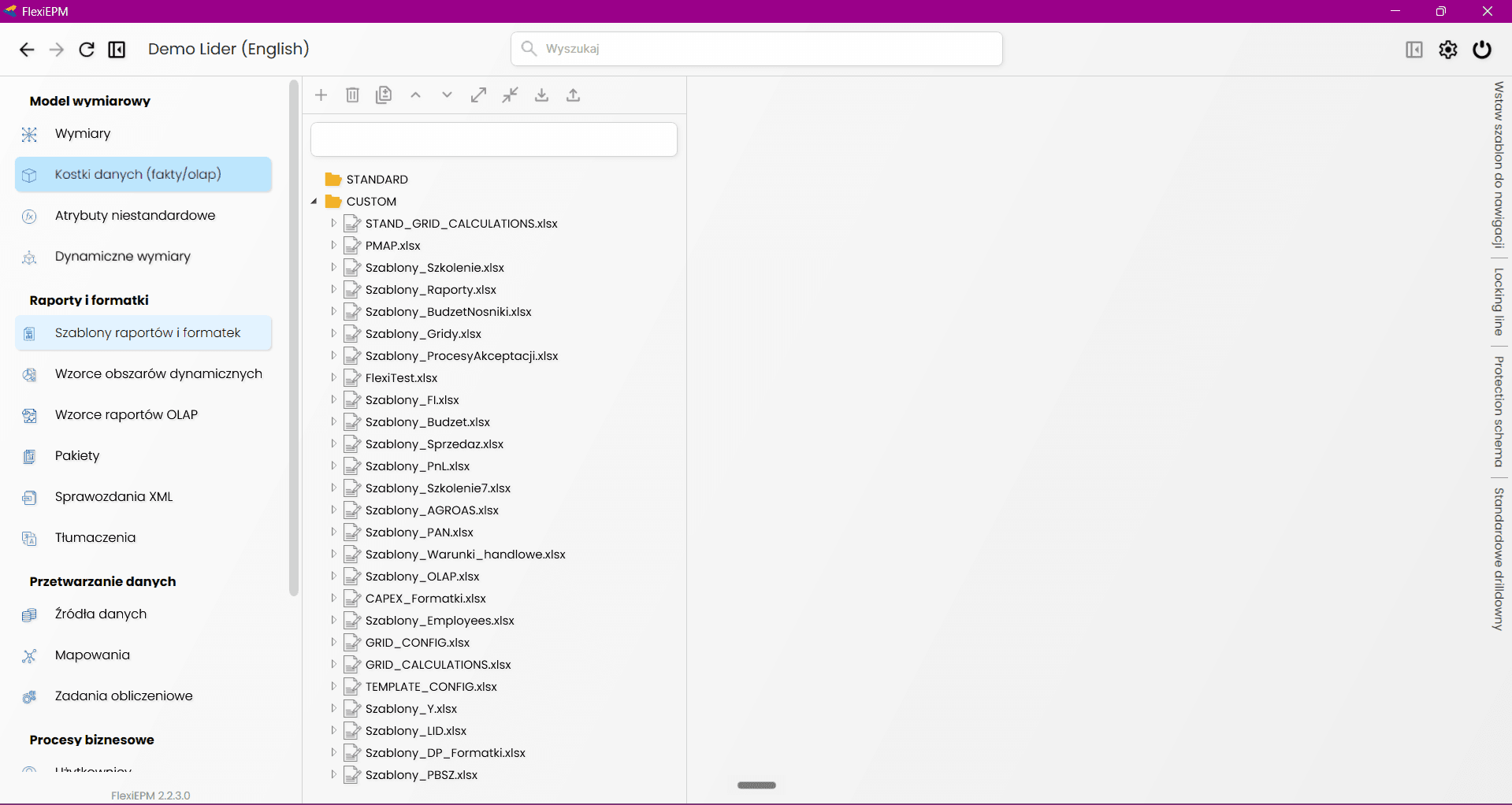
The platform provides tools for centralized management of hierarchies, dimensions, and reporting dictionaries. Process owners can easily adjust data structures to reflect organizational changes, business growth, or reporting requirements.

This ensures that all reports always mirror the current business model, supporting managers in everyday decision-making.

Data mapping and transformation rules

Users can independently manage mapping tables and transformation rules, allowing quick and easy updates to data structures.

This flexibility is crucial when chart of accounts, entities, projects, or customers change, ensuring reports stay current and consistent.

Built-in financial reporting logic

FlexiEPM supports both monthly, quarterly, and year-to-date financial reporting cycles. It allows accurate representation of key financial statements, including the Balance Sheet and Profit and Loss Statement.

The system also handles currency translation, ensuring consistency for financial consolidation and multi-currency reporting.

Personalized access and permission model

FlexiEPM includes an advanced role-based access control system, enabling flexible management of user permissions. Administrators can define user groups, roles, and data filters that tailor information access to each user’s scope of responsibility.

This ensures that every manager sees only the data relevant to their area, improving security, efficiency, and decision-making accuracy.

#EXAMPLE REPORT TEMPLATES

Reporting system
integrated with Microsoft Excel

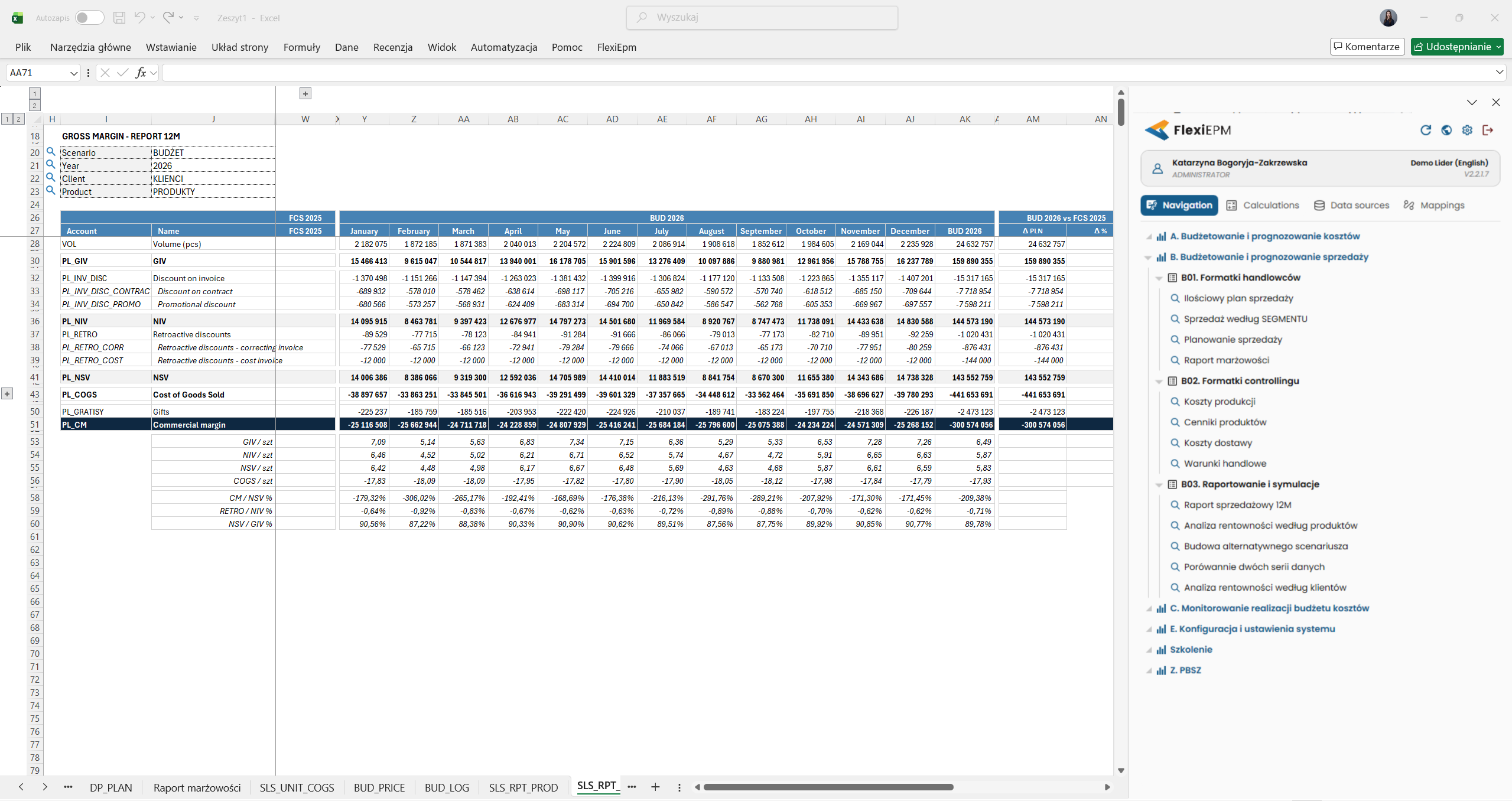
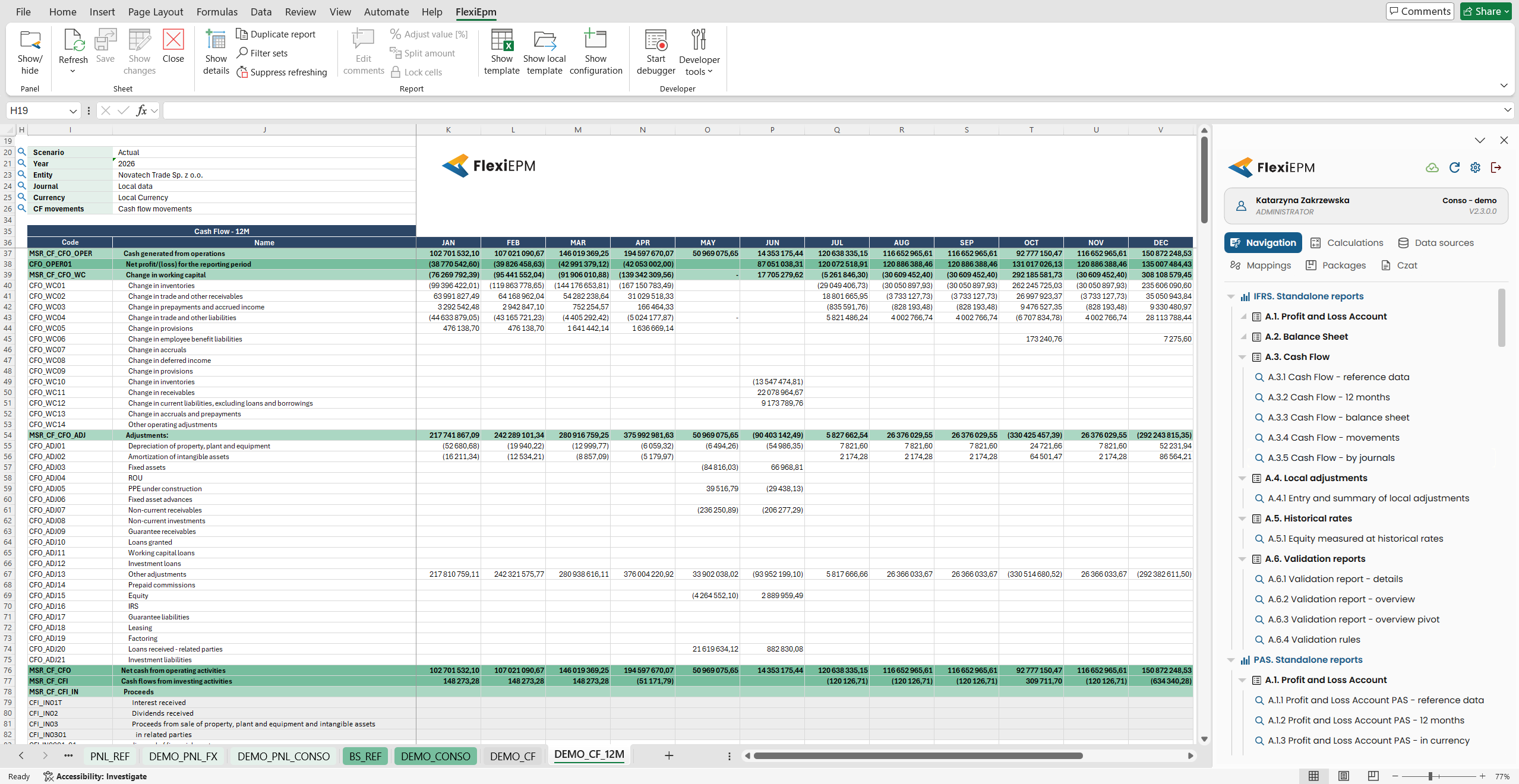
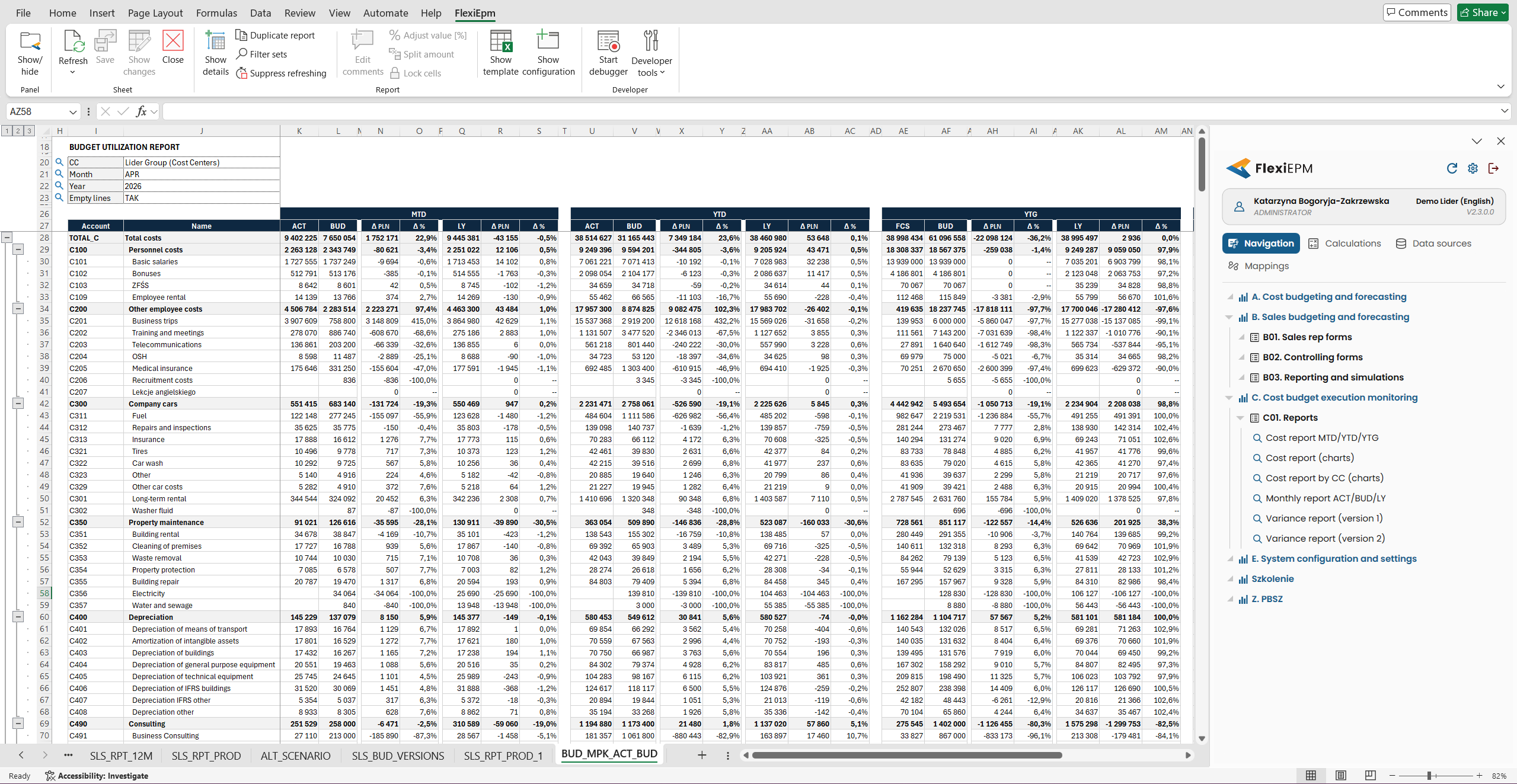
See sample reports from FlexiEPM: actuals vs budget, sales margins, cash flows, variance analysis and dashboards. Each report is an Excel template that you refresh on demand. The layout stays the same, and the data is pulled from the system.

Learn how we can streamline reporting

and help you automate and optimize key business processes across your organization.

#BENEFITS

Reporting system
for large companies and corporate groups

Have you ever wondered how much time and efficiency your company loses due to the lack of proper support for reporting and controlling processes?


Preparing monthly reports in spreadsheets takes hours that could be spent on more valuable work.

Traditional BI systems and data warehouses often create only the illusion of automation: reports still require manual effort or constant involvement from IT teams.

FlexiEPM bridges this gap. It’s a complete solution that integrates all reporting and controlling processes into one coherent system, enabling true automation, higher accuracy, and smarter management decisions based on reliable data.

Selected Implementations of the Reporting System

FlexiEPM is not a ready-made template but a system we adapt to the way a company reports. We reflect the chart of accounts, the structure of companies and cost centers, and the dimensions in which the management board analyzes results, such as products, customers or markets. As a result, the team works in one environment instead of collecting and combining data from many files.

This is how Hortex works: more than 100 users work in the system, with data from SAP R/3 and SAP BW. At Wielton Group, FlexiEPM combines data from companies in several countries and different ERP systems, and monthly reports for the Management Board and Supervisory Board are generated automatically from local trial balances.

The same model also handles mandatory reports. In the Polish branch of an international retail chain, the system prepares reports to Statistics Poland (GUS) for more than 80 companies, from importing data from SAP R/3 to XML files for the GUS portal.

Polski Bank Komórek Macierzystych (PBKM)
Polski Fundusz Rozwoju (PFR)
Enbio
MediaMarktSaturn Polska
Hortex
Wielton
Tchibo
GLS
Answear
Cedrob
Orbico
Zdrowit
XBS Logistics
OKAM Capital
Bielenda
NASK
Maflow, Grupa Boryszew

#HOW TO USE

Most common uses in
Management Reporting

We deliver value where standard BI tools fall short.
FlexiEPM automates management reporting and supports CFOs and controlling departments in building advanced solutions for performance analysis and financial monitoring.
We help organizations create a reporting environment tailored to real business needs.

Financial Performance Reporting

Our system efficiently processes financial data from accounting systems. It automates the reporting of the Income Statement, Balance Sheet, and Cash Flow, based on trial balances, general ledger entries, and account movements.

FlexiEPM fully leverages chart of accounts analytics, taking into account both account numbers and analytical dimensions. This allows you to report results by profit centers, cost centers, or departments.

We combine financial, sales, and operational data to build comprehensive management reports.
FlexiEPM integrates information from operational systems and Excel files, ensuring data consistency and a single source of truth.

You can easily report revenues, costs, and margins, and analyze data from multiple perspectives. The system also supports cross-system reconciliations, eliminating inconsistencies and manual errors.

We design dashboards and management cockpits that give decision-makers a clear view of performance and help them make faster, more informed decisions.

FlexiEPM seamlessly connects budgeting with reporting. Budgets, financial plans, and forecasts are created directly within the system and automatically integrated into management reports.

You monitor budget execution after each data load, analyze variances and get automated performance reports. Managers can instantly review results, explain variances, and add comments, all in one place.

With FlexiEPM, you gain end-to-end control over budgeting, execution, and analysis, all within a single, integrated system.

We design cost allocation processes that go far beyond the capabilities of standard accounting systems or Excel.
With FlexiEPM, you can manage multidimensional controlling models, allocation keys, and distribution rules, all in one place.

Our platform automates complex calculations, ensuring full transparency and auditability at every stage.
Controllers can independently manage allocation rules and keys, quickly responding to organizational or structural changes without relying on IT support.

FlexiEPM empowers you to perform precise profitability, margin, and cost analyses across any dimensions, from business units and products to customers, channels, and projects.

We deliver a solution designed specifically for capital groups, enabling the consolidation of monthly results, budgets, and forecasts across companies and business segments.

FlexiEPM automates currency conversions, reconciliations, and intercompany eliminations, ensuring data consistency and full transparency of group results.

You can choose between ready-to-use consolidation modules or custom-built mechanisms tailored to your organization’s business model and reporting structure.

We build advanced financial and management accounting models that automate revenue recognition for construction contracts and long-term agreements.

Each model is tailored to your organization’s financial processes, ensuring accuracy and alignment with internal policies.
FlexiEPM automates valuations, revenue accruals, and month-end closing activities, reducing manual effort and minimizing errors.

Our solution enhances the precision and granularity of revenue reporting, while significantly shortening financial teams’ workload and closing cycles.

#FAQ

Management and financial reporting: frequently asked questions

Where does FlexiEPM get data for reports?

From accounting and ERP systems, such as SAP, Microsoft Dynamics or Comarch, and from Excel and text files. Mapping tables assign accounts and dimensions from the source to the report structure, and you run the import on demand. Data from all companies goes into one model in a Microsoft SQL Server database, so every report uses the same figures.

Power BI is used to visualize data, and FlexiEPM prepares that data for controlling. The system maps accounts from accounting systems, allocates costs, translates currencies, collects plans and stores their versions and approvals. You open FlexiEPM reports in Excel, and data from its database can also feed Power BI dashboards.

Mainly controlling, without involving IT. Process owners change hierarchies, dictionaries and mapping tables themselves, for example when a new account, cost center, company or customer appears. If dictionaries such as cost centers are maintained centrally in the ERP system or a data warehouse, hierarchies in FlexiEPM can be built from them automatically. The administrator sets up user groups and data filters, so each manager sees only their own area.

Yes. From any figure in a report you go to the records behind the amount with one click. Drill-down reaches the level at which the accounting system provides data, for example journal entries. Users check where a value comes from themselves, without asking controllers or accountants for explanations.

#CASE STUDIES

How we support companies
with reporting

See the challenges we have tackled and the solutions we have implemented for our clients.

Wielton logo

Controlling, reporting and management consolidation in a manufacturing company

The Wielton S.A. Group, a leader in the automotive industry, has integrated its management reporting, budgeting and performance monitoring processes through the implementation of FlexiEPM.

The system has made it possible to automate reporting, unify controlling across the Group’s international structure and support its rapid growth.
The system now serves more than 80 users in Poland and abroad. It includes budgeting, forecasting and management consolidation of results within an international capital structure.

Controlling, reporting and management consolidation in a manufacturing company
Reporting and consolidation of 10 companies in the Automotive segment of Boryszew Group

Reporting and consolidation of 10 companies in the Automotive segment of Boryszew Group

Ten manufacturing companies in eight countries, different currencies and time zones. Plus one person at head office responsible for consolidation. The Automotive segment of Boryszew Group replaced reporting and consolidation in Excel files with FlexiEPM. Today, the companies report in the system themselves, check their data and reconcile intercompany transactions. Head office can focus on analyzing results.

Read more >
Personnel cost budgeting and control at Grupa Żywiec

Personnel cost planning and control at Grupa Żywiec

Grupa Żywiec, part of the HEINEKEN Group, is one of Poland’s largest brewing companies and employs approximately 1,700 people.
At this scale, personnel cost planning requires detailed employee-level data, integration between HR and Finance, multiple reporting structures, rapid scenario modelling, and reliable monthly accrual calculations.
Before FlexiEPM, the process relied on complex Excel workbooks and was dependent on the specialist knowledge of one person. HR and Finance also worked with different datasets, making it difficult to reconcile workforce information with the official income statement.
FlexiEPM replaced the fragmented process with an integrated personnel-cost planning and reporting platform connected directly to SAP HR. The solution supports budgeting, rolling forecasts, employee-level planning, bonus accruals, what-if simulations, and reconciliation of HR data with the financial P&L.

Read more >
Budgeting and cost allocation at INTER Polska

Budgeting and cost allocation at INTER Polska

INTER Polska is a growing insurance company that needed to redesign two business-critical finance processes: cost allocation and budgeting.

The existing processes relied on more than 100 separate Excel workbooks distributed across different locations. As data volumes, model complexity, and the number of users increased, the controlling team spent a growing share of its time collecting, consolidating, and validating data rather than analysing business performance.

FlexiEPM replaced the fragmented workbook-based environment with an integrated budgeting and cost-allocation platform. The solution combines a governed database, standardized input templates, automated data integration, validation controls, and more than 100 allocation rules. The controlling team now manages the process independently, without relying on IT for access administration or workflow control.

Read more >

Recommendation for the Reporting System

Piotr Kamiński
Piotr Kamiński
Vice President of the Management Board, Wielton S.A.
The implemented tools comprehensively support controlling and management reporting processes both at the level of the parent company, Wielton S.A., and its subsidiaries. The system is continuously developed and adapted to meet the growing needs of the organization.
Currently, FlexiEPM is used by all 16 companies within the Group, with over 100 active users. One of the implemented modules is the Intercompany Transaction Reconciliation module, which enables accurate reconciliation of transactions within both management and stock exchange reporting processes.

Book a Consultation with an expert

Streamline your planning, controlling, reporting, and consolidation processes in a single system.
Eliminate errors and reduce time-consuming tasks through integration and automation.
Mariusz Sumiński

Mariusz Sumiński

Managing Director, Co-Founder