




#FINANCIAL CONSOLIDATION MODULE

Financial consolidation
system

With FlexiEPM, you can simplify and automate the entire financial consolidation process – from source data to final management reports. Instead of struggling with scattered files and manual calculations, you work in a single, consistent environment that combines data from multiple companies and ensures full formal compliance. You save time, eliminate errors, and always have reliable data ready to present to management or auditors.

scroll and learn more

100%

integration with Microsoft Excel

#FLEXIEPM Features

Forget the complexities of the
consolidation process

Manually filling in entity reporting packages, keeping adjustments in separate spreadsheets and preparing separate currency and intercompany reports means a lot of routine work and a risk of errors. As the number of companies grows and deadlines get shorter, Excel can no longer keep up.

Consolidation packages

Instead of manually filling in entity reporting packages, you import data directly from accounting systems or existing balance and turnover reports.

Automating this stage significantly reduces data preparation time and eliminates the risk of errors associated with copying information from spreadsheets.

Local adjustments

You automatically record adjustments and reclassifications in accordance with the accounting policies of subsidiaries.

The system allows you to transparently transform local data for group reporting without the need for manual intervention or additional calculations.

Currency differences

Generate reports in line with currency translation rules using central exchange rate tables and built-in transaction rules.

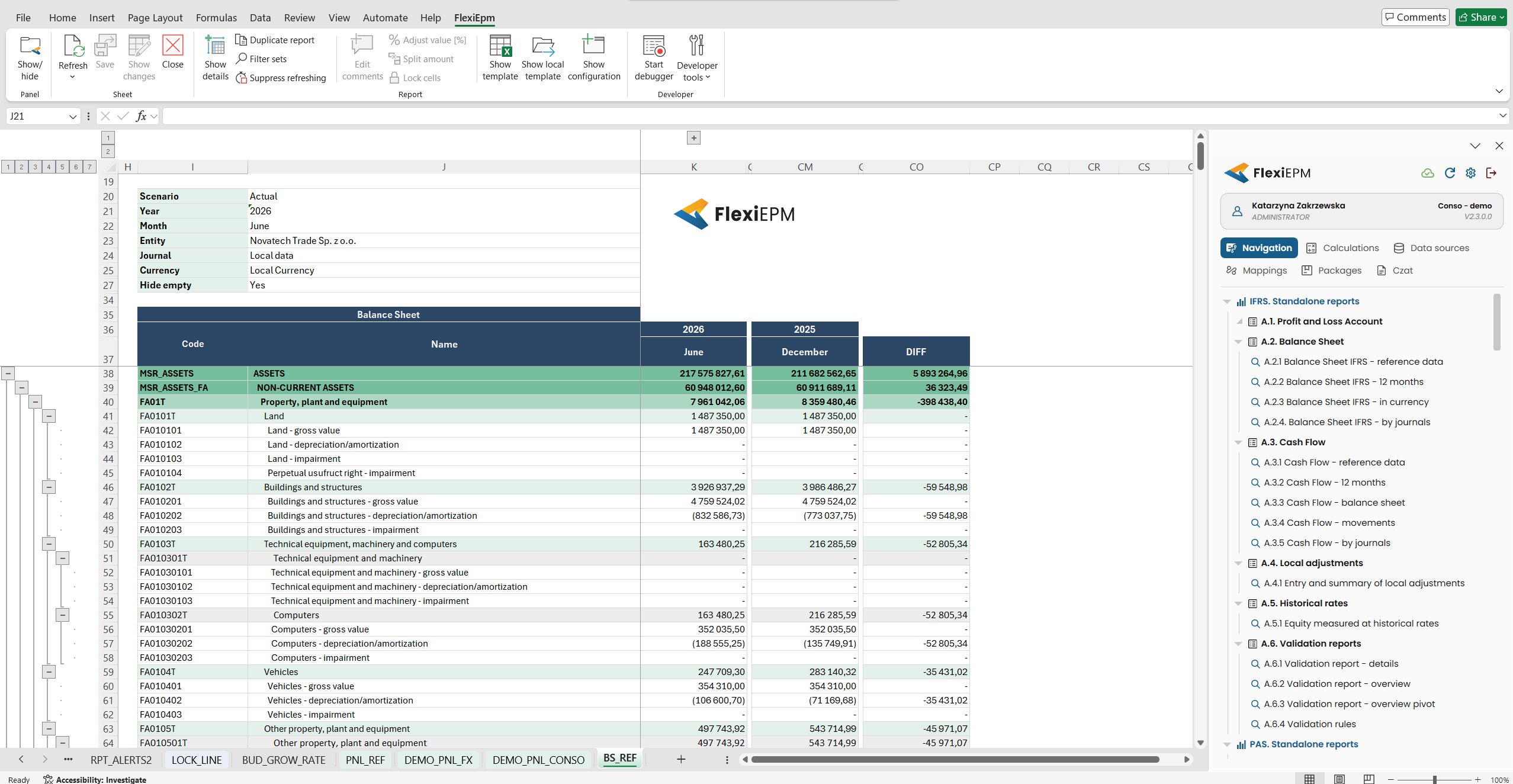
The system supports correct conversion of opening balances, balance sheet and equity differences, also in a historical layout.

Audit reports

You prepare a complete set of data required by the auditor without the risk of omissions or errors.

Predefined reports allow you to easily explain each adjustment, and process automation reduces the time needed to prepare audit documentation.

Management consolidation

You manage the consolidation of financial and operational data in a single controlling model that allows you to monitor segment margins and company performance.

You gain a complete picture of the group, not only for statutory reporting but also for management decisions.

Intercompany transactions

Companies reconcile intercompany balances themselves, in one standard process for the whole Group.

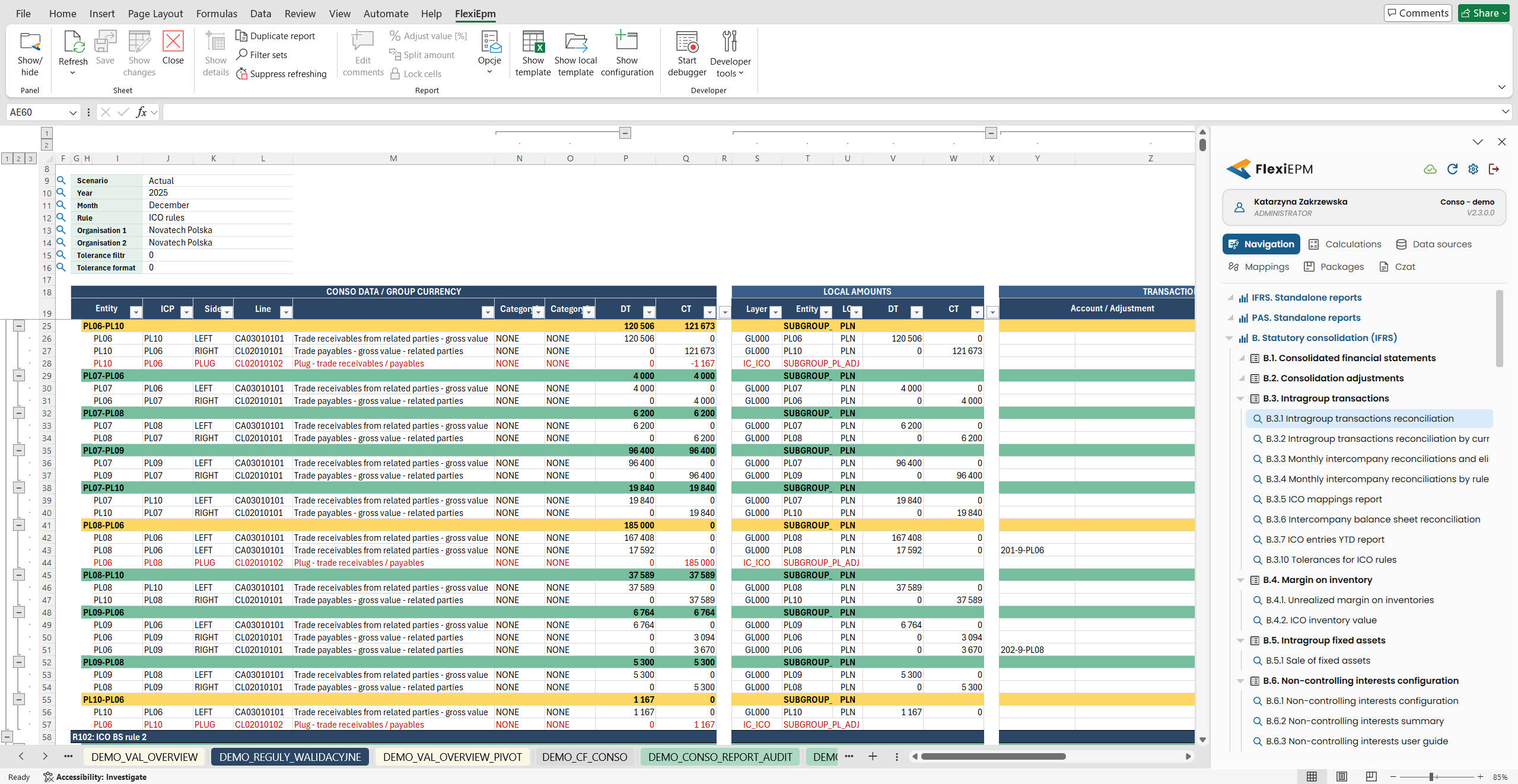
Balances are matched for each pair of companies or, with the InterMatch module, at document level, and the system automates intercompany eliminations according to Group rules.

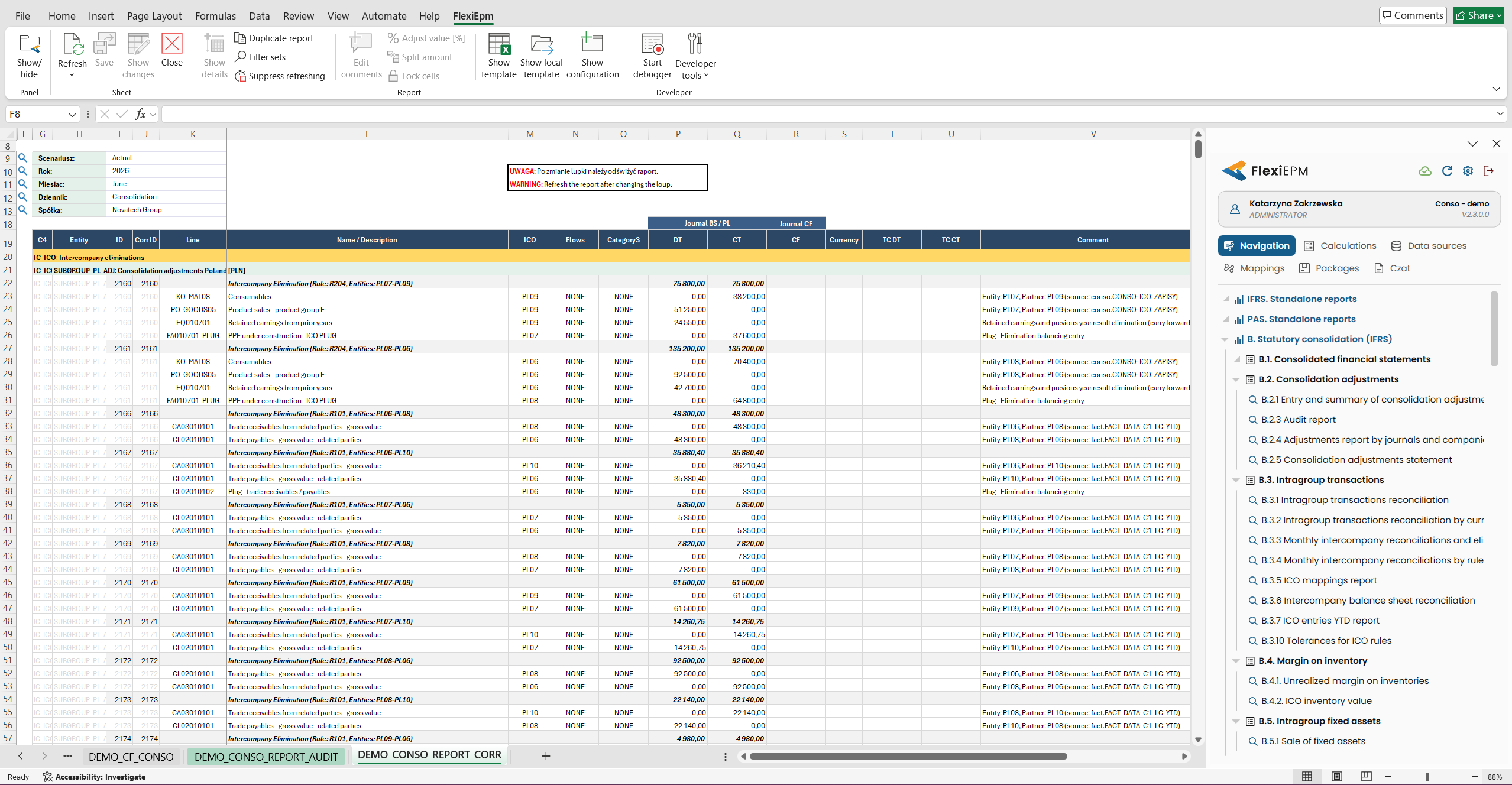
Consolidation adjustments

Well-organised documentation of consolidation adjustments guarantees full transparency of the process.

The software automates the preparation of exclusions and eliminates the risk of inconsistent manual adjustments at the Group level.

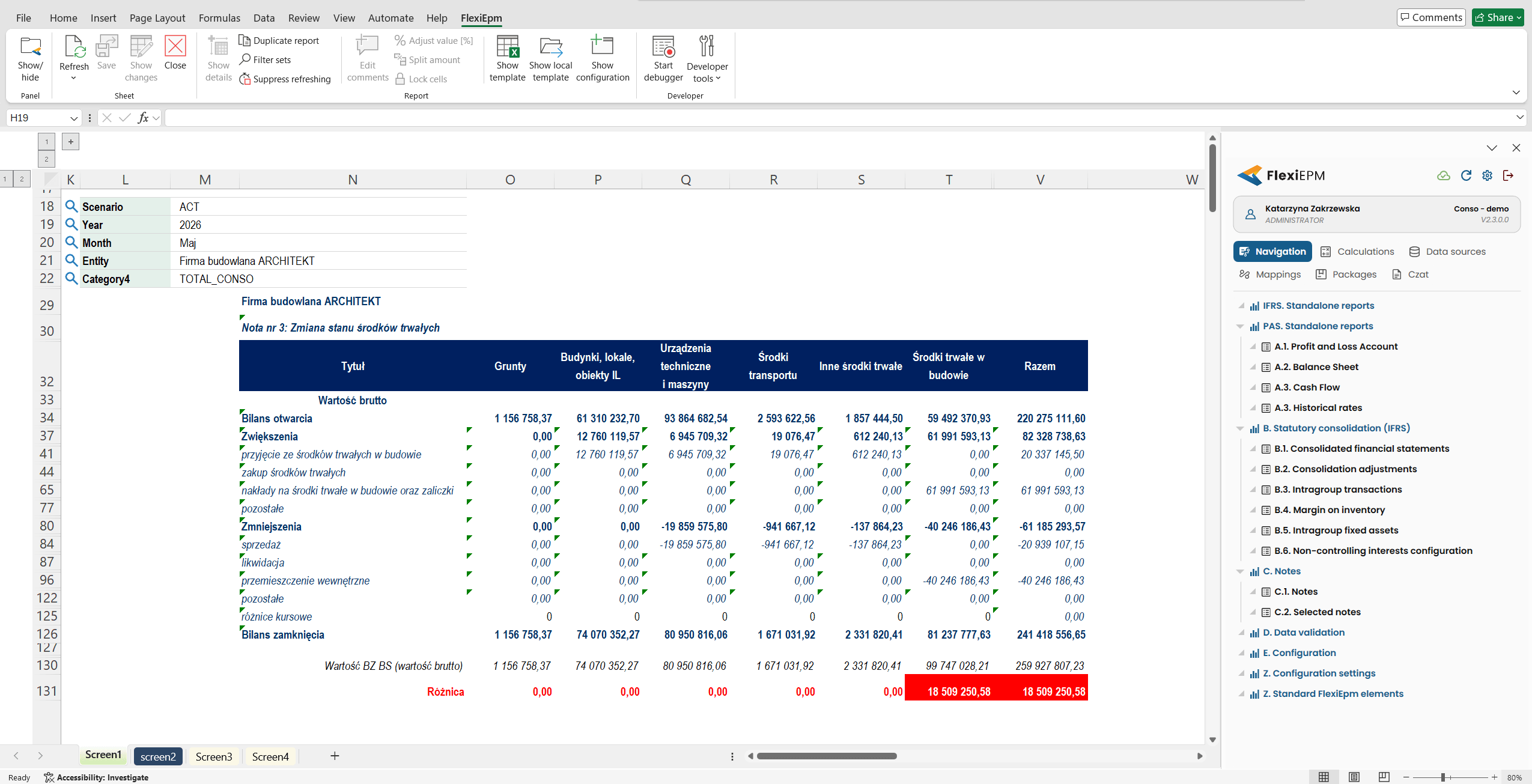
Explanatory notes

You supplement reports with information required in quarterly and annual statements, with the option of linking them to specific analytical items.

Data validation and automatic updates ensure document compliance and consistency.

Sub-consolidation and reporting for subgroups

You can create reports for selected capital subgroups without the need for manual data filtering.

With flexible configuration, you can run sub-consolidations alongside the full Group consolidation, which makes it easier to prepare reports for management or for individual business segments.

#format examples

Consolidation system
integrated with MS Excel

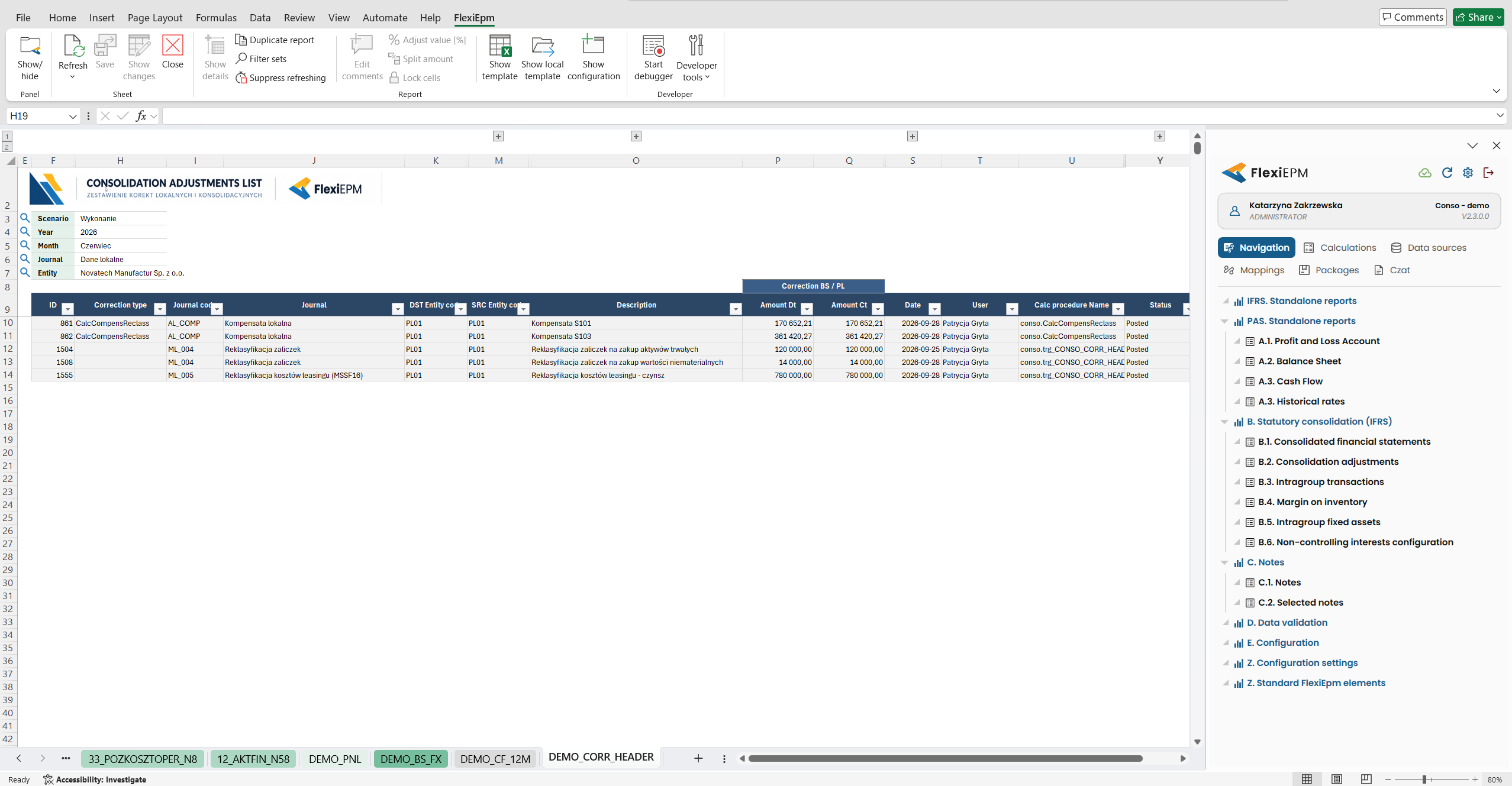
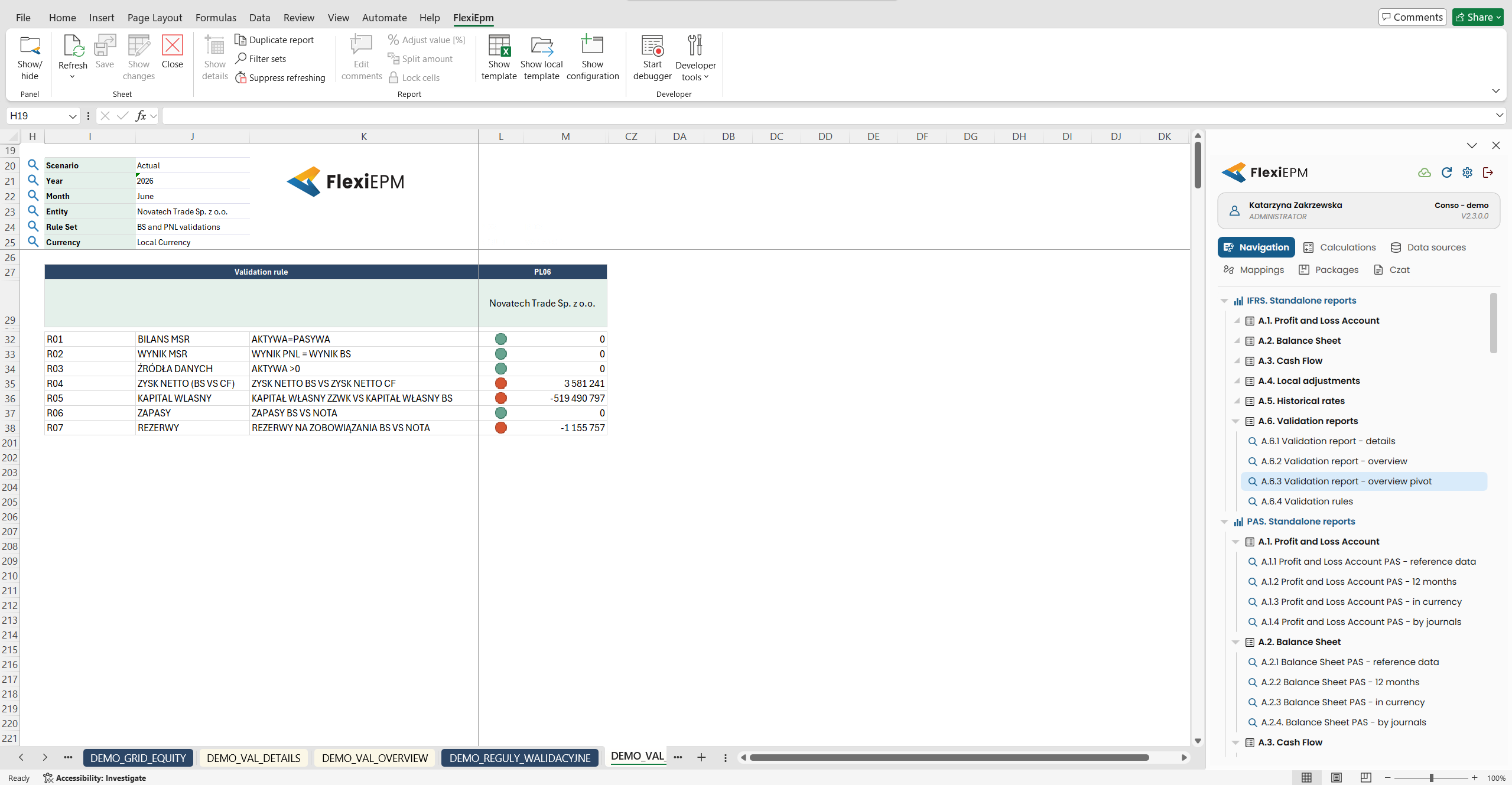
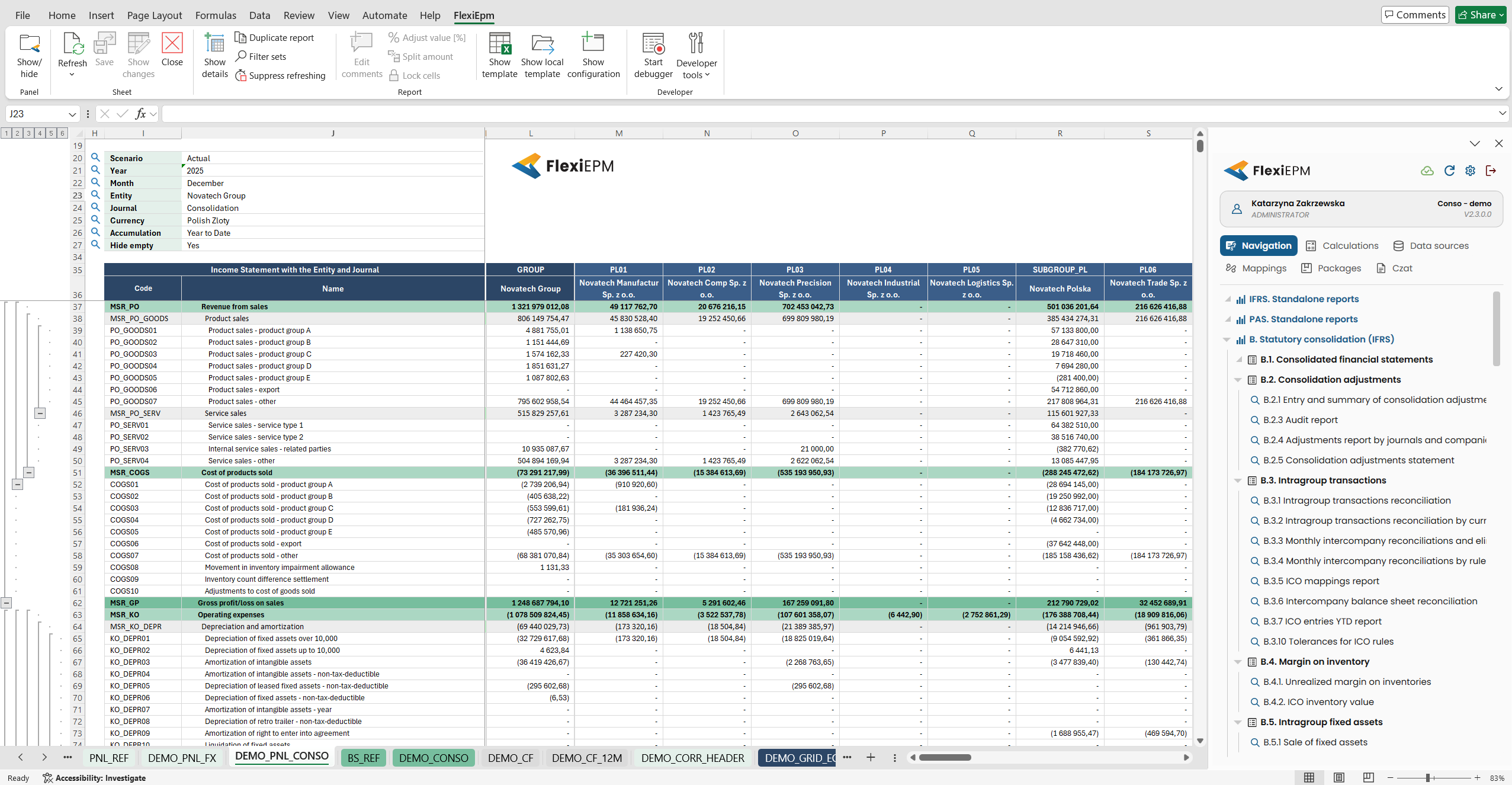
See what consolidation looks like in FlexiEPM, from mapping company accounts to the consolidated financial statements. You fill in forms and read reports in Excel, while the system reconciles intercompany transactions, translates currencies and posts adjustments according to group rules.

See how we can simplify financial consolidation in your company

by automating reconciliations, eliminations, and reporting. Gain more time, fewer errors, and greater control over the entire process.

#BENEFITS

Consolidation system for capital groups

Wondering how to take control of reporting, budgeting, consolidation and technology changes without expanding IT or adding more tools?

FlexiEPM is a consolidation system we have been developing since 2015. It supports financial statements under the Polish Accounting Act and under IFRS, also in groups where some companies report under one framework and others under the other.


Companies can use different accounting systems, including foreign ones or those run by an external accounting office. Each company imports its trial balance, and the system maps the accounts to the group chart of accounts, reconciles intercompany transactions, translates currencies and calculates consolidation adjustments.

In total, our clients consolidate more than 500 companies in more than 20 countries in FlexiEPM. Groups such as Wirtualna Polska Holding, with around 50 companies in 6 currencies, and PBKM Group, with 34 companies, consolidate this way. The consolidation module runs in the same environment as budgeting and reporting, so you can extend the system with further modules.


Selected implementations of the financial consolidation system

We adapt FlexiEPM to the structure of each group. The system covers every stage of consolidation, from entity reporting packages and intercompany reconciliations to adjustments and consolidated financial statements, so consolidation becomes a repeatable, predictable cycle.


Instead of comparing spreadsheet versions and applying eliminations by hand, the team works in one system that brings together data from all companies and makes working with auditors easier.

Baltona
equinor
fulqrum
Gemini
Hortex
OKAM Capital
Polski Bank Komórek Macierzystych (PBKM)
RASP
Transition Technologies
Unimot
WeNet
Wirtualna Polska Holding
Zdrowit
Maflow, Grupa Boryszew
MediaMarktSaturn Polska
Polski Fundusz Rozwoju (PFR)

#FAQ

Financial consolidation: frequently asked questions

What is a financial consolidation system?

It is software that combines the financial data of a group’s companies into one set of consolidated financial statements: it collects entity-level data, translates currencies, eliminates intercompany transactions and posts consolidation adjustments according to group rules.

In FlexiEPM, the starting point is each company’s trial balance, and the output is a consolidated reporting package: financial statements with notes in Excel. Every amount can be drilled down to adjustments, companies and accounts. The consolidation module works in the same environment as budgeting and management reporting.

Companies load their trial balances and enter local adjustments. The system maps accounts to the group chart of accounts, translates the data of foreign subsidiaries into the group currency and checks it with validation reports. It then reconciles and eliminates intercompany transactions, posts consolidation adjustments and produces consolidated financial statements with notes.

All steps, with screenshots, are shown on the page Consolidation of financial statements step by step. Reconciliation and elimination of intercompany transactions are described on the page Intercompany transaction reconciliation.

The balance sheet is translated at the closing rate and the income statement at the average rate. The system can download National Bank of Poland exchange rates automatically for a selected month. The company package holds data in both the local currency and the group currency.

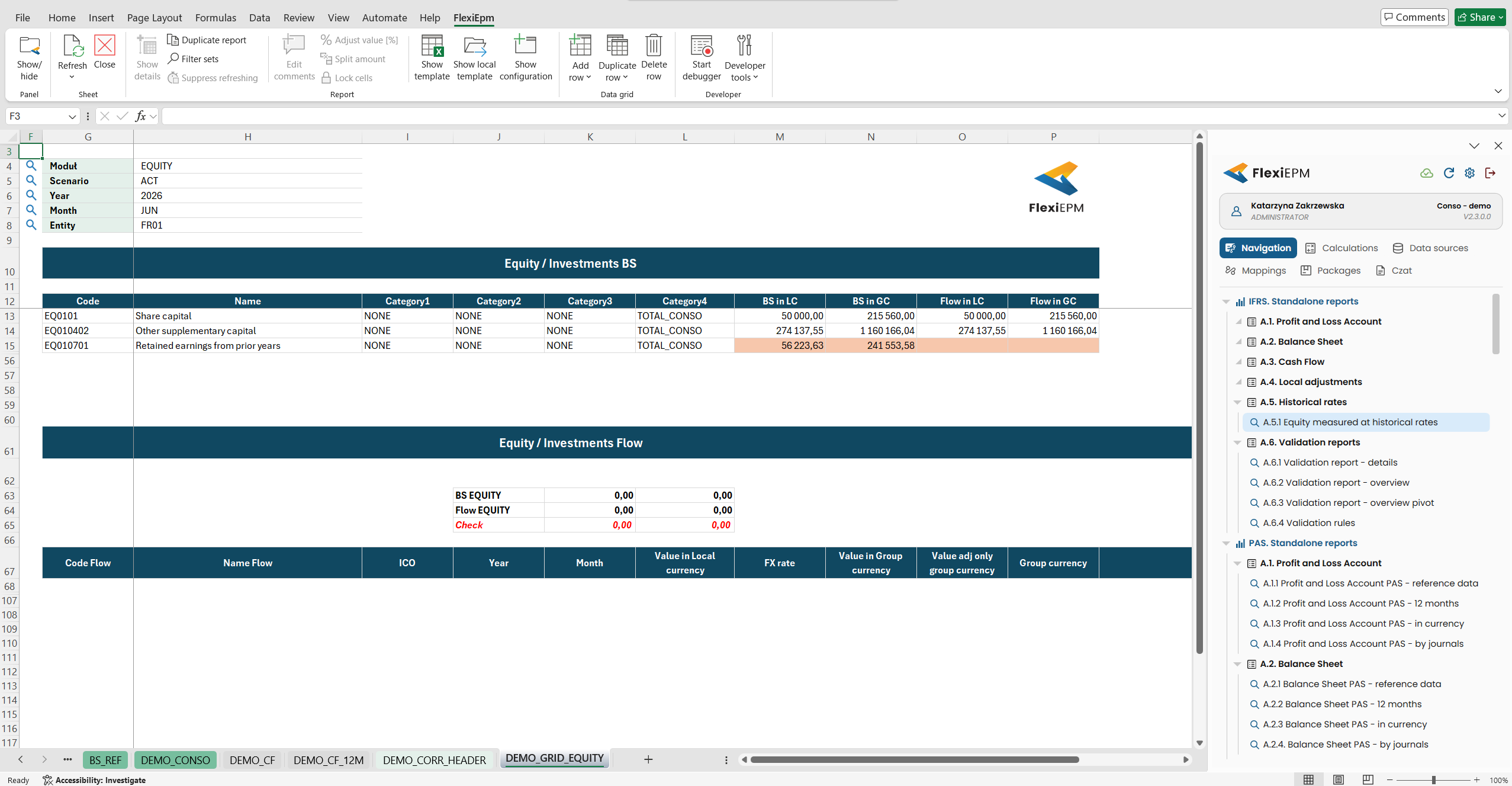
Equity stays at historical rates from the acquisition date, otherwise the elimination of investments would not reconcile. Historical rates and changes in equity, such as dividend payments, are recorded in a separate form. It only has to be filled in correctly once, and the system then recalculates equity and translation differences every month or quarter, also in the notes.

No. For each company we prepare a table that matches the format of its trial balance, because accounting systems produce very different reports: with debit and credit or a single balance, with synthetic and analytical accounts, with or without additional analytical dimensions.

We do not impose one column layout. The company pastes the trial balance exactly as it comes out of its system, without any prior processing. Setting up such a table takes a few hours.

This works particularly well in groups with foreign subsidiaries and where the books of some entities are kept by an external accounting office and there is no system to connect to.

Yes. The target is a single button: the person responsible for reporting clicks import, and the system pulls the trial balance from the source system itself. This can work through a direct database connection, through an API or by reading a file saved regularly in an agreed network location.

Even when an integration is planned, we start the project by loading data for a few periods manually. This way we work on real numbers from the first weeks instead of waiting for IT to be ready. We switch off manual loading only after the integration is running.

In the system, the group structure is a tree, and one company cannot sit in two places at once. When an entity moves from one sub-holding to another, we do not move it technically: its whole history would follow it, and data for prior periods would show a situation that never existed.

Instead, we create a new element in the new place in the structure. Historical data stays with the old element, and new data is collected under the new one. Separately, we agree how opening balances are transferred and what restated and comparative data should look like.

This always requires a design decision and cannot be done with one click in any consolidation system. It is worth flagging such a change early, so that the layout is agreed before the period is closed.

A spreadsheet is a two-dimensional table: rows and columns. Adding tabs gives a third dimension, and that is where it ends. FlexiEPM works on a model in which every value is described by several dimensions at once.

The basic dimensions are scenario, year, month, entity and statement line. The scenario separates actuals, the budget, subsequent budget versions and forecasts. The entity is a company, a cost centre or another element of the organisational structure. The statement line is a line of the income statement, the balance sheet or a management report.

On top of that come analytical dimensions, which play different roles depending on the process. In consolidation, one of them stores the intercompany partner, so you can report that company A has a receivable from company B and match it against company B’s data. Another handles movement tables, i.e. schedules from opening to closing balance for fixed assets or equity. A third handles the layouts of explanatory notes: receivables ageing, maturities, segment structure or currency exposure. A fourth stores data layers, from the general ledger entry to subsequent adjustments.

In practice, the same data set can be presented in many layouts without moving it between files. Changing a report layout does not mean building a new model.

The starting point is each company’s trial balance from the general ledger. We recommend this route over reporting packages filled in by hand by the companies, and in practice all companies reporting to consolidation in FlexiEPM work this way.

The difference matters. When a company types values into a form, nobody can later explain which accounts they come from. When the trial balance is the starting point, every figure in the consolidated statements can be drilled down to specific accounts in a specific company and period. An auditor asking where a value comes from gets the answer straight away.

This approach also simply means less work and a lower risk of error, because data is not retyped by hand.

Yes. The reporting package can be filled in offline and sent to head office. Accountants in companies that have access import their entity data themselves, within their permissions. A completed reporting package can also be saved as an Excel file without a connection to the database, for example for people outside the system.

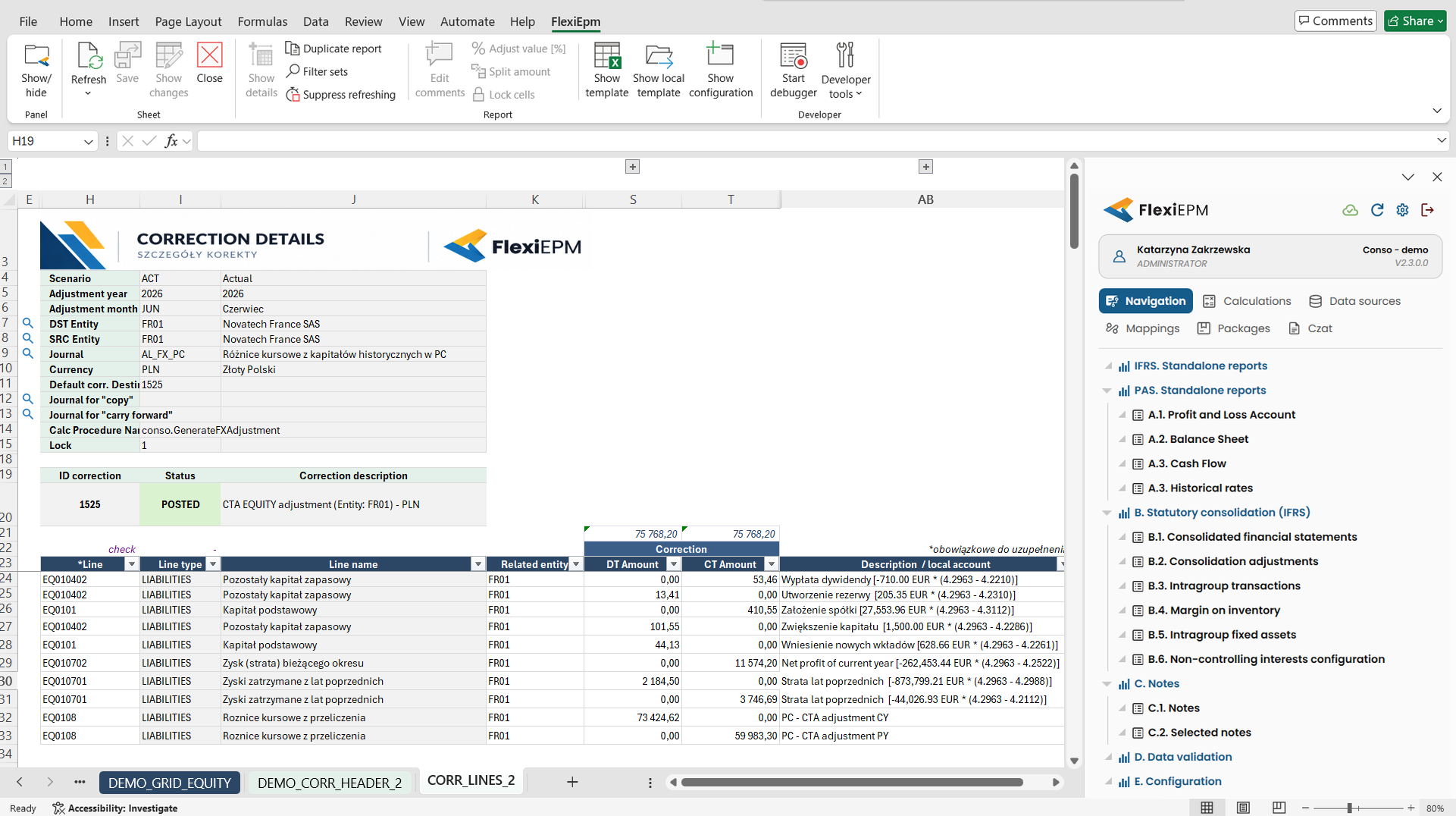
Manual adjustments are recorded as double-entry postings in consolidation journals. In later periods the system copies, repeats or reverses them, and adjustments that changed the prior-year result are moved to retained earnings. Multi-year adjustments, such as those after a sale of a fixed asset within the group, are calculated from the transaction date until the end of depreciation. Each adjustment has a description and a number that lets the auditor trace it to the source.

Examples of such adjustments are described in the article Consolidation adjustments – examples.

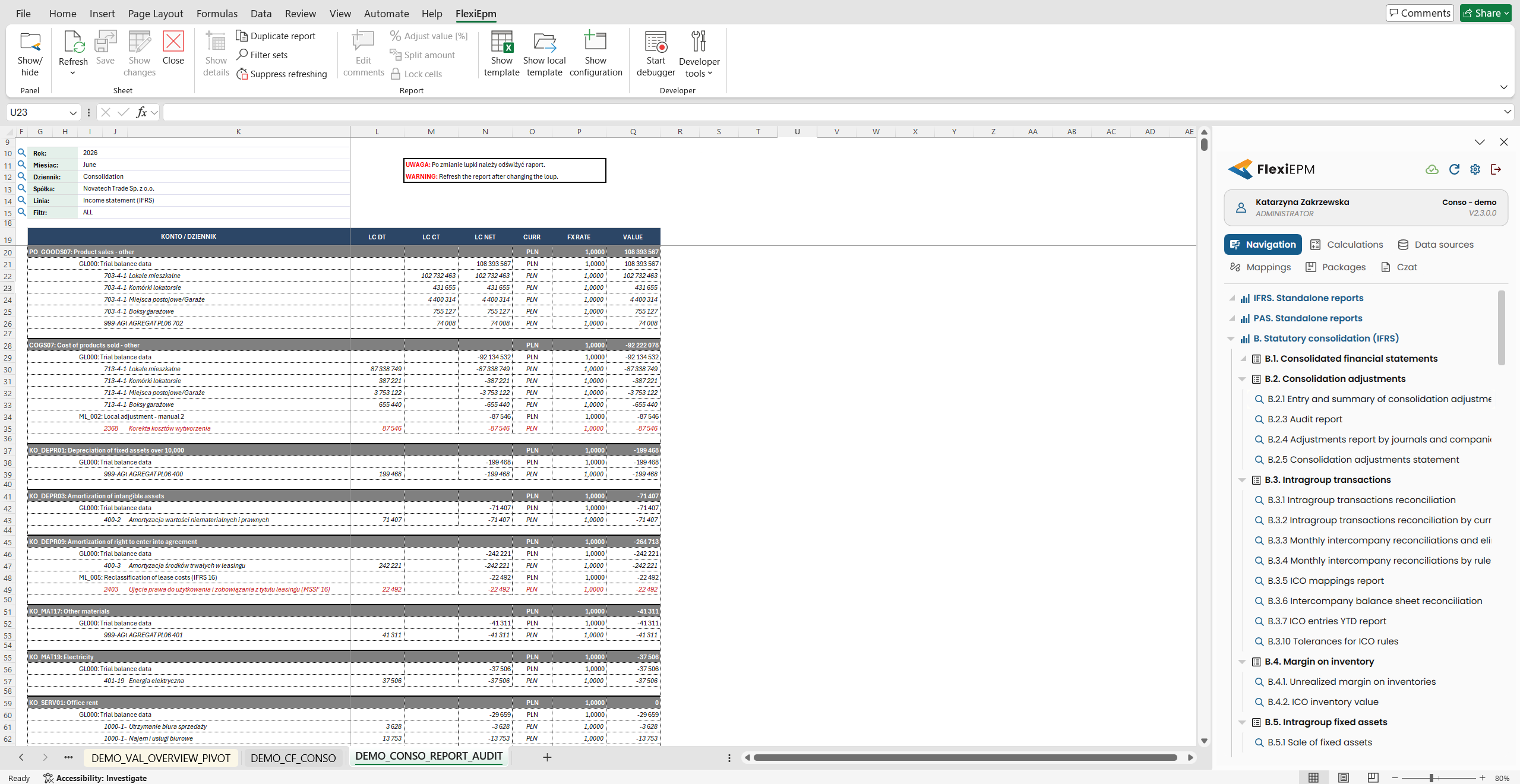
Every figure in the separate and consolidated statements drills down to company accounts and to each local and consolidation adjustment. Adjustments are numbered, described and filtered by company, period, journal and user, and the system records who loaded data and when. Once a period is closed, data and adjustments are locked until an authorised user reopens it.

Yes. A monthly management scenario, by segment and market and compared with budget, runs next to the statutory scenario on the same data. Final management reports use the statutory figures, so the two never need a separate reconciliation.

It is a company’s data prepared for consolidation: the income statement, balance sheet, cash flow statement, statement of changes in equity and notes. In FlexiEPM we call it the entity package. It is built from the company’s trial balance after local adjustments and currency translation, and it is available in both the company’s currency and the group currency. The same package is the basis for the company’s separate financial statements.

The Polish Accounting Act provides for three: full consolidation, proportional consolidation and the equity method. Which one applies depends on the type of relationship with the company.

In FlexiEPM, the ownership share and the consolidation method of each entity are recorded in the group structure. Subsidiaries are consolidated using the full method, and the system calculates non-controlling interests. Entities accounted for using the equity method are included through a separate adjustment. Companies outside the consolidation sit in a separate branch of the structure, and their transactions with the group feed the related-party note.

It depends on the number of companies, the reporting framework and the scope of automation. At Wirtualna Polska Holding, with around 50 companies, the main stages took about 9 months. In the Automotive segment of Boryszew Group, companies have reported in FlexiEPM since February 2026, and the management reporting stage took about 3 months. Projects start on real trial balances in the first weeks, before integrations are ready.

#CASE STUDIES

How we support companies with consolidation

See the challenges we have tackled and the solutions we have implemented for our clients.

RASP

Financial statements and consolidation at Ringier Axel Springer Polska

Ringier Axel Springer Polska keeps the books and handles financial reporting for eight group companies. Some of them report under International Financial Reporting Standards, while most report under the Polish Accounting Act.

For years, the team put the financial statements together by hand: it filled in tabs in Excel, printed pages to PDF and pieced the document together from them. A single correction sent all the editing work back to the start. Today, data from SAP flows into FlexiEPM, and the system builds the notes and the complete financial statements from it.

Financial statements under IFRS and local GAAP at Ringier Axel Springer Polska
Automating financial consolidation at WeNet Group

Automating financial consolidation at WeNet Group

For more than 30 years, WeNet Group has been helping small and medium-sized businesses build their online presence. It was formed by combining two well-known brands, Panorama Firm and PKT, and today it is one of the largest providers of online services for businesses in Poland.

The challenges of consolidating financial statements grew as the Group expanded. Excel was no longer enough: the files were hard to read, format and manage, and the reporting process was time-consuming and lacked transparency. WeNet decided to change this by implementing the FlexiEPM consolidation module.


Read more >
Reporting and consolidation of 10 companies in the Automotive segment of Boryszew Group

Reporting and consolidation of 10 companies in the Automotive segment of Boryszew Group

Ten manufacturing companies in eight countries, different currencies and time zones. Plus one person at head office responsible for consolidation. The Automotive segment of Boryszew Group replaced reporting and consolidation in Excel files with FlexiEPM. Today, the companies report in the system themselves, check their data and reconcile intercompany transactions. Head office can focus on analyzing results.

Read more >
Financial consolidation at Wirtualna Polska Holding

Financial consolidation at Wirtualna Polska Holding

Wirtualna Polska Holding is a large, rapidly growing technology and media group comprising approximately 50 companies, including international subsidiaries operating in different currencies and local accounting environments.
As the organization expanded and its reporting environment became increasingly multi-currency, an Excel-based consolidation process could no longer provide sufficient data security, control over account mappings, or process repeatability.
FlexiEPM was implemented as a central financial consolidation platform, bringing entity reporting packages, currency translation, account mappings, historical data, and drill-down analysis into one governed environment.

Read more >

Recommendation of the system for consolidation

Marcin Radziszewski
Marcin Radziszewski
CFO at PBKM S.A
The system has handled the scale and complexity of our Group very well – as a result of the implementation, we now have a unified repository of financial data from all consolidated entities, regardless of differences in systems or accounting structures maintained at the local level. From the perspective of the monthly reporting process, we especially value the use of control reports that allow for quick verification of the consistency of local data provided by subsidiaries, as well as reports that simplify the reconciliation of balances and intercompany accounts.In addition, the tool’s capabilities have been used to collect and consolidate budgets from all entities. Seeing the real benefits, we continue to expand the scope of system use in our company – not only within the finance department.

Book a Consultation with an expert

Streamline your planning, controlling, reporting, and consolidation processes in a single system.
Eliminate errors and reduce time-consuming tasks through integration and automation.
Mariusz Sumiński

Mariusz Sumiński

Managing Director, Co-Founder