IFRS 16 lease accounting
When does IFRS 16 apply? How should a lessee present leases in its financial statements to comply with IFRS 16? How do you measure the right-of-use asset and the lease liability?
#FLEXIBLE EPM SYSTEM
FlexiEPM is an EPM system for financial consolidation, planning, budgeting and management reporting. Its scope is comparable to Oracle Hyperion Financial Management (HFM) and Hyperion Planning, so one system can replace both.
Considering a move to Oracle Fusion Cloud EPM? Contact us to compare it with FlexiEPM and discuss a migration path for your organization.
Scroll down to learn more.
100%
integration with Microsoft Excel

FlexiEPM is used by 60 organizations, from large companies and corporate groups to fast-growing mid-sized companies. Top Farms, for example, moved its IFRS 16 process to FlexiEPM from a global EPM system.
It supports advanced budgeting and consolidation processes, handles complex organizational structures, and has proven its effectiveness in demanding EPM implementations – delivering predictable costs and flexibility aligned with local business realities.
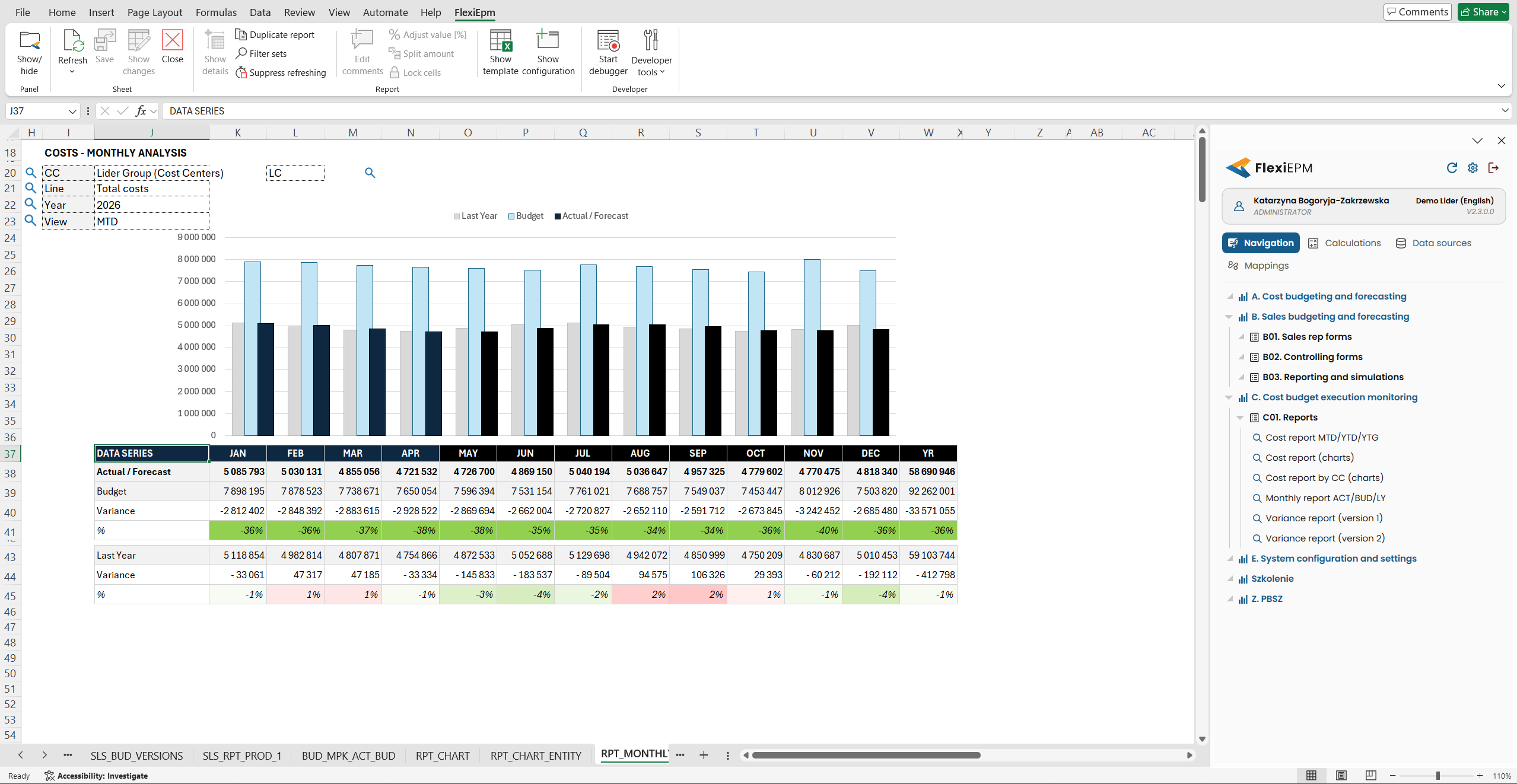
FlexiEPM combines the familiarity of Excel with the functionality of an enterprise EPM system.
FlexiEPM covers the entire performance management cycle: planning, forecasting, reporting, and consolidation. It’s a mature EPM platform designed around the needs of controlling teams and fully compliant with local reporting and regulatory requirements.
Work directly in Excel. All forms and reports are run from the familiar Excel interface, reducing implementation time and improving user comfort.
Replace two separate systems with one integrated environment that connects finance and controlling. Fewer systems mean lower costs, consistent data, and easier collaboration. Manage all processes in a single workspace – without complex third-party integrations.
FlexiEPM's functional scope matches that of global vendors' platforms, while licence terms are set for the local market. For a comparable scope, this means a favourable licence cost and predictable terms throughout the cooperation.
#STEP BY STEP
Migration from Oracle Hyperion (Planning or HFM) to FlexiEPM is a structured and transparent process that preserves your key functionality, optimizes workflows, and increases flexibility. Each stage ensures data continuity, security, and user confidence.
The migration starts with a full review of the current architecture and the definition of the target model.
Our goal is not just to mirror existing functionality, but to use migration as an opportunity to optimize processes, align the solution with new business needs, and expand automation.
We recommend conducting an “as-is” vs. “to-be” analysis, clearly defining project scope and priorities.
Both Hyperion Planning and HFM are based on a multidimensional data model (Essbase or the consolidation model).
FlexiEPM also leverages multidimensional processing, enabling a seamless replication of all dimensions, hierarchies, and data structures.
For projects replacing HFM, we offer a predefined consolidation model that allows you to transfer your group structure, financial statement layout, disclosures, audit journals, and currency configuration directly into FlexiEPM.
One of the key advantages of FlexiEPM is its native integration with Microsoft Excel.
All reports and planning forms from Hyperion can be seamlessly migrated and adapted to the new environment – regardless of how they were originally built.
FlexiEPM’s flexibility allows you to replicate not only the layout and structure of reports, but also the entire calculation logic, fully aligned with your users’ needs.
An essential part of the migration process is preserving automation, interfaces, and calculation rules.
In FlexiEPM, many of your existing data sources, integration interfaces, and transformation processes can be reused without rebuilding them from scratch.
Thanks to its open architecture and flexible calculation engine, FlexiEPM enables the migration of calculation and transformation logic from Hyperion Planning and HFM, accurately replicating scripts in the new environment without any loss of functionality.
Maintaining data continuity is crucial.
The migration mechanisms in FlexiEPM support both incremental and full migration, depending on the organization’s preferences.
The project is carried out in a way that allows the old and new systems to operate in parallel, ensuring a smooth transition.
The final data migration takes place just before the go-live phase and includes all planning, reporting, and reference data, guaranteeing their complete availability in the new system.
Testing the new environment ensures that results and processes are fully consistent with what the organization has used so far.
Tests run in parallel with the migration, from data import, through calculations, to final reports. For consolidation, we reproduce the processes covering historical data import, reconciliation, adjustment postings and final group reports. For Hyperion Planning, testing means reproducing budget scenarios and forecasts using identical input data.
This validation path lets you confirm the results before you switch to the new environment.
FlexiEPM is built on concepts similar to Hyperion, which makes the knowledge transfer process smooth and efficient.
Administrators quickly adapt to managing the data model, user permissions, and report configurations, while end users immediately feel comfortable in the familiar Excel-based environment.
If the underlying business process remains unchanged, managers, controllers, and subsidiary users can transition to the new system with ease – often after just a single training session.
After migration, we provide comprehensive support during the production go-live phase.
Our local team of consultants and engineers ensures quick response times and efficient resolution of any potential issues.
During critical periods, such as month-end closing, budgeting or annual consolidation, we can provide hypercare support, with closer monitoring and faster response from our support team.
and streamline your reporting and consolidation processes.


The implementation of FlexiEPM as a replacement for Hyperion Planning or HFM typically takes between 3 and 12 months. The duration depends on the scale and complexity of the current environment, as well as on the scope of changes and optimizations introduced during migration.
A key factor affecting the project timeline is the availability of the client’s project team and the timely completion of tasks related to testing, knowledge transfer, and the transition of processes to the new solution.
Therefore, the project schedule should take into account the annual operating cycle of the existing system and include a time buffer for testing and a smooth go-live phase.
Yes. In FlexiEPM, reports and planning forms also run in Excel. Smart View reports are rebuilt as FlexiEPM reports, keeping their layout, and stay available to both business users and administrators.
This architecture improves ergonomics and user experience, providing a consistent interface (no need to switch between multiple tools) and ensuring easy adoption for end users.
Not necessarily. In most cases, the transition to FlexiEPM can be done using the existing data sources and interfaces.
At the same time, FlexiEPM includes built-in mechanisms for managing data transformation and mapping directly by business administrators. As a result, many rules currently embedded in ETL scripts can be migrated into configuration tables, which simplifies maintenance and increases flexibility.
While this requires configuration work during implementation, it significantly enhances self-administration capabilities for reporting and controlling teams in the long term.
Yes. The interface is available in both Polish and English, and all configuration elements – such as financial statement items, multidimensional structures, report names, forms, and calculation tasks – can be fully localized.
This ensures that each user can operate the system in their preferred language and that the environment remains consistent across international teams.
FlexiEPM is built entirely on Microsoft technologies.
All data is stored and processed within Microsoft SQL Server.
The system also uses multidimensional data processing, with its own calculation engine.
It enables easy management of hierarchies, attributes, and reporting structures while maintaining excellent performance, even with highly complex models.
FlexiEPM has been successfully implemented in large and complex organizations, supporting automation of reporting and planning across massive datasets.
The platform efficiently handles hundreds of thousands or even millions of transactions, with planning templates easily managing 1,000+ product structures.
Its consolidation mechanisms aggregate hundreds of partial budgets – by customers, products, or business units – ensuring both accuracy and high performance.
Yes. FlexiEPM is designed with business users in mind, offering much simpler administration than Oracle Hyperion.
It provides a unified, intuitive administrative interface for managing the multidimensional model, report structures, forms, and user permissions.
Many business process configurations – including data mapping and transformation rules – can be managed directly in Excel.
Using clear configuration and mapping tables, most routine changes can be made independently by controlling and reporting teams, without the need to involve IT departments or external consultants.
#KNOWLEDGE BASE

When does IFRS 16 apply? How should a lessee present leases in its financial statements to comply with IFRS 16? How do you measure the right-of-use asset and the lease liability?

How do you prepare a consolidated balance sheet for a group of companies? This practical guide walks you through the process step by step: preparing separate balance sheets, local adjustments, capital adjustments and goodwill, and eliminations of intercompany balances.

Since IFRS 16 came into force, lease liabilities have become more complex to manage. One of the key elements is discounting future payments. In this article we show how to calculate the present value of the liability, compare different approaches to the discount factor and explain what to watch out for in monthly calculations.







Oracle offers Premier Support for its on-premises applications, including Hyperion, through at least 2037, so there is no fixed date by which companies have to leave Hyperion Planning or HFM. Moving to a new EPM system, whether Oracle Fusion Cloud EPM or another platform, means replacing the platform rather than upgrading it. That is why it is worth planning the migration around the annual reporting and budgeting cycle.
For companies relying on Hyperion or BPC for management reporting, budgeting, and consolidation, migration will not be a simple upgrade – it will require replacing the entire EPM platform.
FlexiEPM is an alternative to Oracle Hyperion Planning and HFM for large companies and corporate groups with complex management reporting, budgeting, forecasting and financial consolidation processes. FlexiSolutions was founded in 2014 by experts in Oracle Hyperion implementations, and our EPM consultants have worked on projects with Hyperion Planning, HFM and other global EPM systems.
FlexiEPM has been implemented since 2015 and is used by 60 organizations, including listed companies, international groups and fast-growing companies. In our implementations, more than 100 users work in a single system, with thousands of products and customers in one EPM environment.
FlexiEPM supports multi-country financial consolidation, handling different charts of accounts, currencies, languages, and ERP systems.
In total, our clients consolidate more than 200 companies in more than 20 countries in FlexiEPM.
FlexiEPM is an advanced, enterprise-grade EPM platform that serves as a real alternative for users of Oracle Hyperion Planning, HFM, and SAP BPC.
FlexiEPM is an enterprise EPM platform for users of Oracle Hyperion Planning and HFM who want to keep budgeting, forecasting, reporting and consolidation in one environment and continue working in Excel.
The platform is built on Microsoft SQL Server and integrates with ERP and accounting systems and with Excel. FlexiEPM runs in the client’s infrastructure – on its own servers or in a cloud it manages – or in a dedicated Microsoft Azure instance managed by FlexiSolutions.
Its central MS SQL Server database can also serve as the controlling data warehouse, and the model supports complex budgeting, multidimensional reporting and distributed controlling processes.
What sets FlexiEPM apart is its complete functionality, compliance with Polish and international reporting standards (including XML MF and IFRS 16), and intuitive Excel-based interface.
With FlexiEPM, you gain not only a system but a strategic implementation partner, helping your finance and controlling teams build a modern, integrated reporting environment.