#AI IN FINANCE

AI in finance needs data you can trust

AI tools in finance are only as reliable as the data and rules they work on. ERP systems hold transactions. FlexiEPM holds management and group data after mapping, adjustments and consolidation, in agreed versions and with a full change history. That is why we are developing FlexiEPM so that language models chosen by the client can use this data safely, with permissions and controls preserved.

FlexiEPM reports in Excel: monthly cost analysis with actuals, budget and last year, and the group’s consolidated income statement

Our clients include

PBKMPFRHOYAMediaMarktSaturn PolskaHortexWieltonTchiboGLS PolandAnswearCedrobOrbicoZdrowitWirtualna Polska HoldingOKAMTorf Corporation (obecnie Bielenda)NASKMaflow (Grupa Boryszew)EquinorTop FarmsINTER Polska

In brief

  • FlexiEPM has no built-in language model. The client chooses the AI model and decides what data to share with it.
  • Results are calculated by rules stored in the model, and AI analyses and comments on them. Every figure can be traced to company accounts and adjustments.
  • Data stays on the client’s servers or in a cloud the client manages.
  • Users work in Excel, where AI tools such as Microsoft Copilot are already available.

#DATA

Why
AI in finance needs a governed data layer

CFOs are increasingly responsible for bringing AI into the finance function. Gartner’s 2025 survey shows that most finance functions already use AI, but results take time, and data is the biggest obstacle.

59%

of finance leaders report using AI in their finance function

91%

of respondents report a low or moderate initial impact of AI

Data

data literacy and technical skills, along with data quality and availability, are the biggest obstacles

Source: Gartner, 2025 AI in Finance Survey (183 CFOs and senior finance leaders, 18 November 2025)

#FLEXIEPM

FlexiEPM as
a reliable foundation for AI in finance

The tasks AI is expected to support in finance include the month-end close, explaining variances, forecasts and board reports. All of them depend on shared definitions, calculation rules, permissions and an audit trail. A transaction system does not hold those definitions. In spreadsheets they live in formulas, often known to one person. FlexiEPM holds them in one model.

ERP and accounting systems

They hold transactions: each company’s ledgers and documents. They answer the question of what happened.

FlexiEPM

Management and group data in one model:

  • the group reporting chart of accounts
  • mappings from every company’s ledger, including different ERP systems
  • currency translation and eliminations
  • budget versions and approvals

Data, versions, rules and permissions in a central MS SQL Server database

AI chosen by the client

It comments on results, explains variances and builds forecasts. Its answers start from the same numbers the finance team signs off.

#RULES

Rules calculate,
AI analyses

When an auditor or the board asks where a figure came from, the answer is in the model: the rule, the company accounts and the adjustments. AI comments on that figure, but does not calculate it.

Model rules calculate

  • Calculations, allocations and consolidation run on rules stored in the model.
  • They give the same result every time.
  • A figure in a report can be traced to company accounts and to each adjustment.

AI analyses and comments

  • It comments on results and explains variances based on figures from the model.
  • Its explanation can be checked against the source.
  • It does not calculate figures.

#AREAS

What data FlexiEPM
gives AI in each area

From FlexiEPM, AI gets not only a figure but also the context needed to check it. Examples from the modules:

Bring AI into finance
on data you can trust

Talk to us about how FlexiEPM can become a reliable foundation for AI in your finance team.

Book a consultation >

#CONTROL OVER DATA AND AI

Your infrastructure,
your choice of AI model

FlexiEPM runs on the client’s servers or in a cloud the client manages. Financial data stays in that environment.

FlexiEPM does not tie the client to one AI vendor. The client decides which model to use and what data to share with it.

A service under your agreement

An AI model under your company’s corporate agreement.

The AI you already use

For example, Microsoft Copilot in Excel.

A model in your infrastructure

A language model running on your own servers.

#EXCEL

Excel, where
AI already works

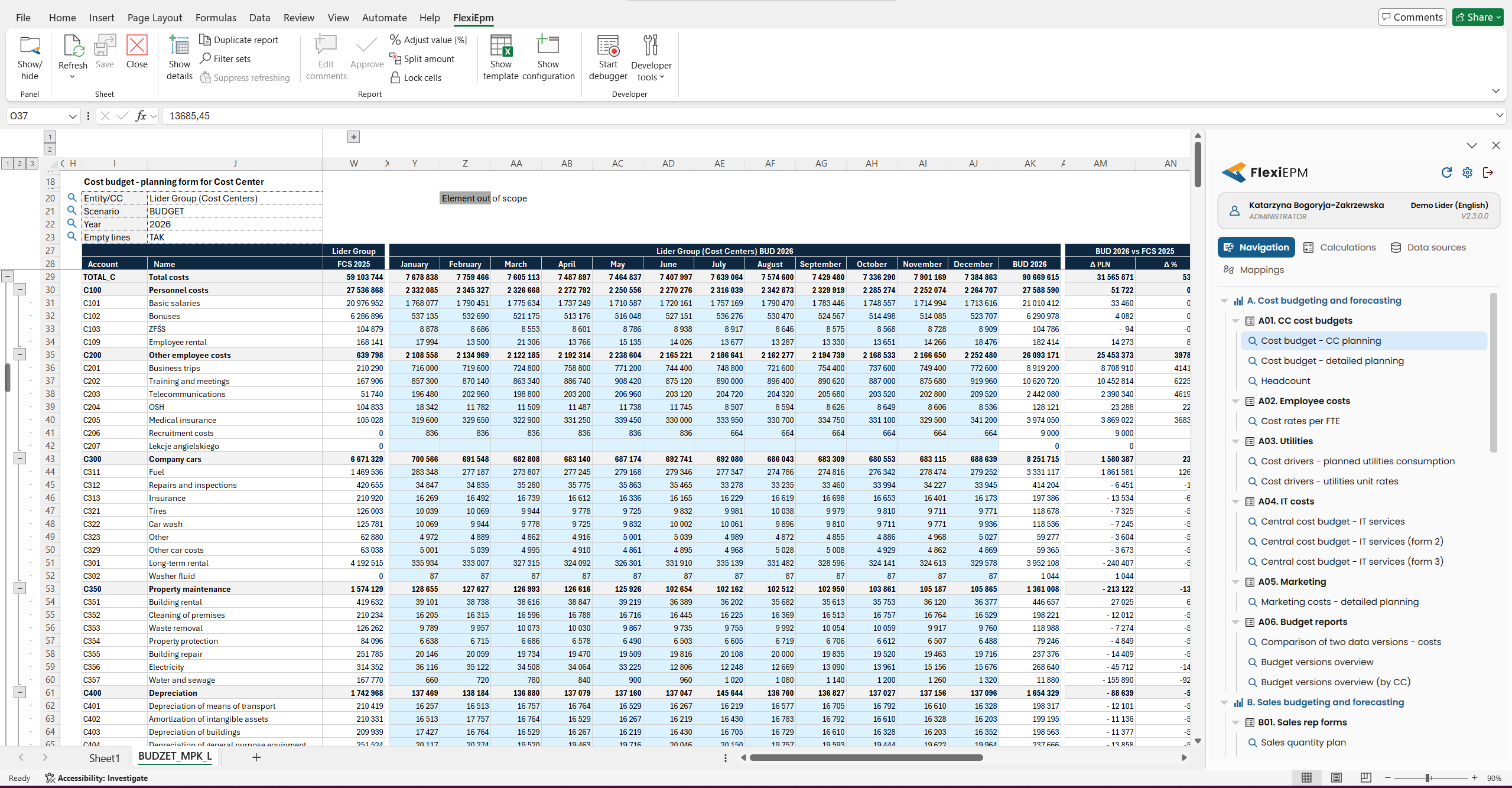
FlexiEPM users work in Excel, where AI tools such as Microsoft Copilot are already available. FlexiEPM forms and reports connect this work to a central data model instead of to more spreadsheets. AI in Excel then works on figures from the model, not on copies passed between files.

Cost budget planning form in FlexiEPM in Excel: the FlexiEPM ribbon, the form and the navigation panel. Excel is the user interface, and underneath runs a central MS SQL Server database with data, versions, rules and permissions.

#VERIFICATION

Controls that make
AI output verifiable

These FlexiEPM mechanisms let you check where a figure comes from, who changed it and when, and who has access to it.

01

Change history

The system records every change to data and configuration: who, when, and the value before and after.

02

Versions and locks

Actuals, budgets and forecasts are separate versions. A closed period is locked until an authorised user reopens it.

03

Approvals

Plans move through defined statuses, from data entry to approval.

04

Permissions

User groups and security filters limit what each person, and each tool working on their behalf, can see.

05

Cell value explanation

A user can view the query behind a value in a report and check where the figure comes from. From a report, you can also drill down to source data, right down to journal entries.

06

Permission simulation

An administrator checks what a given user will see before the data reaches them.

#IMPLEMENTATIONS

Artificial intelligence
in our implementations

Our consultants configure FlexiEPM models with the help of artificial intelligence, using knowledge of the system prepared for language models: a description of the data model, procedure patterns and lessons from implementations.

01

A consultant prepares with artificial intelligence

Data loads from client files, calculation and allocation procedures, reports and input forms, translation of model configuration into other languages, and a review of existing procedures.

02

A consultant reviews and tests

Every result, before it goes live.

03

The client takes over the model

It is easier for the client to take over running and developing the model.

#CASE STUDIES

How do we support CFOs
with controlling and reporting?

Take a look at the challenges we have faced so far and the solutions we have implemented for our clients.

#FAQ

AI in finance: frequently asked questions

Answers to the questions CFOs ask about AI in finance: where AI gets its data, which model to choose and whether AI calculates results.

Does FlexiEPM send our financial data to an AI provider?

No. FlexiEPM has no built-in language model and runs in the client’s infrastructure. The client decides which AI model its users work with and what data that model can access.

The ones your organisation already uses or approves, for example Microsoft Copilot in Excel, a service under your corporate agreement or a model running in your own infrastructure. FlexiEPM does not tie you to one AI vendor.

No. Results are calculated by rules stored in the model and give the same result every time. AI analyses and comments on those results, and every figure can be traced to its source accounts and adjustments.

Our consultants configure FlexiEPM models with AI, using knowledge of the system prepared for language models. They review and test every result before it goes live.

Talk to an expert
about your processes

In a 30-minute online call, you tell us about your processes and financial data, and we point out where to start.

Mariusz Sumiński

Mariusz Sumiński

Managing Director, Co-Founder

Book a consultation >