#TECHNOLOGY

Architecture of the FlexiEPM system

Explore the architecture and technology behind FlexiEPM. See how it integrates with other systems, how it processes multidimensional data on MS SQL Server, and what its administrative tools can do.

FlexiEPM brings planning, reporting and consolidation together in the familiar Excel environment, giving you full control over your data and business processes.

The solution is built for large companies, capital groups and fast-growing mid-sized companies, including those operating across multiple countries and currencies.

#FLEXIEPM ARCHITECTURE

Modern technology for efficient reporting, planning and consolidation

From the very beginning, FlexiEPM was designed to combine advanced integrations, centralised data processing and work in the familiar Microsoft Excel environment. This approach gives users intuitive, convenient access to the full functionality of the system, without the need for lengthy training.

The system is built for managers, controllers and financial analysts, giving them an efficient tool for reporting and budget work. A high-performance, scalable and optimised data model built on Microsoft SQL Server ensures fast processing of large data volumes, even when complex business logic is applied.

FlexiEPM combines the computing power of SQL Server with the convenience of working in Excel, delivering a high level of performance, security and everyday usability.

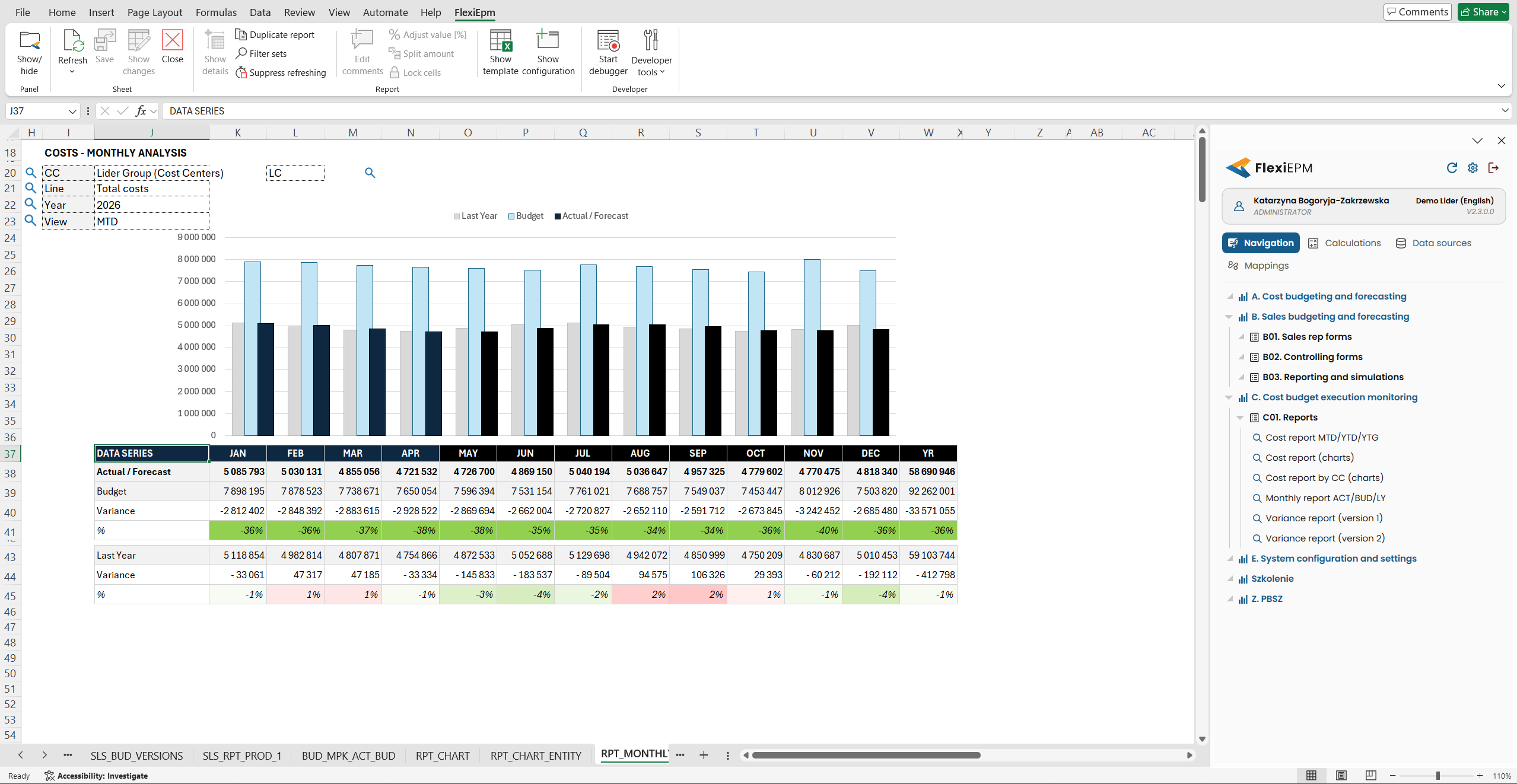
Monthly cost analysis in FlexiEPM: actuals, budget and last year on a chart and in a table
Monthly cost analysis in FlexiEPM: actuals and forecast compared with the budget and last year, on a chart and in a table with variances.
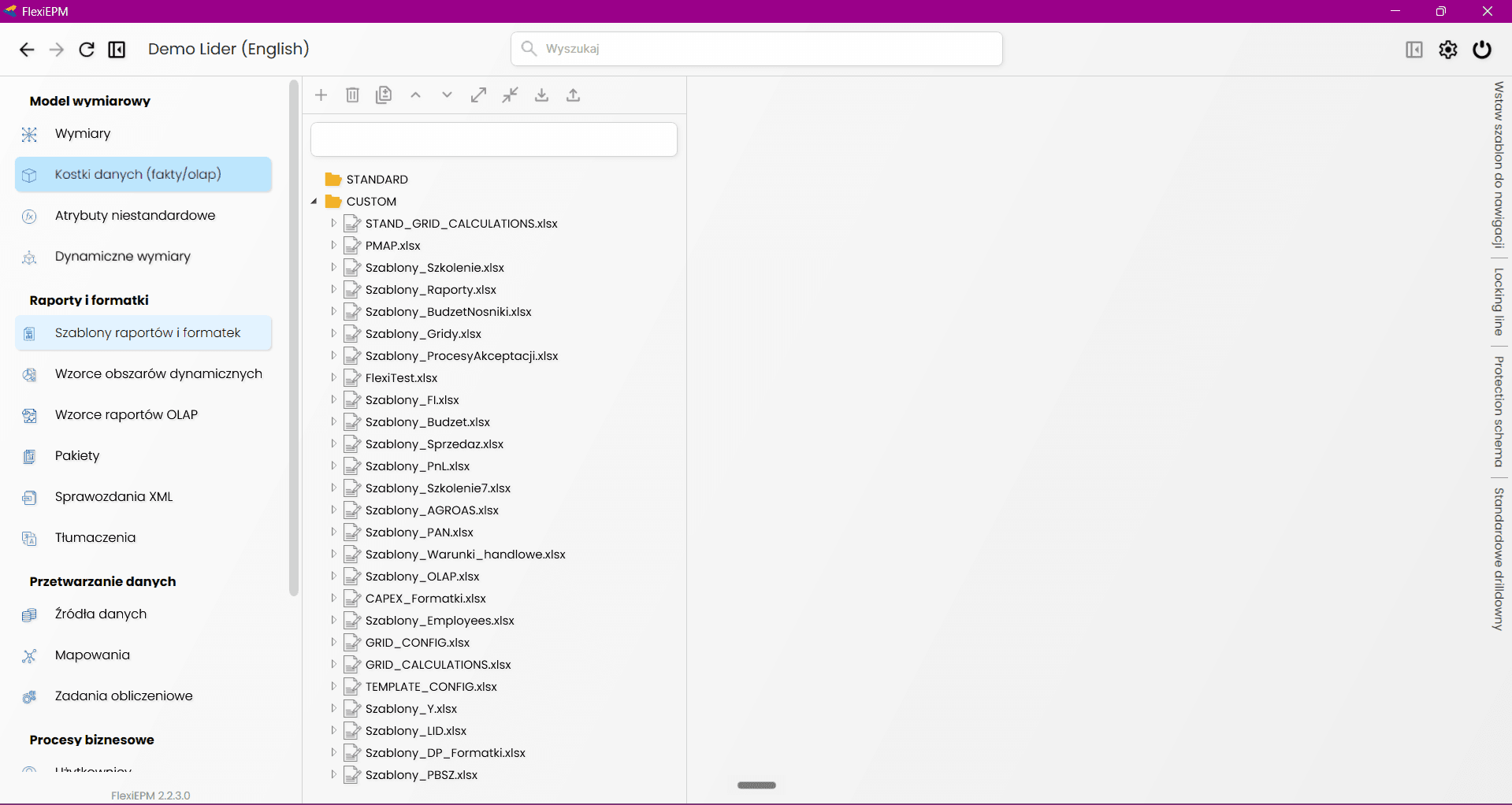
List of report templates and Excel formats in the FlexiEPM administration panel
Report and form templates. Each report is an Excel file managed centrally within the system.
#ms excel

A user interface 100% integrated with Microsoft Excel

FlexiEPM is fully integrated with Microsoft Excel, giving users a familiar working environment for planning, reporting, and consolidation. The system runs in Excel, while advanced data processing takes place in the background – without the risk that comes with manual formulas or unstable links between files.

Outside the company network, including from a Mac, users work in the full version of the system through remote desktop (an RDS server).

All reports, input forms, analyses and calculations are available directly in the standard Excel interface, which removes the need for time-consuming training. Users keep working in an environment they already know, while the system takes care of data consistency and security.

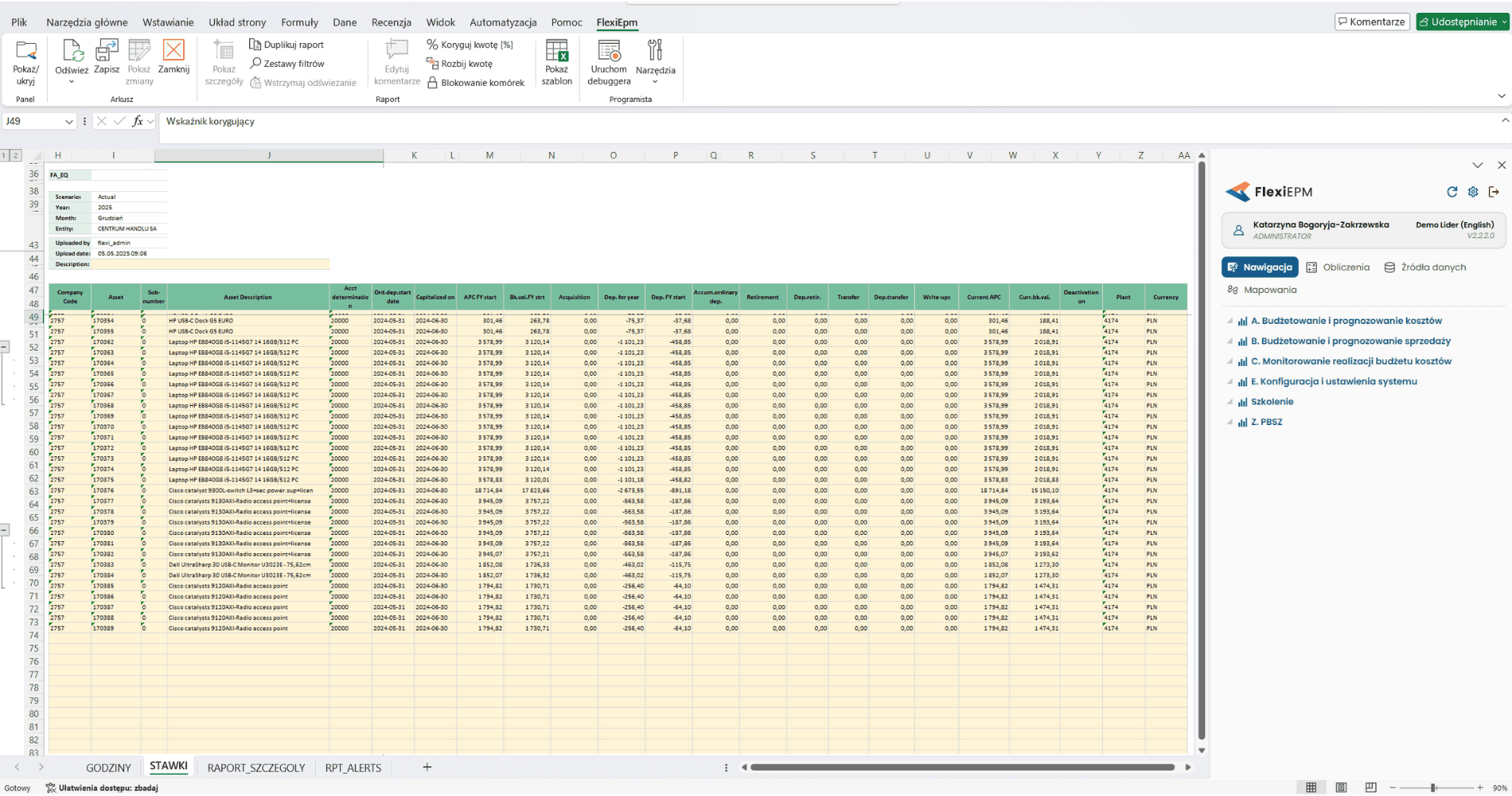
Excel works as the presentation layer. Each report consists of an Excel template, which defines its layout, and a definition in the admin panel, which specifies what data to pull from the database. Templates are protected by permissions, and all data processing and storage logic runs in the background, in a secure system environment.

#ADMINISTRATION

Administrative tools for managing the model independently

FlexiEPM Admin is the panel where controllers, accountants and analysts manage the system themselves. When the company’s structure, a report or the scope of responsibility changes, they make the change on their own, without involving IT or consultants.

The panel covers four areas: the dimensional model, reports and input forms, data processing, and business processes. In the model, you manage organisational units, accounts, budget codes and projects. In reports, you maintain Excel templates and translations. In data processing, you set up data sources, mappings and calculation tasks. In business processes, you grant permissions and define approval processes and global variables, such as the current month and year.

User groups determine which reports and input forms each person sees, and security filters narrow the data down to specific cost centres, companies or projects.

FlexiEPM isn’t a closed “black box”, it’s an open, transparent system. Every rule and every setting is visible in the panel, and controlling processes stay under the full control of the process owners in the company.

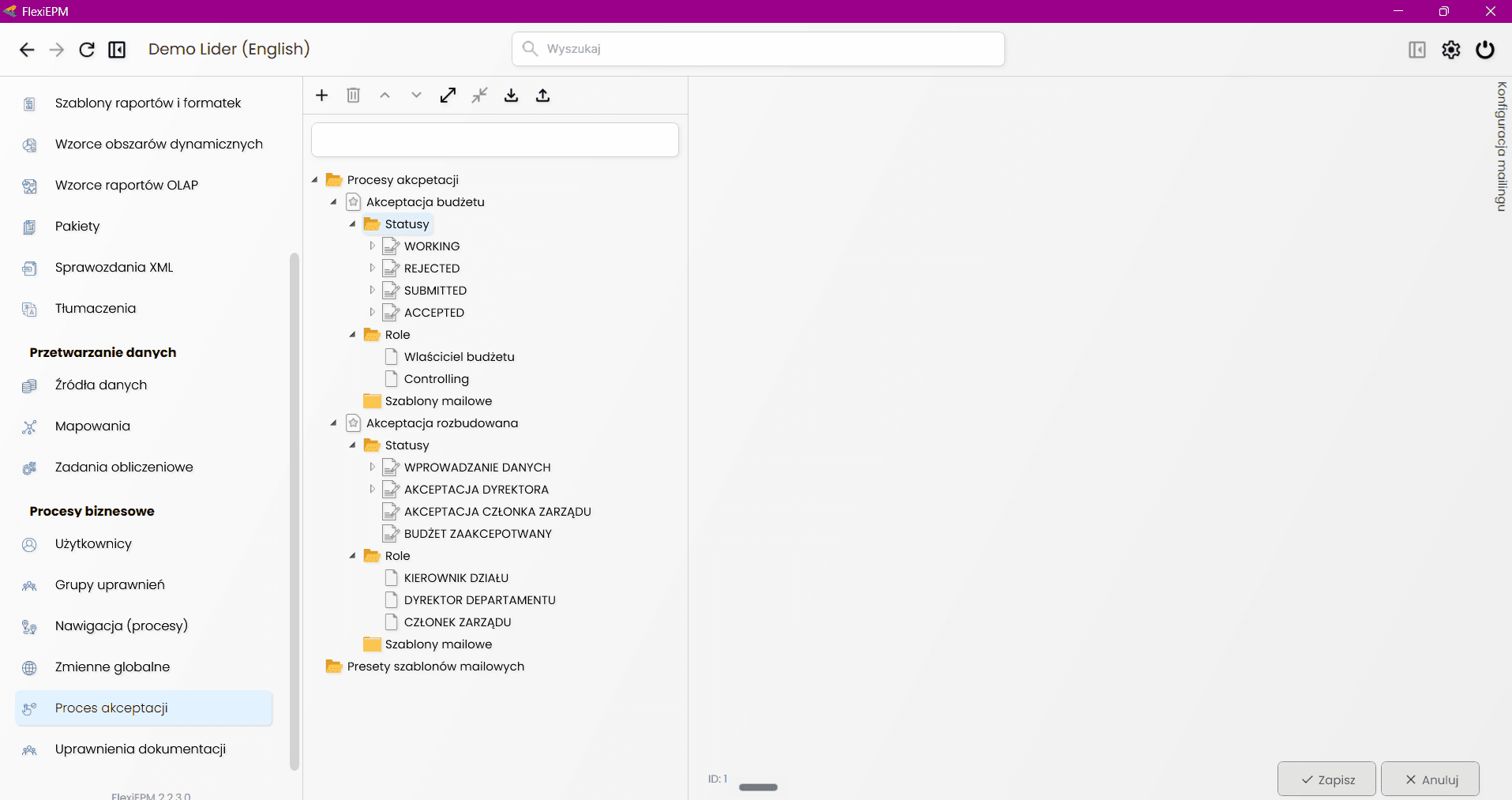
Budget approval process. Each plan goes through established statuses, from data entry to approval by a board member.
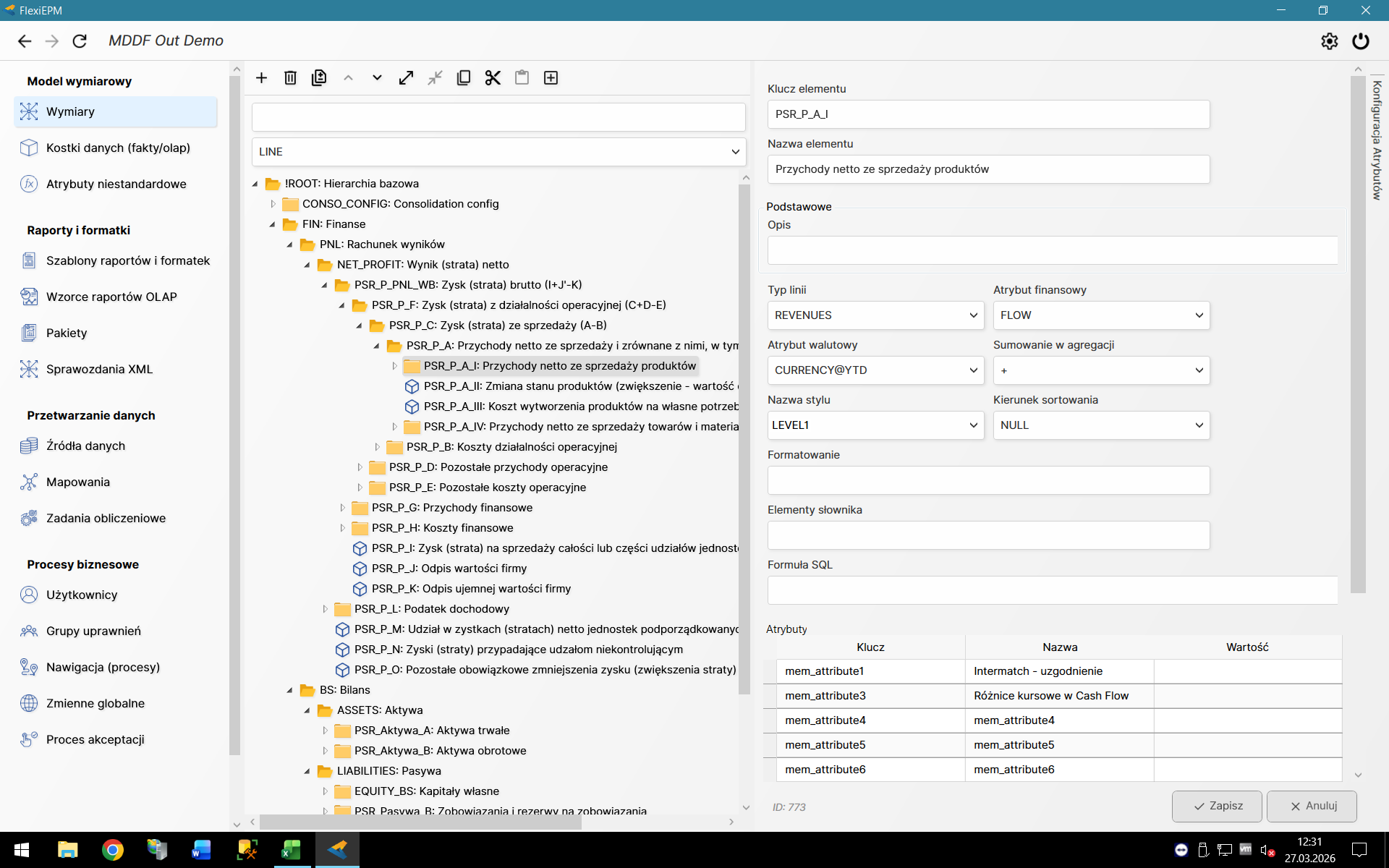
Centralized management of reporting dictionaries in the FlexiEPM administration tool
Dictionaries and reporting hierarchies are managed centrally within an administrative tool. Changes are immediately reflected in the reports.
#olap

A multidimensional data model for efficient planning and reporting

FlexiEPM is built on a multidimensional data model. Every value is described by scenario, year, month, entity, financial statement line and currency. We tailor the analytical dimensions to the company: they can be distribution channels, customers, sales reps, products, projects or employees. When analysis by more attributes is needed, we extend the model with OLAP databases.

Report lines, i.e. the lines of the income statement, balance sheet and management reports, form a line hierarchy in the model. You maintain it in the FlexiEPM Admin panel: add lines, move them within the structure and set their properties, such as line type, sign when rolling up to the parent level and currency translation method. Reports and input forms use the same hierarchy, so a change in the structure flows straight into every report.

The model is built on a reporting chart of accounts. Mapping tables assign the accounts from each company’s chart of accounts to it. One account can go to different lines depending on other dimensions, for example country or project. A new account or a change to the chart of accounts only requires updating the mappings, with no rebuild of the model.

#INTEGRATIONS

Advanced integration capabilities with existing systems

The MS SQL Server database that FlexiEPM runs on can also serve as a controlling data warehouse. It brings data from different systems and sources together in one consistent model.

In implementations to date, FlexiEPM has been integrated with systems including SAP, Microsoft Dynamics, Infor, JD Edwards, QAD, Streamsoft, Symfonia, enova365, Comarch ERP XT, Comarch ERP Optima and Comarch CDN. On the HR and payroll side, these include SAP HCM, Teta HR, enova365, Symfonia HR, Simple and Comarch HRM.

Don’t see your system on the list? We design the integration model around the specific data source, so a system missing from the list doesn’t mean integration isn’t possible.

Built-in integration mechanisms enable effective transformation of source data, adapting it to the requirements of financial reporting, consolidation, and cost allocation and profitability management. Flexible management of dictionaries and transformation rules is available directly to business users, so reporting processes can be run without outside support.

Data enters the system through data sources and mappings, directly from the accounting system or from a data warehouse, overnight or at the click of a button. A mapping assigns columns from an export, for example from SAP, to the FlexiEPM structure and standardises codes and formats. Data from subsidiaries running different ERP systems lands in one model and can be analysed together. Additional tables, such as timesheets, can be pasted into a prepared form.

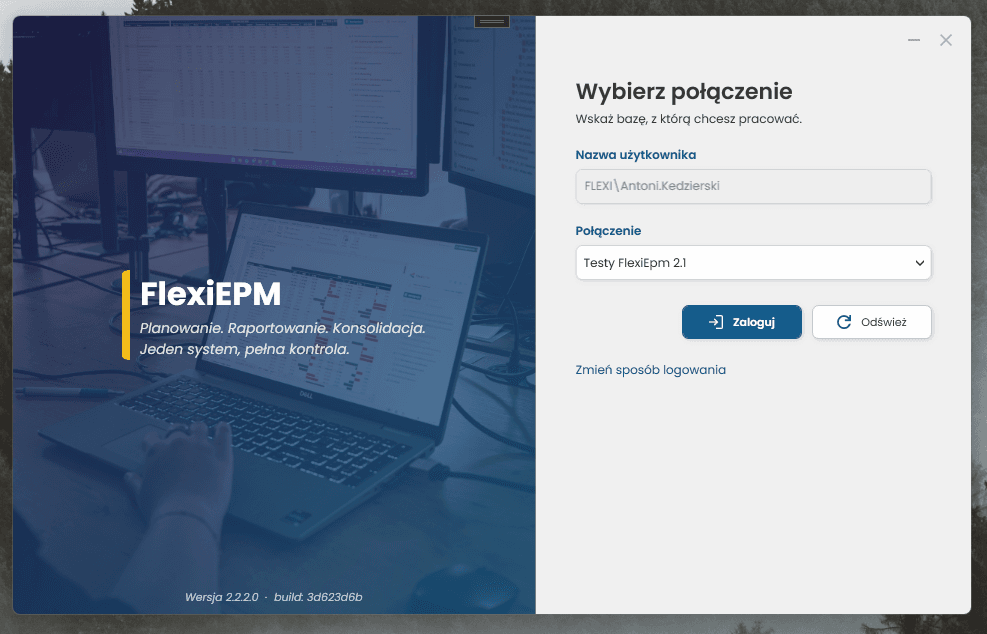
New FlexiEPM Admin start screen
FlexiEPM Admin welcome panel.
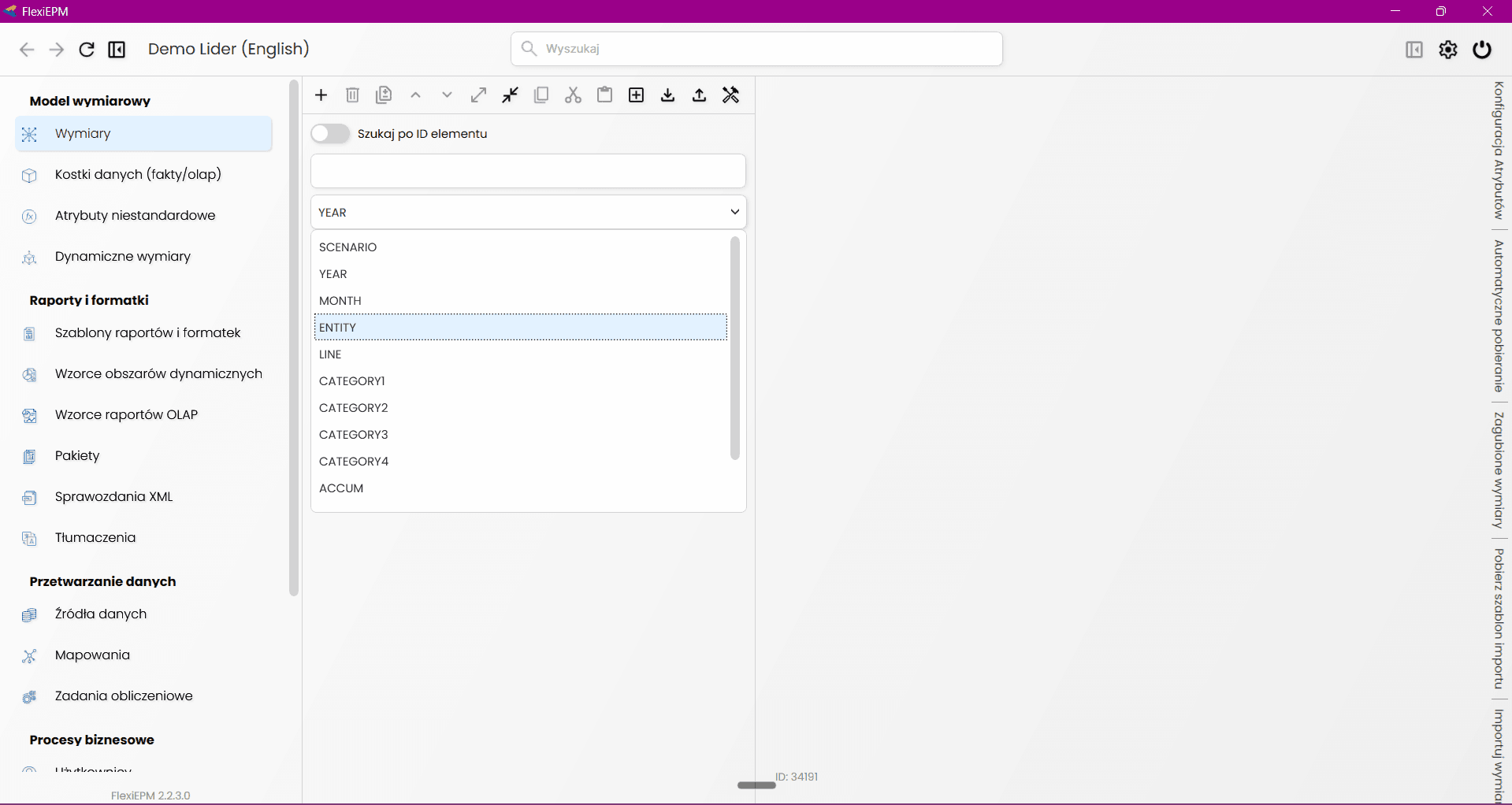
List of dimensions for the FlexiEPM data model: scenario, year, month, unit, line, four categories, and accumulation
#DATA WAREHOUSE

The MS SQL Server platform

FlexiEPM is built on proven Microsoft SQL Server technology, which delivers high performance, scalability and data security. Thanks to this architecture, the system comfortably handles large data volumes – in some projects, more than a million records a year.

The system supports large-scale budget models covering more than a thousand products, customers, employees or production orders, handling complex budgeting, forecasting and cost allocation processes.

FlexiEPM’s physical data structures and storage design are optimised for the requirements of management reporting, consolidation and budgeting. Financial data is processed in purpose-built fact tables, which support fast generation of monthly, quarterly and year-to-date reports, in line with what management and finance teams need.

#CLOUD

Cloud deployment options

FlexiEPM is fully open to cloud deployment. The system runs successfully on platforms such as Microsoft Azure and Amazon Web Services, giving clients flexibility in choosing their deployment architecture.

Being able to deploy FlexiEPM either on-premise or in the cloud means the solution can be matched to the organisation’s requirements. Our system architects work closely with clients’ IT teams, jointly designing the technical architecture to deliver optimal performance, security and scalability.

As a result, FlexiEPM makes efficient use of available IT resources, keeps infrastructure costs down, and leaves room for the system to grow and scale alongside the organisation.

Mapping table: each company's ledger accounts are assigned to group reporting lines
Each company has its own mapping table that assigns accounts from its ledger to group reporting lines.
Example of Power BI integration with FlexiEPM
Sample Power BI integration with FlexiEPM
#power bi

Strong integration with Power BI and other reporting tools

FlexiEPM is a natural complement to Business Intelligence tools such as Power BI. The system provides a complete set of controlling data, ready for advanced analysis and visualisation.

Through its Power BI integration, FlexiEPM lets you present key data in a clear, visual way – as management cockpits, dashboards and visual reports.

Data from budgeting, forecasting, allocation and consolidation processes can be analysed in Power BI, also on mobile devices, with data access permissions preserved.

Working together with Power BI enables in-depth, visual analysis of controlling data, helping managers make decisions based on current, reliable information about the company’s performance and profitability.

#WHAT'S NEW

See what's new in the system

FlexiEPM (known as FlexiReporting until January 2025) is the new generation of the system. Along with the new name, we made significant changes to its architecture.

After more than a decade on the market, we looked closely at what we’d learned and optimised the solution to serve users even better. We release new versions of the system every 4 months.

Mikołaj Dziugieł (CTO) and Antoni Kędzierski (Head of Development) walk through the key changes in the new version of the system.

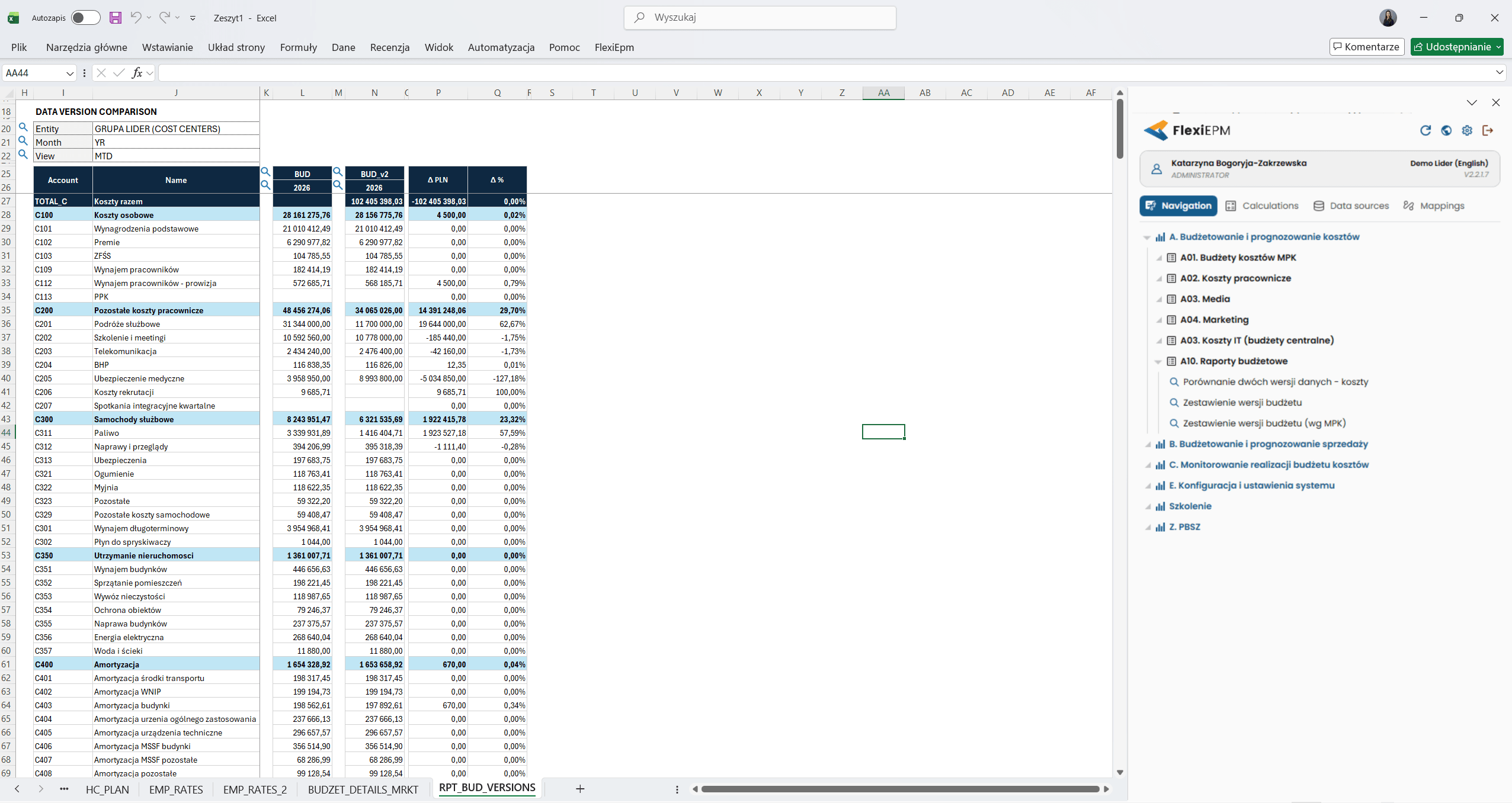
FlexiEPM report in Excel comparing two cost budget versions, with variances in amounts and percentages
A FlexiEPM report comparing two versions of a cost budget, with value and percentage variances.
#LANGUAGE VERSIONS

Working across languages and countries

FlexiEPM has an English and Polish user interface, and can be localised into other languages if needed. Dimensions and descriptions in templates can be translated too. The same report is then displayed in the user’s language, with no separate versions for each country. This matters in capital groups, where reporting has to be consistent across the whole organisation.

A user at a foreign subsidiary works in their own language, on the same structures and the same rules as head office. Data flows into a single model, regardless of which accounting system it came from or which currency it was recorded in.

Multi-currency support is built into the data model. The system handles currency translation according to defined algorithms, so you can run consolidation and group reporting without manual calculations outside the system.

Seamless integration with ERP platforms

Do end users have direct access to the database?

No. All communication goes through the system’s application layer. The client application and the administrative tools talk to the server through an API, not directly to the database.

How does user authentication work?

Users sign in with their Active Directory accounts, the same credentials they use on the company domain (Kerberos, with NTLM as a less recommended fallback), or through Microsoft Entra ID with single sign-on (SSO) and multi-factor authentication (MFA). Domain-independent login with MFA (Google Authenticator, Microsoft Authenticator) is also available. Permissions can be assigned to groups linked to Entra ID groups, and the system signs users out automatically after a period of inactivity.

Is HR and compensation data given extra protection?

Yes. The HR module supports table-level encryption in the database, so even the client’s own database administrators can’t see this information.


Who's responsible for backups and infrastructure security?

In deployments in the client’s infrastructure, the client is responsible for servers, network, backups and day-to-day environment security, following their own standards for production environments. FlexiSolutions installs and configures the system in the development, test and production environments, handles updates and support, and provides configuration guidelines. Failover procedures are agreed jointly.

Is data sent to the system encrypted?

Yes. Communication runs over a connection encrypted with TLS 1.3 or 1.2 and secured with an SSL certificate, which the client can generate themselves, buy from an external provider, or reuse one they already have.

How does FlexiSolutions protect client data on its side?

We have an information security policy that we review and update every year. In 2024, we passed a personal data protection (GDPR) audit. We sign NDAs and data processing agreements with our clients. Client data is not copied outside the project environment, and our consultants connect to it through the client’s VPN, using named accounts.

The system undergoes internal and external penetration testing. The most recent external test was carried out by SecuRing in January 2025, with fixes verified in March 2025. We share the test report on request. Installers are signed with a Code Signing certificate. FlexiSolutions holds civil liability insurance, including professional liability, with a sum insured of PLN 5 million.

What can the controlling team change on its own after implementation?

Most day-to-day changes are made by key users in finance or controlling, without waiting for IT or the vendor. These include new accounts and organisational units, new reports, changes to input forms, mapping tables, and user roles and permissions. A change saved in the model applies to all users straight away.

Every change to data and configuration is recorded with its author, date, and the value before and after the change.


What are the technical requirements?

Database server: 4 CPU cores, 32 GB RAM, 300 GB SSD, Windows Server 2022 Standard or later and Microsoft SQL Server 2022 Standard or later. Application server: 2 cores, 16 GB RAM, 200 GB SSD, IIS 10.0 with ASP.NET Core 10.0 Runtime; both roles can run on one machine. Workstations: Windows 11 (64-bit), Excel 2021 or later or Microsoft 365 desktop, .NET Framework 4.8 or later and VSTO Runtime. Windows 10 and Excel 2016–2019 work but are not supported. We agree the exact requirements with your IT team, as they depend on the modules being implemented and the volume of data.

#KNOWLEDGE BASE

Find out more on our blog

Alternative to Oracle Hyperion and SAP BPC
Controlling

FlexiEPM as an alternative to Oracle Hyperion and SAP BPC – a comprehensive EPM system for controlling and consolidation

Many companies running Oracle Hyperion or SAP BPC are wondering what comes next: migration to Oracle Fusion Cloud EPM or another platform? FlexiEPM is a modern EPM system that combines budgeting, reporting and consolidation in one environment, fully integrated with Microsoft Excel and with support close to the user. See what your future after Hyperion could look like.


Read more >
IFRS 16 lease accounting
IFRS 16

IFRS 16 lease accounting

When does IFRS 16 apply? How should a lessee present leases in its financial statements to comply with IFRS 16? How do you measure the right-of-use asset and the lease liability?

Read more >
skonsolidowany bilans / system controllingu HR
Consolidation

How to prepare a consolidated balance sheet?

How do you prepare a consolidated balance sheet for a group of companies? This practical guide walks you through the process step by step: preparing separate balance sheets, local adjustments, capital adjustments and goodwill, and eliminations of intercompany balances.

Read more >

What do customers say about us?

Hanna Stachowicz
Hanna Stachowicz
Senior Financial Reporting Specialist at Ringier Axel Springer Polska
Previously, we had a separate Excel sheet for each note and each element of the report. Once the data had been entered, we had to export each page to PDF, arrange the pages in the correct order, merge them into a single file and then adjust them so that the formatting was consistent throughout. If anything changed, we had to start all over again.

Nowadays, some of the notes are generated automatically and we don’t have to re-enter the data. It’s a much more organised process. It’s also easier to trace the source of the data for an audit. And if someone asks me for a report for a specific period, I load the turnover figures, do the calculations and I have a preliminary report.
Iwona Borowska
Iwona Borowska
Deputy Chief Accountant at Notus Finanse S.A.
From the perspective of the monthly reporting process and the necessary support for reporting processes, Notus Finanse S.A. highly values the use of the tool for calculating IFRS 16 lease agreements.

The tool allows for ongoing verification of the consistency of entered parameters, resulting in data sets necessary for reconciling financial and accounting balances.

FlexiEPM provides the ability to analyze data from the input level, enter supplementary information and parameters in various configurations, resulting in a fully automated, consistent repository of lease agreements and a set of reports enabling clear analysis of data and transactions necessary for the work of the finance department.

Michał Gumiński
Michał Gumiński
Financial Director at Torf Corporation
Working with FlexiSolutions allowed me to create a flexible ecosystem that addresses difficult operational issues such as sales planning and consistently reflects them in the controlling area.

It's particularly worth emphasizing the flexibility of the FlexiSolutions team's solutions and highly problem-solving approach – thanks to this, we were able to find non-standard solutions that out-of-the-box systems couldn't handle.
Marcin Radziszewski
Marcin Radziszewski
Financial Director at PBKM S.A.
The system has handled the Group's scale and complexity very well – as a result of the implementation, we have a consistent repository of financial data for all consolidated companies, regardless of differences in the systems and structures of accounting records maintained at the individual level.

From the perspective of the monthly reporting process, we particularly value the use of control reports, which allow for quick verification of the consistency of local data provided by companies, as well as reports that simplify the reconciliation of balances and settlements.

Additionally, the tool's capabilities were utilized to gather and consolidate budgets for all companies. Seeing real benefits, we are systematically expanding the scope of the system's use within our company, not just in the finance department.
Piotr Kamiński
Piotr Kamiński
Vice President of the Management Board at Wielton S.A.
The implemented tools broadly support controlling and management reporting processes at the level of the parent company, Wielton S.A., and its subsidiaries. The system is constantly developed and adapted to the growing needs of the enterprise (...).

Currently, FlexiEPM is used by all 16 companies in the group, and the solution is used by over 100 users.
One of the implemented modules is the intragroup transaction reconciliation module. The provided tool enables transaction reconciliation within management and stock exchange reporting processes.
Grażyna Maciejuk
Grażyna Maciejuk
Chief Financial Officer at Instac
FlexiEPM is a highly flexible tool whose reporting structure can be fully customized to the company's specific needs. I recommend this solution because it meets the needs of users at various levels – operational, financial, and management.

The implementation team thoroughly understands the client's analytical and reporting needs, proposing various possible solutions based on their extensive experience. Their knowledge of data analysis and reporting, not just the technical aspects of application implementation, greatly simplifies the implementation process.
Jolanta Anton
Jolanta Anton
Chief Accountant at MediaMarktSaturn Polska
The solutions provided by FlexiSolutions enable automatic processing of input data in the form of appropriate SAP R/3 reports and transactions, and enable users to enter additional information and parameters directly using specially designed forms.

The implemented configuration provides full support for reporting processes, including the ability to automatically prepare final reports in XML structures compliant with regulatory requirements.
Justyna Szumowska
Justyna Szumowska
Chief Accountant at Transition Technologies
The system was used to prepare individual reports for group companies and consolidated reports. Currently, the system is used by 18 group entities (including foreign subsidiaries). The set of reports allows for clear analysis of transactions between companies.

Control reports allow for data analysis from aggregate values to the lowest level of input data. The solution was tailored to the specific needs of our organization. Financial and accounting data processing mechanisms ensure appropriate process automation. The result is a consistent repository of financial data for all companies, regardless of differences in systems and structures.
Michał Kacprzak
Michał Kacprzak
Member of the Board at Baltona
FlexiEPM supports the following reporting areas: consolidation in the statutory system for monthly reporting packages for the owner, preparation of individual and consolidated reports for stock exchange reporting, preparation of annual reports in accordance with the Accounting Act, and consolidation and management reporting.

The system demonstrates the flexibility necessary to support various capital structures, and the implementation team has the appropriate competencies and experience to effectively carry out implementation and development work.
Małgorzata Sulkowska
Director of the Controlling Office TU INTER Polska S.A.
For me, as the person responsible for controlling, the biggest change and benefit is that we can focus on analysis rather than technical process support. Data consolidation and changes now take a fraction of the time we used to spend on Excel.
Beata Wąsowska
Beata Wąsowska
Compensation & Benefits Manager at Grupa Żywiec
Together with the FlexiEPM team, we transformed what had been a highly complex budgeting process. A model previously dependent on complicated and error-prone Excel workbooks became a transparent solution that gives us confidence in the data and ensures full continuity within the team. We particularly value the flexibility of the platform and the responsiveness of the implementation team. For the first time, HR and Finance at Grupa Żywiec can work from the same figures and speak the same language when discussing personnel costs.
Joanna Pilipczuk
Joanna Pilipczuk
Group Financial Reporting Director at Wirtualna Polska Holding
At this scale, Excel was no longer a sufficiently secure solution. Today, we have confidence in our data, full control over account mappings, and the ability to work with multiple currencies without maintaining parallel calculations outside the system.
Iwona Czech
Iwona Czech
Head of Controlling in the Automotive segment of Boryszew Group
We shifted the workload from copying data to analyzing it. Previously, head office collected Excel files from all the companies, copied the data and prepared the consolidation manually.
Today, the companies report in FlexiEPM, and even before they submit a report, they can see in the validation report what needs to be corrected.
They reconcile intercompany balances among themselves. We receive ready-to-use data, start the consolidation process and only have to explain any differences. With this many companies, going back to manual reporting and consolidation in Excel is out of the question.

Book a Consultation with an expert

Streamline your planning, controlling, reporting, and consolidation processes in a single system.
Eliminate errors and reduce time-consuming tasks through integration and automation.
Mariusz Sumiński

Mariusz Sumiński

Managing Director, Co-Founder