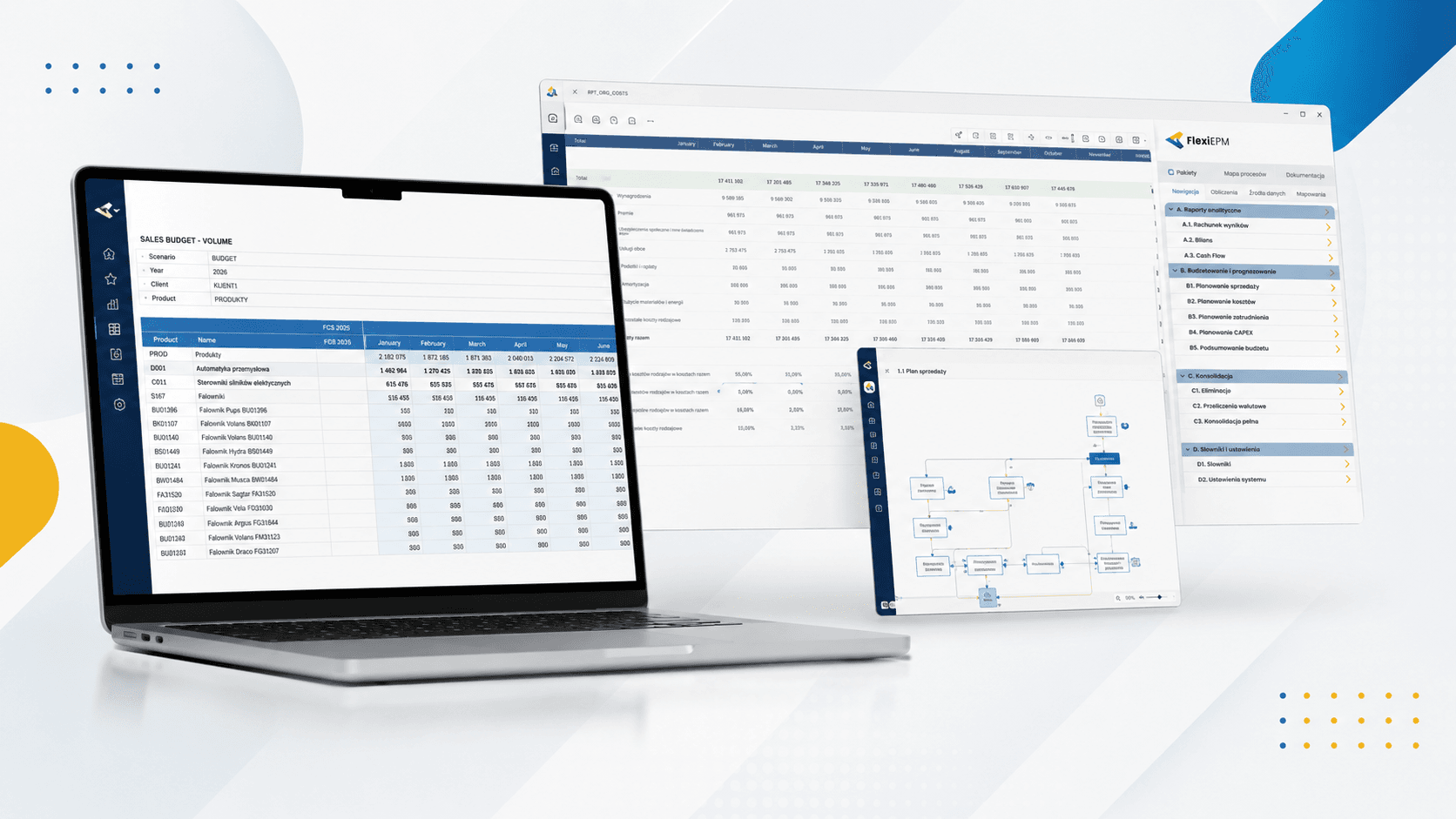
A local EPM system is a planning, reporting and consolidation system built and implemented by a vendor operating in the same country as its customers.
Key takeaways
- In Western Europe, including Germany, France, Austria and the Benelux countries, preferring local suppliers is a common and deliberate business practice.
- Working with a local vendor often means faster response times, a better understanding of needs and a more predictable relationship.
- A long-term relationship with a supplier gives a better total cost of ownership (TCO), even if the unit purchase price is higher.
- In Poland, this model requires a change of approach, including purchasing criteria based on TCO rather than price and treating suppliers as development partners.
- Local EPM systems such as FlexiEPM can successfully compete with foreign vendors.
What you will learn from this article
When looking for an EPM system, we often assume that foreign products are better. With an EPM system, where the team behind the implementation can be the key success factor, a local system for local companies may turn out to be the best solution.
In Western European countries such as Germany, France, Austria and the Benelux countries, preferring local suppliers is a common and deliberate business practice. It is not open protectionism. It stems from a long-term approach to economic stability, supply chain security and corporate social responsibility. More and more often the question arises whether a similar model could work effectively in Poland.
Working with local suppliers often means:
- faster response times,
- a better understanding of needs,
- easier verification of whether the requests you raise can be delivered,
- a more predictable relationship.
As a result, a local vendor should be viewed in terms of the stability of the entire process of implementing and supporting the system.
Supporting the local economy and labour market
Favouring local suppliers is also a form of investing in your own economy. Money spent with a local producer is far more likely to stay in the country. It returns as taxes, wages, investment and consumption.
In Western Europe there is a strong awareness that:
- a local supplier means local jobs,
- local companies strengthen regional industrial ecosystems,
- stable SMEs are the foundation of long-term growth.
The state, local governments and large private companies act consistently in this area, even though free-market rules formally apply.
Quality, cooperation and innovation instead of price alone
The Western model of working with suppliers is largely based on long-term relationships. A local supplier:
- responds faster to changes in specifications,
- gets involved in product development more easily,
- is available technologically and operationally.
As a result, the supplier–customer relationship often turns into a partnership. Companies jointly optimise processes, costs and quality instead of applying constant price pressure. In the long run this gives a better total cost of ownership (TCO), even if the unit purchase price is higher.
Could such a model work in Poland?
In theory, yes. In practice, it requires a change of approach on several levels.
First, short-term, strongly price-oriented thinking dominated in Poland for years. The local supplier often lost to imports, even if the total cost of risk was higher.
Second, companies in Poland too rarely treat suppliers as development partners. Relationships are transactional rather than strategic, which makes it harder to build local expertise.
Third, the state has only recently started talking about supply chain security and reindustrialisation.
What would have to change?
For the Western European model to work effectively in Poland, the following would be needed:
- a change in purchasing criteria at large companies (TCO instead of price),
- greater stability and predictability of economic policy,
- real use of public procurement as a tool for developing local industry,
- building a culture of long-term cooperation with suppliers.
Importantly, this does not mean closing the market or giving up competition. It is rather about consciously balancing price, risk and the value added to the economy.
| Criterion | Foreign vendor | Local vendor (e.g. FlexiEPM) |
|---|---|---|
| Response time | Depends on time zone and queue | Fast, direct contact |
| Understanding of local conditions | General, global approach | Knowledge of local regulations and practices |
| Relationship model | Transactional, contract-based | Partnership, development-oriented |
| TCO (total cost of ownership) | Often higher in the long term | More predictable and controllable |
| Impact on the economy | Money flows abroad | Money stays in the country |
Conclusion
The preference for local suppliers in Western Europe is neither an accident nor an ideology. It is the result of many years of experience, crises and a pragmatic approach to the economy. Poland has the potential to move in this direction, but that requires moving away from short-sighted cost thinking towards a long-term strategy of security and development.
Looking at this topic from the perspective of local technology, we can see that local EPM systems such as FlexiEPM can successfully compete with foreign vendors. We got over any sense of inferiority towards the competition long ago, because we know that our local product can be better than the systems delivered by foreign competitors.