What you will learn from this article
Integrating FlexiEPM with SAP via API: an example of feeding a financial consolidation system with ERP data
An EPM system can be integrated with an ERP in several ways. The choice of model depends on the architecture of the source system, the scope of data, the refresh frequency and the business case.

In one of the projects in which FlexiEPM was implemented as a financial consolidation system, we used API integration to retrieve data from SAP.
In practice, this is not a one-off mechanism tied to a single ERP system, but an integration pattern based on FlexiEPM ETL components, which can be adapted to the specific source system, scope of data and client architecture.
Integrating FlexiEPM with ERP systems: files, database and API
FlexiEPM can be fed with data from ERP systems in different models, chosen to match the organisation’s needs and the capabilities of the source system.
The simplest model is loading files generated from the ERP. It works well when a project needs to start quickly, in smaller companies, for foreign subsidiaries, external accounting offices, or wherever automatic integration is not needed.
In many implementations we also use database-to-database integration. This is a common scenario in on-premise environments, especially when the ERP system does not provide a suitable API. However, this model requires a good knowledge of the data structure and business logic of the source system.
An increasingly common approach is integration via API. If the source system provides suitable interfaces, the API makes it possible to retrieve data without reading the underlying ERP database structures directly. This is particularly important for cloud systems, but it can also be the right integration model for on-premise systems if the API is the standard data access layer.
Integration via API is one of three ways of getting data into FlexiEPM. The other two are a direct connection to the source system database, used most often with systems such as Comarch, Symfonia or enova365, and reading a file exported periodically to an agreed network location. The latter is chosen when there is no access to the database and the source system can export the trial balance to a file.
Whichever route is used, we usually start the project by manually uploading trial balances for several periods. This makes it possible to work on real data before the integration is ready on the IT side.
Source data in a financial consolidation project
Implementing FlexiEPM as a financial consolidation system very often requires feeding the system with general ledger data. This mainly concerns the data needed to prepare the reporting packages of individual entities, i.e. local financial data, which is then mapped to the group reporting structures and used in the consolidation process.
The basic scope of data is account balances, most often retrieved in the form of a trial balance. On this basis, the entity’s balance sheet and income statement can be prepared, and the local chart of accounts can then be mapped to the group reporting layout.
In many projects, however, the trial balance alone is not enough. For management analytics, reconciliations and the identification of transactions with related parties, journal entries with references to documents are also needed. This matters in the consolidation process, because some of the information needed for eliminations and analyses is not visible at the level of account balances alone.
In the project described, the parent company used SAP as its financial and accounting system, and the scope of data needed was typical for feeding a consolidation system with general ledger data.
Integrating FlexiEPM with SAP S/4HANA 2020 via API
Why did we use the API in this project?
The key issue was the choice of the technical integration model. Importing files did not provide the level of automation expected by the team responsible for reporting, and direct database-to-database integration was not the right route for the SAP environment.
Since a suitable API was available on the source system side, feeding FlexiEPM was based on controlled data retrieval through the interface made available on the SAP side.
Retrieving data from the API and configuring the data source in FlexiEPM
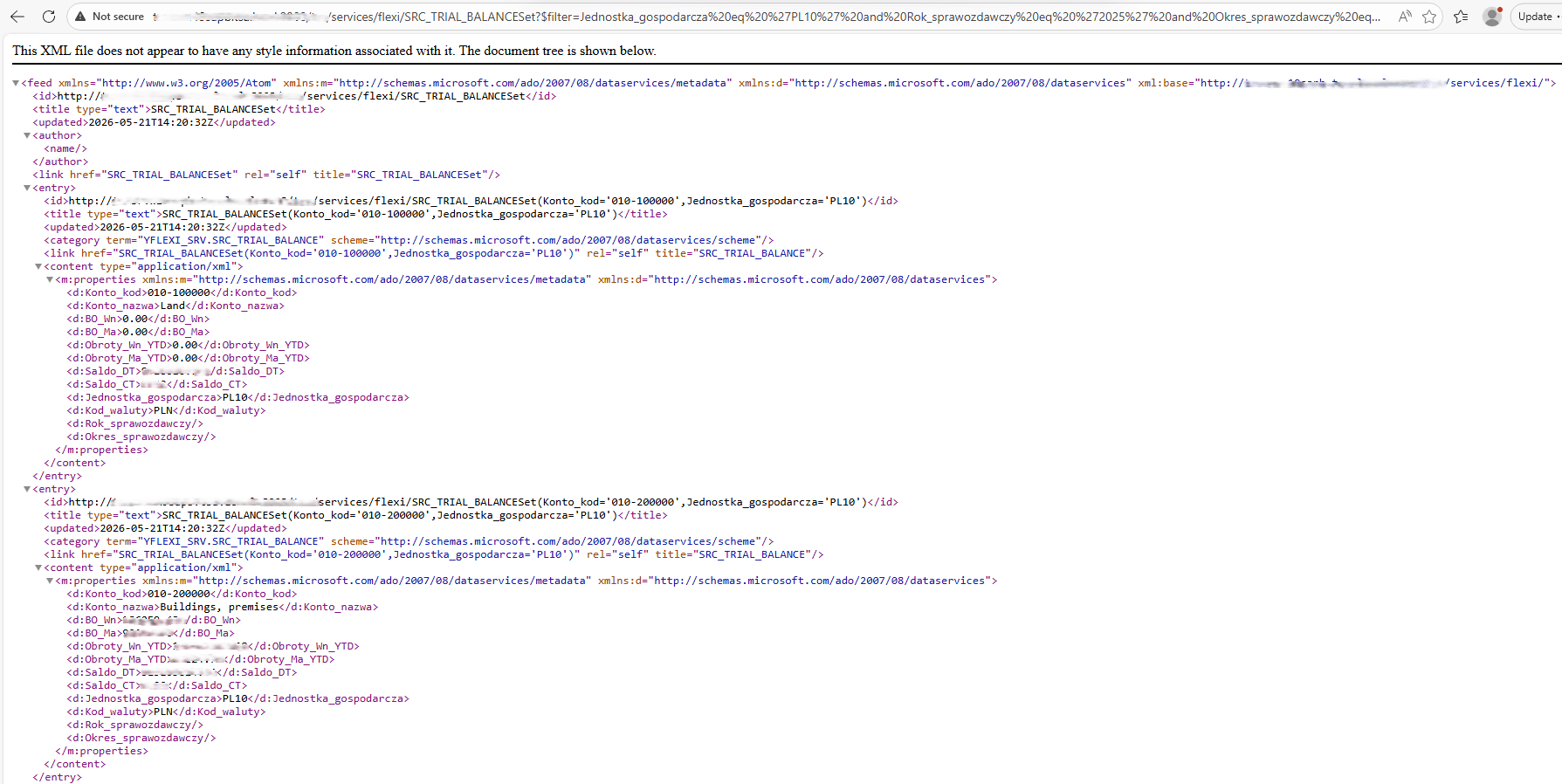
On the SAP side, it was necessary to provide access to the appropriate API and an authentication mechanism for the agreed scope of data. In practice, the details depend on the architecture of the source system and the client’s security rules. This may mean a technical user, a token, a key, SSO, network restrictions or other access control mechanisms.
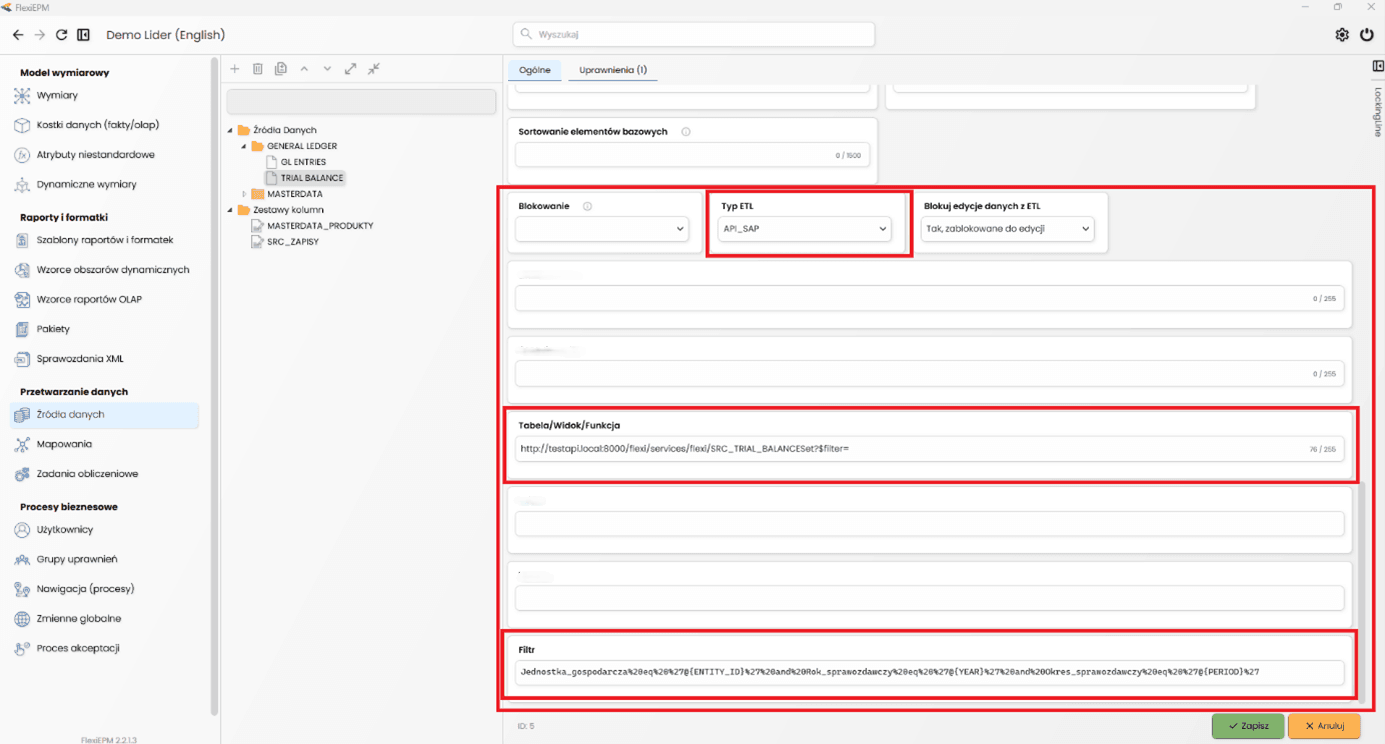
On the FlexiEPM side, the configuration is done within the ETL components. For a given data source, we define the API address, the way data is retrieved, the structure of the input data and the mapping of source fields to the structures used in FlexiEPM. Such a source can then be included in the ETL process that feeds the relevant areas of the consolidation model.
What matters is that we do not build a separate, one-off integration script in such a case. We use a proven pattern of working with APIs in the FlexiEPM ETL module and adapt it to the specific source system, scope of data and project requirements.
Mapping data to the Group Chart of Accounts
Data retrieved from SAP is not used in FlexiEPM only in the structure of the local chart of accounts. In the consolidation process it has to be mapped to the common reporting layout of the group, which in our implementations we call the Group Chart of Accounts.
The Group Chart of Accounts acts as a common denominator for data coming from different companies and financial and accounting systems. The local charts of accounts of individual entities are mapped to this layout independently. This makes it possible to prepare consistent data for the balance sheet, the income statement and selected notes.
At the mapping stage, typical presentation issues are also resolved, which do not result directly from retrieving data from the ERP. An example is settlement accounts which, depending on the balance, should be presented as a receivable or a liability.
That is why technical integration is only the first stage of the process. It is equally important to process the accounting data correctly into the reporting structure required by the group.
API as one of the models for integrating FlexiEPM with source systems
The example described concerns integration with SAP S/4HANA 2020, but it is not a closed mechanism tied to a single ERP system. In practice, it is an integration pattern based on FlexiEPM ETL components, which can be adapted to the specific source system, scope of data and client architecture.
API is becoming an increasingly important integration model, especially where the ERP system runs in the cloud or where the vendor provides an API as the standard data access layer. In such situations, integration via API avoids reading the underlying database structures directly, reduces dependence on the internal table logic of the source system and can be more resilient to changes in the ERP version or configuration.
We use a similar model not only when integrating with SAP. FlexiEPM ETL components can also be used to retrieve data via API from other ERP and domain systems, provided they offer suitable interfaces and an agreed scope of data. In our projects we have used this approach, among others, for integrations with Teta ERP and Odoo.
In practice, this applies not only to financial and accounting data. In FP&A, management reporting and financial consolidation projects, data may also come from sales, production, CRM, workflow, timesheet or other domain systems.
From the FlexiEPM perspective, however, what matters is not the retrieval of data itself but its further use in the financial model: validation, mapping, calculations, reconciliations and presentation in the group reporting structures. That is why integration with an ERP or another source system is the first stage of the process. The value of the implementation depends on whether the data can be used consistently in consolidation, budgeting, management reporting or other financial processes.
Summary
Integration via API does not replace the other models of feeding data. It complements them where the source system provides suitable interfaces and the expected level of automation justifies using them. In some projects loading files will remain the right choice, in others database-to-database integration, and in others the API. What matters is choosing the integration model to match the actual system architecture, the quality of the available data and the business goal of the implementation.