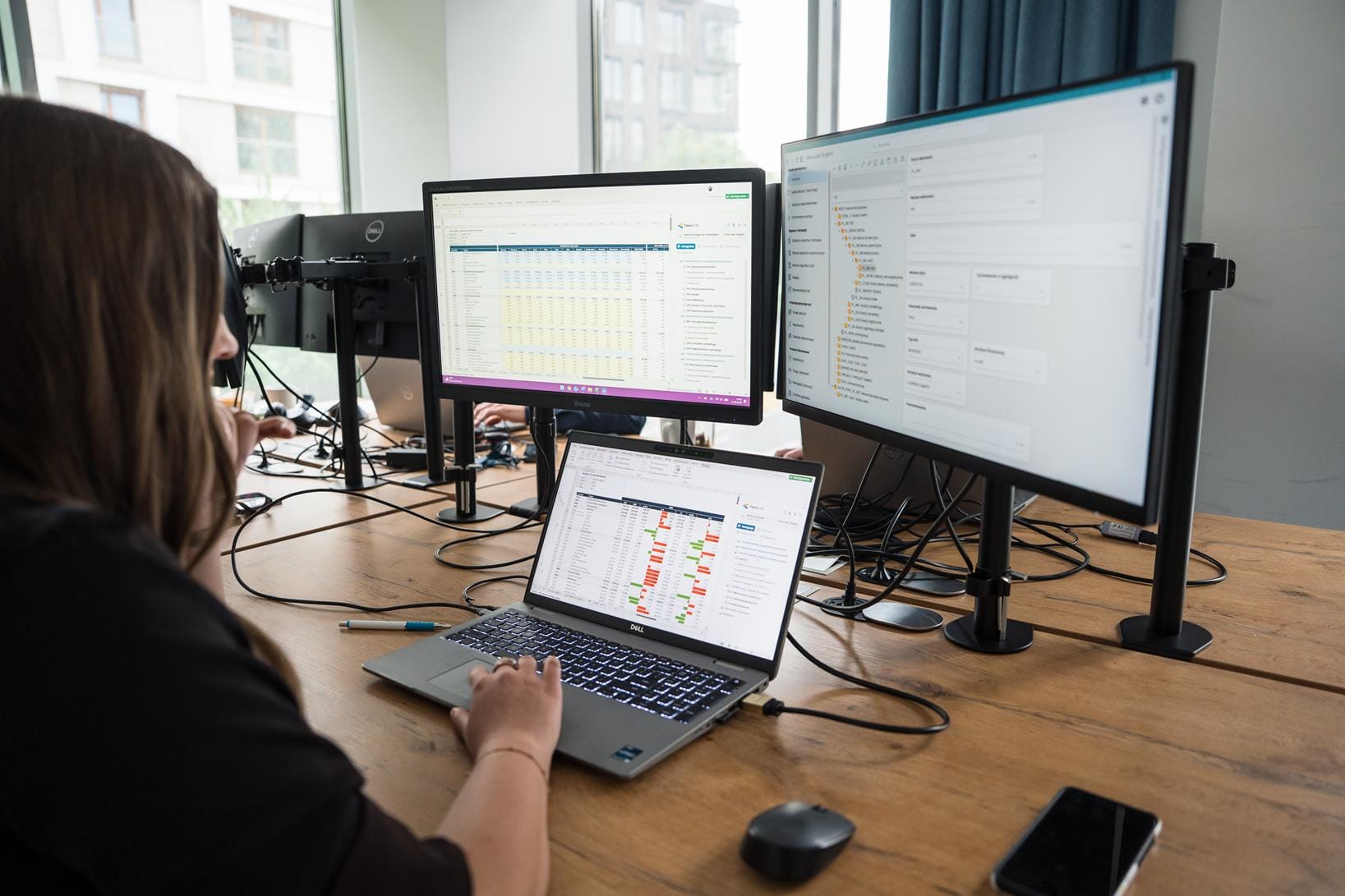
At a certain stage of an organisation’s growth, the natural step is to move to FP&A or EPM systems, which bring order to planning, reporting and consolidation, ensuring data security and the ability to scale as the company grows.
Excel is great. And that is exactly why it is so easy to overdo it.
Why did Excel catch on so well in finance?
Excel is widely used in finance departments. It is hard to find a controller or CFO who does not use it, often every day. And there is nothing wrong with that in itself.
A few years ago at a conference I heard the slogan: “Excel should be burned out with a hot iron”. It sounds impressive, but it is technological radicalism that adds little to a real discussion. Excel was, is and will be present in finance departments.
It is a very good analytical tool. It lets you work with numbers quickly and flexibly. It is intuitive, malleable and easy to adapt, a bit like a simplified version of Darwin’s theory: it wins because it can occupy every free space.
The question is not “will Excel disappear?” but “are we using it where it makes sense, or where it simply caught on?”
Excel did not come to dominate controlling because it was designed for it. It came to dominate because for years it filled a gap in tooling. It works well for ad hoc analyses, modelling, conceptual work and a quick “let’s see what happens if…”.
Finance and accounting systems and ERP did not support processes such as budgeting, forecasting, management reporting and consolidation.
And where there were no dedicated tools, the spreadsheet appeared. Nature, organisational nature included, abhors a vacuum.
Excel is not a tool for everything (and nobody pretends it is)
Nobody sensible tries to keep the general ledger in Excel, manage production or run transactional processes.
And yet in controlling we manage to do something paradoxical: use Excel like a system.
Meanwhile:
- Excel is not a tool for processing huge volumes of data: that is what databases are for,
- it is not meant for data integration: that is what ETL processes and tools are for,
- it was not created with 20, 30 or 100 people in mind working in parallel on a budget, forecast or consolidation.
And yet it is precisely in these areas that it tends to be used most intensively.
Why do organisations stick with Excel?
Finance departments know Excel very well. They can build impressive solutions in it that somehow work. On top of that they are cheap, at least at first glance.
That is why CFOs often accept this approach, and sometimes even promote it. In the short term it is a rational decision.
At a larger scale, however, these are not very stable structures. If there were a “building inspectorate” in finance, many of them would probably not get an occupancy permit.
The CFO’s responsibility for how Excel is used
At this point the conversation stops being about the tool itself and starts being about responsibility. Ultimately it is the CFO who signs off on financial and management reports before the management board, the supervisory board, investors or the auditor. The CFO is responsible not only for whether the result is correct, but also for how it was produced and whether the whole process is under control.
That is why the role of the finance director does not end with analysing the numbers. It should also include reflection on whether Excel in the organisation is used where it really has its natural place, or whether it has become the backbone of processes such as budgeting, consolidation or management reporting. In many companies this boundary shifts gradually and often unnoticed: more files, more versions, more people added to the process.
At some point the question is no longer “do the numbers add up?” but “do we have full control over how they were produced?”. This is not a dispute about the superiority of one tool over another. It is a decision about whether the finance process is secure, transparent and scalable enough for the CFO to take responsibility for it with confidence.
So where is Excel’s place?
Excel still has a very important role in controlling: in ad hoc analyses, in designing models, in the experimentation phase and wherever flexibility matters more than repeatability.
But at some point in an organisation’s growth a need for something else appears: control, security and scalability.
And this is where systems built for specific processes come in: BI, FP&A, EPM. Not to “kill Excel”, but to take over those parts of the work that have to run in a stable and predictable way.
What is worth remembering?
Excel is not bad. But it is not a tool for everything.
There are mature systems on the market designed specifically for consolidation, budgeting or cost allocation. At a certain point in a company’s growth they become not so much an option as a condition for scaling finance processes safely.
And the question worth asking is not “will Excel disappear?” but “is Excel in our organisation where it really makes sense?”
Where does Excel end and FP&A / EPM begin?
Excel works well
An FP&A or EPM system is needed when
In other words: the system is not meant to kill Excel. The system is meant to take over those parts of the work that have to run in a stable and predictable way.