What you will learn from this article:
- Which elements of the consolidation process can be automated
- What the practical benefits of automation are
- What to look for when choosing a consolidation tool
- What an example of an automated process looks like
- Why FlexiEPM supports the most demanding reporting teams
How do you automate the consolidation of financial statements?
Preparing consolidated financial statements is one of the biggest challenges in the annual reporting cycle of corporate groups. The process requires meticulousness, precision and compliance with the applicable accounting standards.
At a time when information is the most important resource, reporting departments have less and less time to prepare their statements. What does this mean in practice? If a reporting department gets a shorter deadline without any additional support, this can have specific consequences, such as:
overtime,
lower team morale,
errors and omissions,
simplifications that go too far.
What is lean information and how does it affect the consolidation process?
Recently, in the pursuit of reliable information delivered on time, you often hear about lean information. According to its principles, information should be:
properly selected (that is, to the point, without padding),
as simple as possible,
checked and reliable,
standardised.
Using data processed in this way greatly helps automate the whole consolidation process.
Why does automation make sense in the consolidation process?
Although consolidation is an extensive subject, it can be broken down into specific tasks, which are often simple, repetitive and, let’s be honest, monotonous.
The Process Strategy Matrix tells us how to approach automating any process, including consolidation: simple and repetitive topics and tasks should be automated, precisely so as not to waste people on unambitious work.
The key to success: the right software
Coming back to the reporting team’s daily work, the first association with automating, speeding up and streamlining consolidation is the right software. The task of the software is to take the data that has already been entered into the systems and collected in trial balances and in the journals of the general ledger and subsidiary ledgers, and then:
- recalculate it,
- transform it and present it in the format required by the user.
Example stages of an automated consolidation process:
Trial balances from different accounting systems can be loaded into the tool automatically (with one button) and processed further.
A calculation task, based on the prepared mapping, turns the trial balance into a balance sheet and a profit and loss statement.
Debit and credit turnover can be used to prepare the notes and the cash flow statement automatically.
Foreign currency transactions are translated on the basis of exchange rates retrieved from the National Bank of Poland for the reporting date and for the period.
A configured reporting template makes it possible to enter data in a fixed layout, and the system automates the totals in the individual tables.
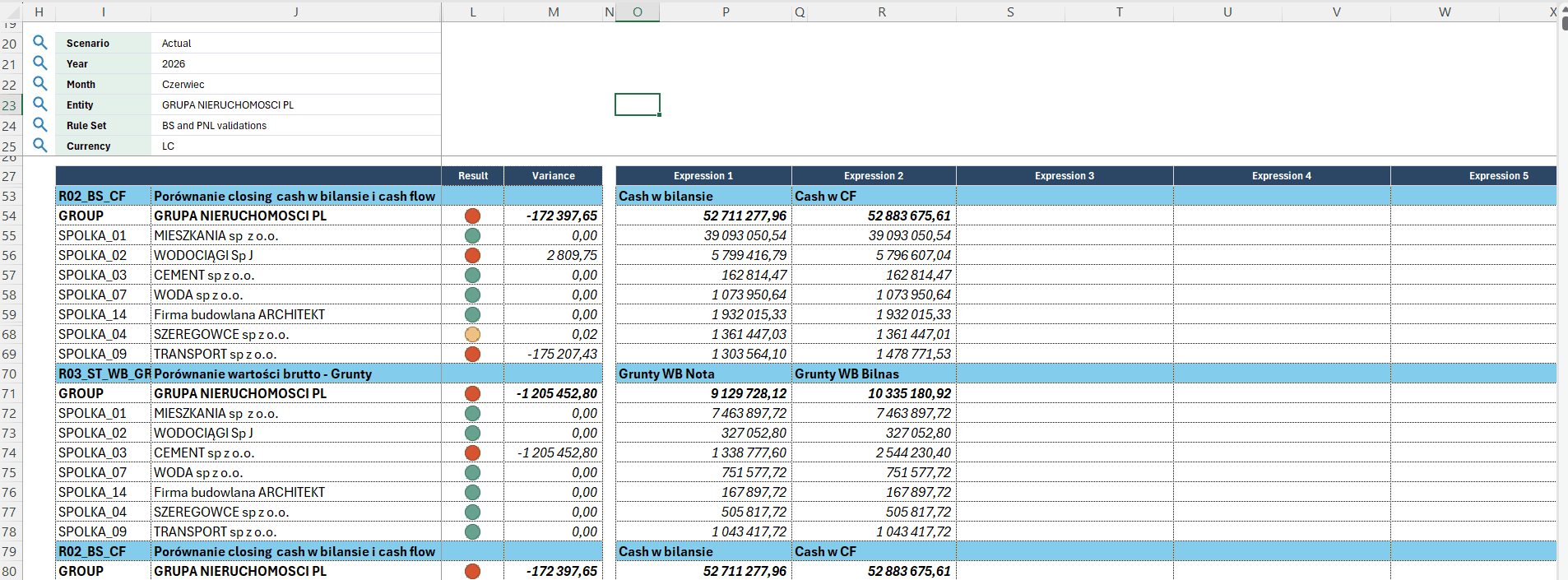
Finally, a validation table that checks in 3 seconds which subsidiaries have delivered their data.
A grid of further validations checks whether the data delivered is internally consistent and whether the data presented in the individual notes reconciles to the primary statements.
Many reporting teams dream of automating intra-group reconciliations. Assigning the right partner codes to dedicated accounts, or tagging accounting entries with this code, lets the system match receivables against payables and revenue against costs in just a few seconds.
Assuming that all subsidiaries have access to the reconciliation report, reconciliation can take place in parallel, without creating additional statements or sending emails.
Another potential element of automation is generating the elimination adjustment for intra-group transactions in the balance sheet and income statement on the basis of the reconciliation report.
Next: cash flow. With properly configured calculation formulas, preparing it can become a pleasure. Once set up, and recalculated automatically on demand, they stay with us for a long time and significantly speed up the whole process.
At the very end, the system helps check the internal consistency of the consolidated data automatically.
And with an add-in that automatically retrieves the calculated and reconciled data in Excel, we can link it automatically to a Word document, pull the data into it with one button and, if necessary, update it in the same way.
Why is automation so important?
Remember that, with all the complexity of consolidation, the process described above does not run only once. Preparations start so early that accountants and reporting teams do not yet have all the information at hand. If one of the subsidiaries changes its trial balance, the whole process has to be refreshed from the beginning.
With automation, one click is enough for the whole process to be refreshed and recalculated, without touching dozens of formulas and files. This means not only saving time, but also consistency and control over data quality. At a time when management boards and investors expect precise information quickly, this is an advantage that cannot be overstated.
Summary: automating consolidation with FlexiEPM
Preparing consolidated financial statements is a complex process that requires reliability and attention at every stage. Using the solutions described above significantly streamlines the work, reduces the risk of errors and increases efficiency.
Using modern tools such as FlexiEPM makes it possible to automate many stages, which means time savings and peace of mind for the whole team. Contact us to find out how you can streamline this process in your company.