No more printing and merging
The financial statements are produced in the system. After each correction, the team no longer has to put the document together again.
Notes straight from account transactions
The related-party transactions note and the movement tables are calculated automatically. Previously, they took the most work.
Financial statements on demand
Loading the trial balances and recalculating is enough to prepare a simplified document outside the annual cycle, for example for a bank.
IFRS and the Accounting Act in one model
Eight companies report under two different standards, using the same solution.
Project overview
- The implementation took place in two stages. It first covered two companies reporting under IFRS, and then further group entities whose accounting Ringier Axel Springer Polska had taken over.
- Today, the reporting process covers 8 companies and 2 reporting standards, while consolidation covers two companies.
- The team generates accounting data from SAP in an agreed format and loads it into FlexiEPM, which recalculates the items and puts together the financial statements.
- The team moved some of the narrative notes from Excel to Word and handles them with the FlexiStatements add-in.
- For companies reporting under the Polish Accounting Act, the system makes it easy to generate financial statements in the XML format required by the Act.
„I load the trial balances, recalculate and have a preliminary financial statement"

Today, some of the notes are generated automatically, and we don't have to retype data.
It's a more structured process. It's also easier to show the auditors where the data comes from. And if someone asks me for financial statements as at a particular date, I load the trial balances, recalculate and have a preliminary financial statement.
Challenge
Financial statements put together by hand, page by page
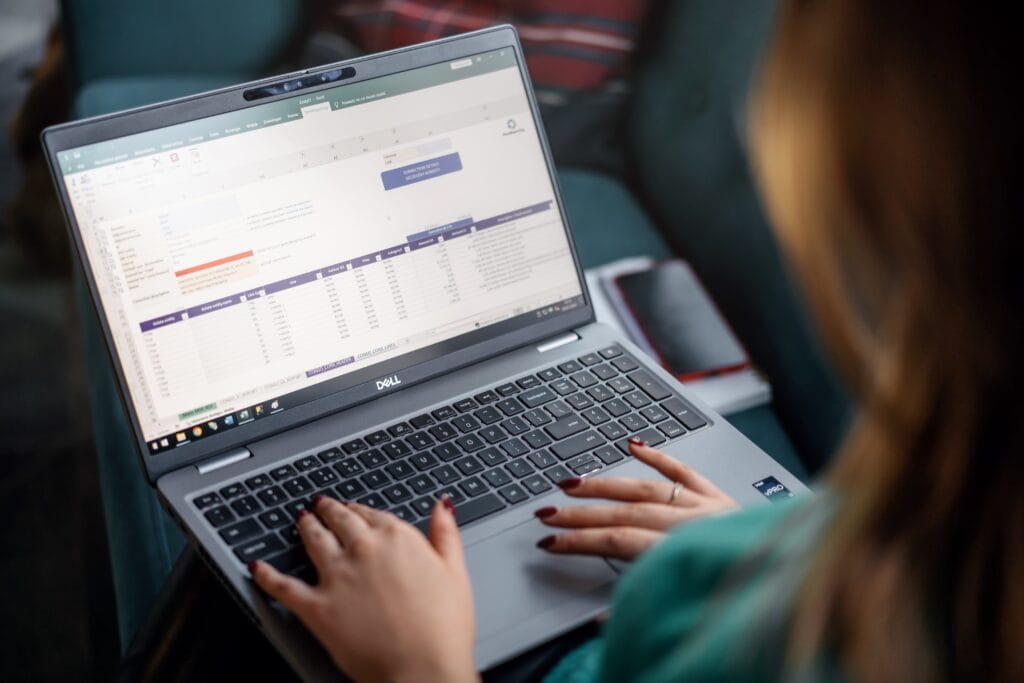
Before FlexiEPM was implemented, financial statements were prepared in a single Excel file that had been used at the company for years. Every note and every element of the statements had its own tab. The spreadsheet itself worked; however, the problem began once the data had been filled in.
The finished pages had to be printed to PDF, put in the right order, assembled and aligned so that the document looked consistent. Every correction meant repeating the whole operation from the beginning. Work on the financial statements usually started in mid-February and had to be completed by the end of March.
In practice, the entire process relied on one person. Individual notes were prepared by additional people, usually one or two.
A growing number of companies and consolidation at the company's own level
On top of the workload, there were two organisational changes. A need to prepare consolidation arose at the level of Ringier Axel Springer Polska as well, not only at the owner’s level. At the same time, the company took over the accounting of further entities from the group.
Previously, consolidation was performed manually, in spreadsheets built on the files used earlier for the standalone financial statements. With a larger number of companies and two reporting standards, the existing approach was no longer sufficient.
Solution
A ready-made system instead of a solution built from scratch
The most important selection criterion was that FlexiEPM was a ready-made system that worked in practice. The implementation was planned in two stages. The first stage covered two companies reporting under IFRS, and the second covered further group companies, most of them reporting under the Polish Accounting Act.
One data set and notes built from account transactions
Accounting data is generated from SAP into files in an agreed format and loaded into FlexiEPM. Based on this data, the system performs the calculations and prepares the financial statements. The balance sheet and the income statement come out practically complete, and the statement of changes in equity is largely automated. If needed, the system also allows presentation adjustments to be entered directly.
The biggest difference can be seen in the notes, which previously took the most work. The note on transactions with related parties is generated automatically from account transactions, and the movement tables are automated. Manual input in them is mainly limited to separating disposals through sale.
Mapping control is a separate element. The chart of accounts used by the companies does not allow mapping by ranges, and new accounts appear on an ongoing basis. The system flags unmapped items immediately, so the team knows where to look for discrepancies. At the same time, the result is still reconciled to SAP, which is a deliberate decision by the team and provides a double check.
Business impact
A structured process, less manual work and financial statements available on demand
The financial statements are no longer put together by hand from separate printouts. Data is not retyped between tabs, and some notes are produced without any user involvement. Moreover, the team no longer has to rebuild the document after every correction.
The nature of the work involved in preparing standalone financial statements has changed. The team can focus more on verifying the accuracy of the data and the reasonableness of the results, rather than on entering them into the statements or editing.
The way the team works on consolidation has also changed. Consolidation covers two companies, and only individual notes and elements of the cash flow statement require manual adjustment. Most of the calculations are performed automatically.
Another benefit is the ability to prepare financial statements outside the standard annual cycle, for example for a bank. It is enough to load the trial balances and recalculate the data to obtain a document ready to be submitted, with a note that it has not been audited. The team used the same mechanism for quarterly statistical reports.
Structuring the process also matters during the audit of the financial statements. It is easier to show which data a specific item in the statements comes from, because the entire path can be traced in the system.
The client also highlights the way the implementation team worked: their commitment, quick response to reported issues and search for solutions even when they were not obvious. From FlexiSolutions’ perspective, the involvement of the client’s team was equally important. Issues were resolved on an ongoing basis instead of postponing verification, which made it possible to complete the implementation with finished financial statements.
Project in numbers
8
companies in the reporting process
30+
notes in the financial statements
2
reporting standards: IFRS and the Polish Accounting Act
30
minutes for a simplified financial statement for a bank