Why is traditional consolidation time-consuming and prone to errors?
In many corporate groups, financial consolidation still relies on manually merging data in Excel. Every additional spreadsheet increases the risk of errors and requires extra checking.
A lack of consistency between companies is another challenge: different charts of accounts, report formats and local accounting standards force additional reconciliations before the data can be prepared for consolidation. On top of that comes manual management of exchange rates, which complicates the settlement of exchange differences and increases the risk of inaccuracies.
Eliminations of intercompany transactions are particularly problematic in large corporate groups. Reconciling balances and invoices between companies often takes weeks and involves many people from the finance departments. There is also a lack of transparency: auditors find it hard to trace who entered specific adjustments and on what basis.
As a result, the period-end close in a corporate group takes much longer, and instead of analysing results and supporting the management board in decision-making, the finance team spends its energy on cleaning data by hand.
Automating consolidation in practice
FlexiEPM was created to remove these problems. The system automates the whole process, from importing data to preparing audit reports.
1. Importing data from the companies’ systems
The system integrates with popular accounting systems (SAP, Comarch Optima, Microsoft Dynamics) or lets you load trial balances easily. As a result, the data reaches a single environment without manual copying.
2. Group chart of accounts
The implementation starts with building a common chart of accounts, which makes it possible to report results in a uniform format, both for the management board and for statutory reporting.
3. Automatic data mapping
FlexiEPM automatically maps local accounts to the group chart of accounts, which removes the need for manual transformations and reduces the risk of mistakes.
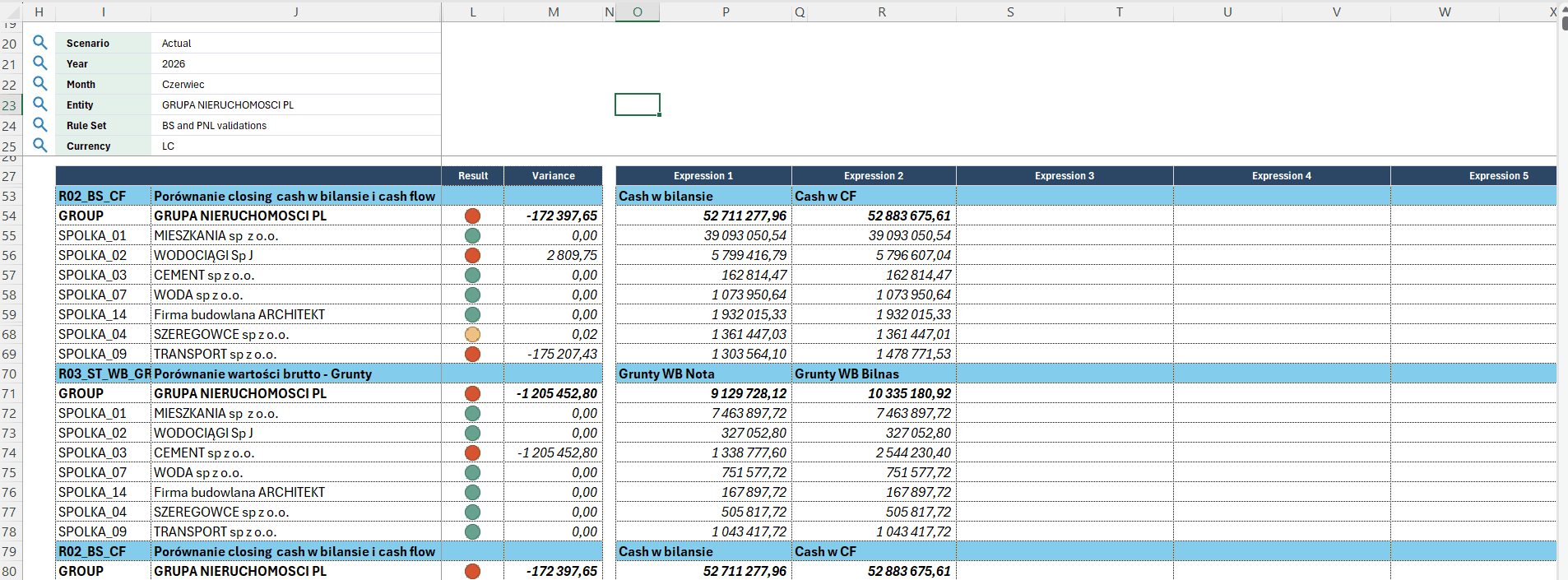
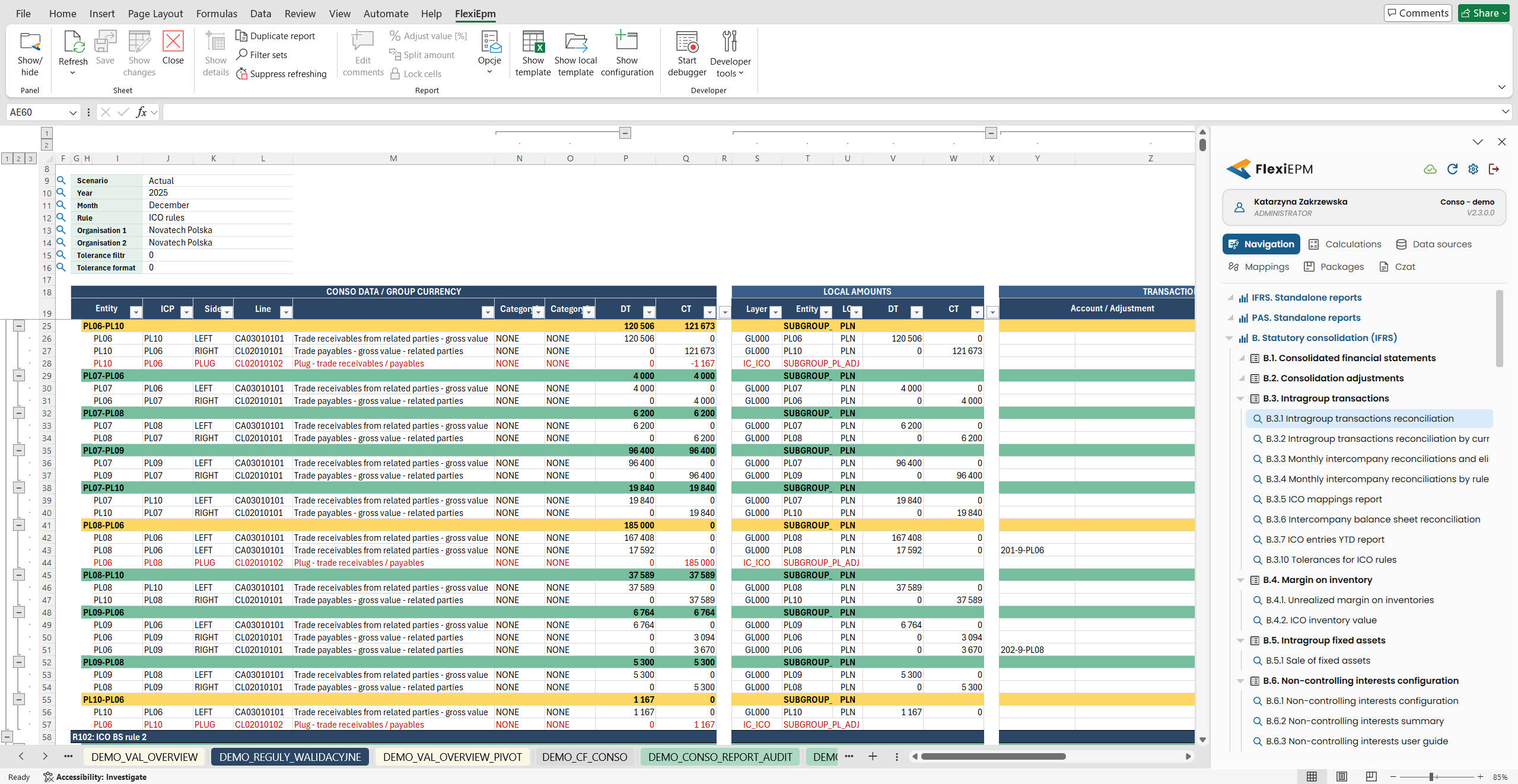
4. Intercompany reconciliation
The system supports the companies in reconciling intra-group balances and invoices, and eliminations can be carried out automatically on the basis of defined rules.
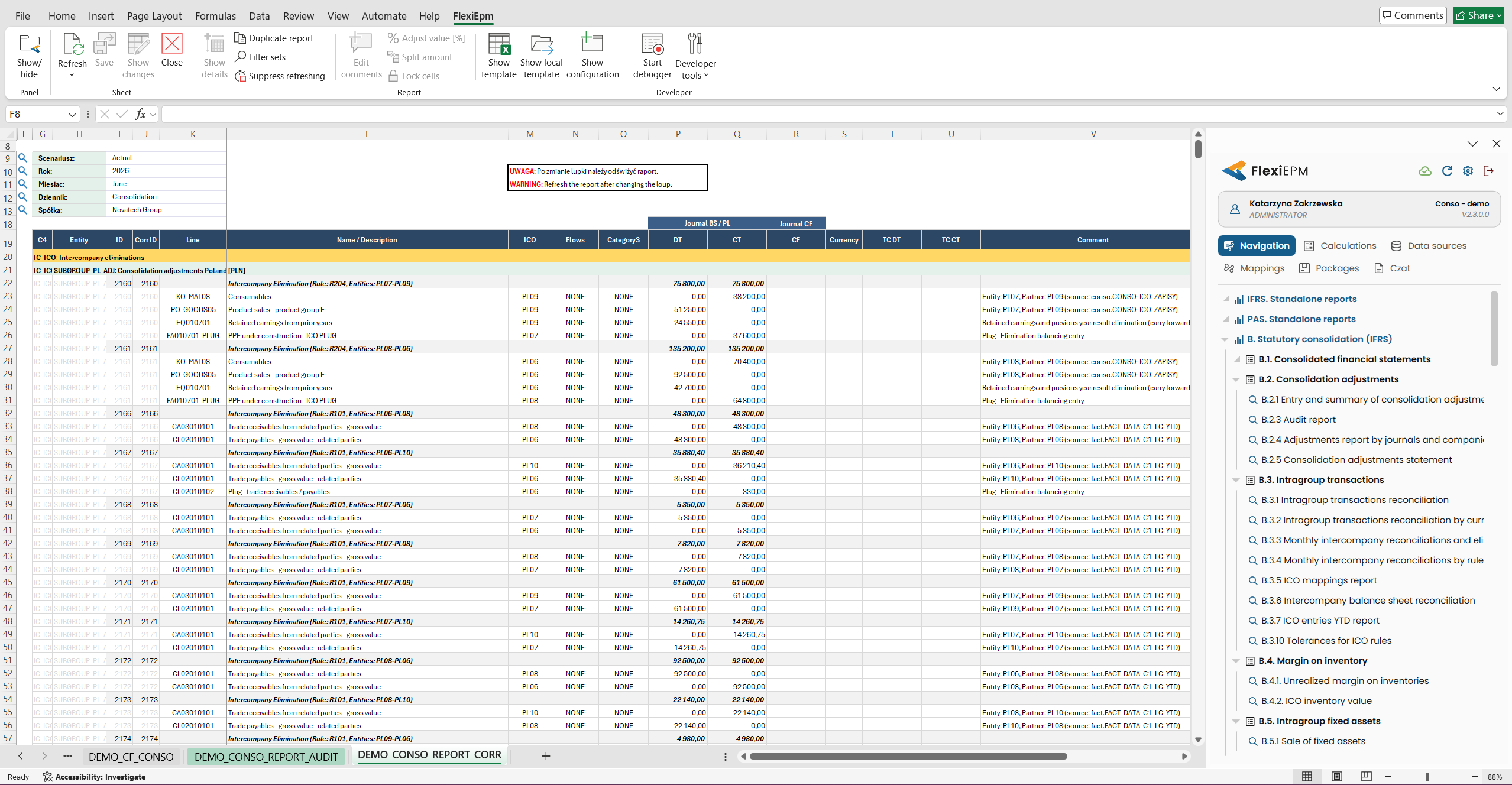
5. Consolidation adjustments
Every adjustment is posted in the system with a full audit trail: you know who entered it, when and why.
6. Automatic currency translation
FlexiEPM translates data from local currencies into the reporting currency, creates the exchange difference entries and removes manual calculations.
7. Notes and audit reports
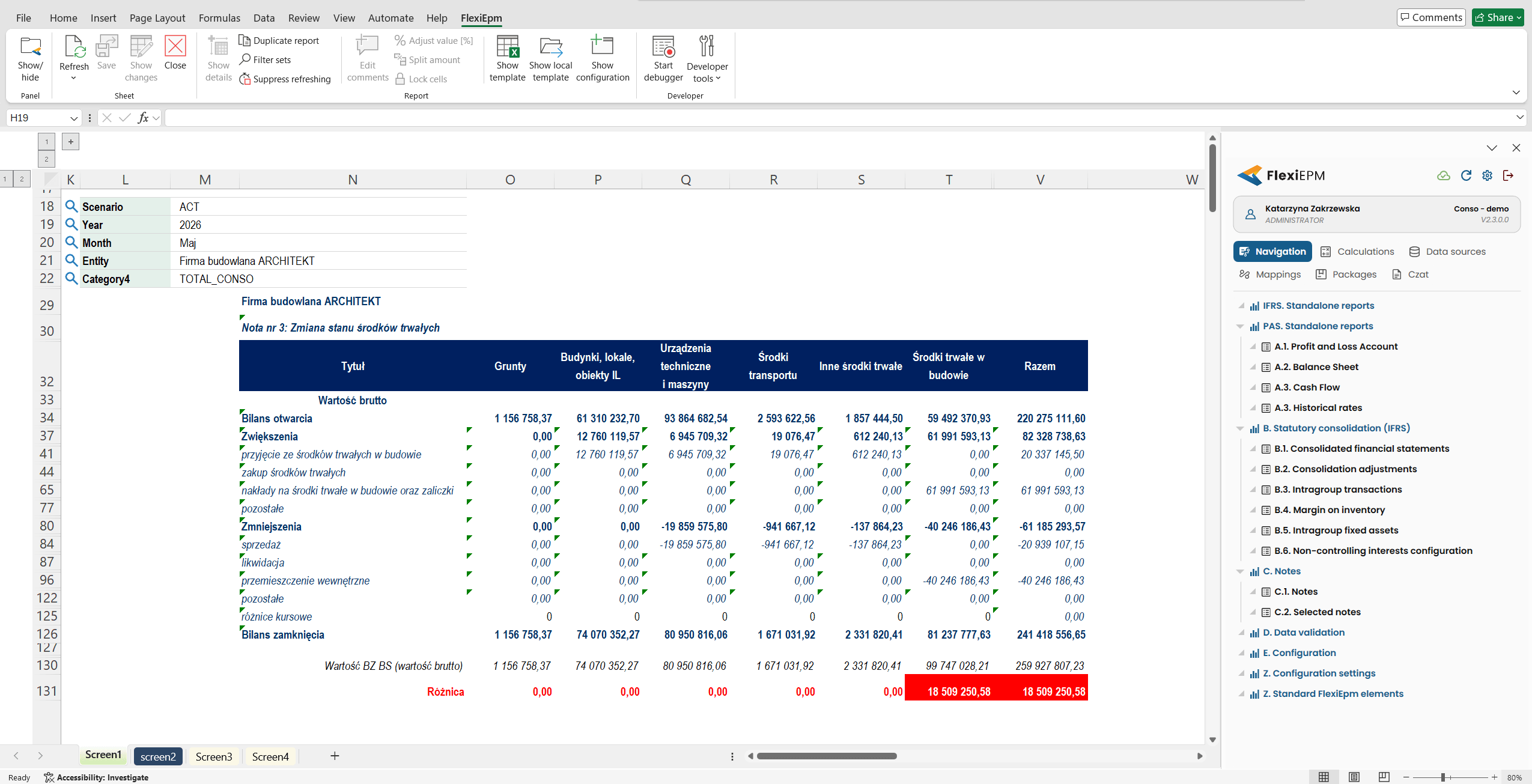
The system generates explanatory notes (for example movements in fixed assets and statements of changes in equity) and complete reports ready for the auditor.
Real implementations: examples of companies that simplified consolidation
FlexiEPM is used by both local and international corporate groups. The system is fully adapted to the Polish Accounting Act and IFRS, and in addition provides comprehensive technical and business support both during the implementation and after it.
As a result, international corporate groups choose not only a consolidation tool, but also a partner who helps them organise their financial data, automate processes and genuinely take the load off the team on the client’s side.
Consolidation in an international corporate group
By implementing an integrated consolidation system, PBKM gained a tool for efficient data consolidation and top-level reporting. The new system provides flexibility, automation and full financial consistency, which supports further expansion in domestic and foreign markets.
FlexiEPM was fully integrated with the parent company’s ERP and CRM system (Microsoft Dynamics NAV), so data can be retrieved automatically and processed straight away. The finance team reports results by company, business segment and function, and consolidation takes place both for management purposes and for statutory purposes in line with IFRS.
The implementation also included the calculation of deferred revenue adjustments under IFRS 15 for each customer contract. The system is used in 12 countries by several dozen users, enabling scalable management of consolidation and reporting across the whole group. Learn more.
Consolidation and controlling in a duty-free retail chain
A corporate group operating in retail and food service at travel locations implemented FlexiEPM as a comprehensive system for statutory consolidation and controlling. Initially it covered only the financial consolidation module, but over time it was extended to further areas: management reporting, budgeting and performance monitoring.
The system was integrated with Comarch CDN, used by the Shared Service Center that serves the group’s Polish companies. As a result, data can be retrieved automatically and consolidated in a uniform format, regardless of the local charts of accounts or the various financial systems of individual companies.
FlexiEPM enabled full automation of management reporting (MIS), with analysis of results by company, business segment and location. In addition, a complete model for budgeting and long-term planning based on key performance indicators was implemented. As a result, the management board, investors and operational managers have access to uniform, consistent financial data. Read the case study.
How WeNet organised the consolidation of financial statements and sped up reporting with FlexiEPM
The WeNet Group, one of the largest providers of internet services for business in Poland, used Excel for consolidation for years. As the organisation grew and the number of companies increased, however, the process became inefficient: the files were hard to maintain, and preparing reports took up to two weeks.
Implementing the FlexiEPM consolidation module made it possible to organise the whole process. Data from the individual companies is reported in the system, and consolidation takes place automatically. What is more, thanks to FlexiStatements, data is transferred directly from Excel to Word templates in the format required by the auditors, which significantly shortened the final editing of the documents.
In addition, semi-automatic cash flow calculation, the ability to preview adjustments and full compliance with IFRS 16 were implemented. About 5 users from 8 companies are involved in the process, and the time needed to prepare the consolidated financial statements was cut from two weeks to just 3 days. Find out more about the implementation.
How FlexiEPM shortens consolidation by up to 70%
Automatic data processing
The system retrieves data from accounting systems, maps accounts, translates currencies and generates reports, without Excel. This removes the most time-consuming tasks and speeds up the period-end close.
One environment for all companies
FlexiEPM lets all units work in one system. The companies enter data in an automated way, and the head office sees their status immediately, which significantly shortens reconciliations.
A transparent process and a full audit trail
Every adjustment and every elimination is recorded in the system. Auditors have access to complete information, which reduces the number of additional queries and streamlines the audit.
Summary
Automating financial consolidation means not only saving time, but also greater precision and data security. Companies that implement FlexiEPM shorten the month-end close, reduce errors and gain full control over financial reporting.